Trial Day in Swiss Hospitality: Pay, Insurance and Length

Before your trial day
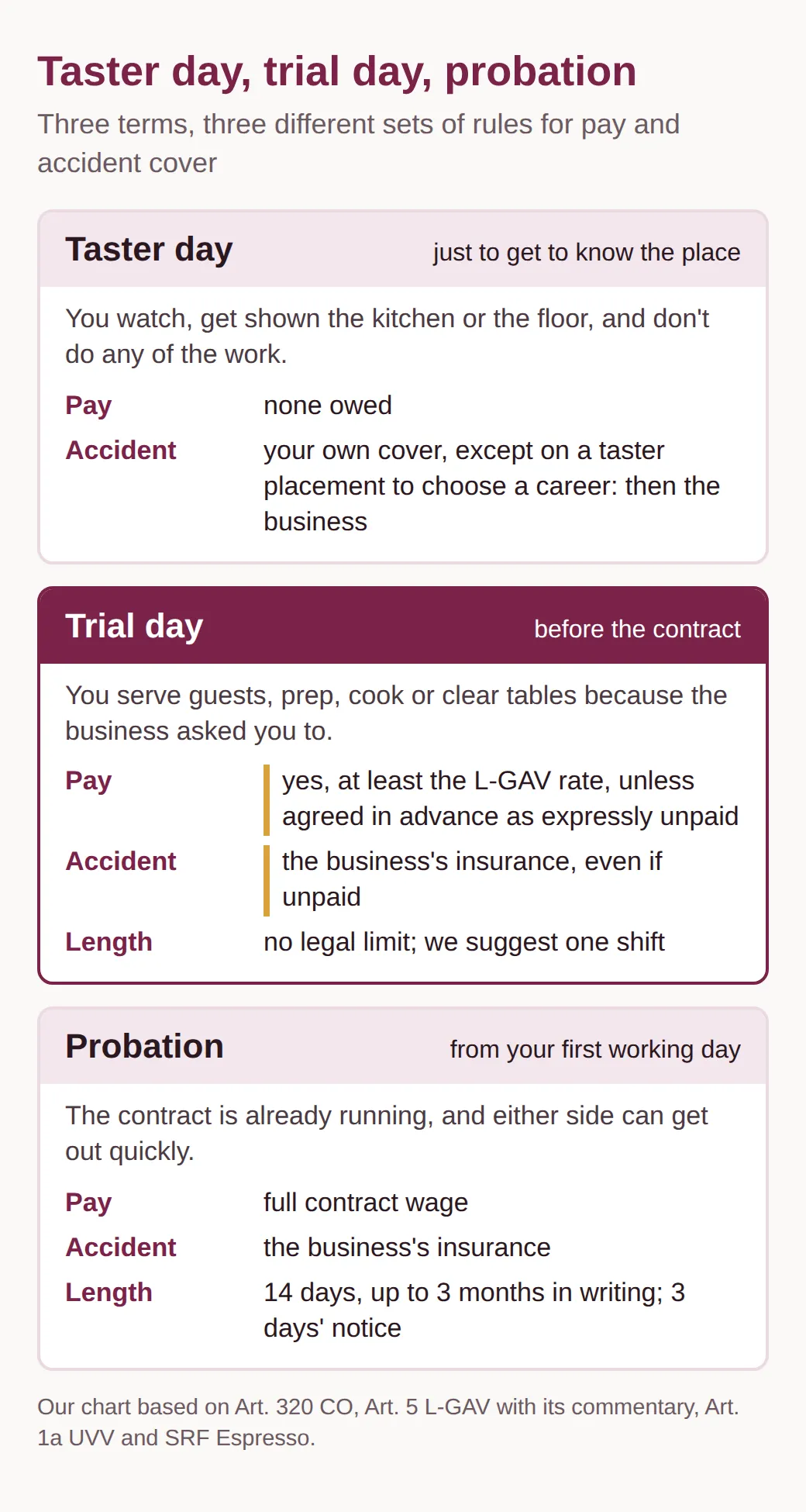
A trial day where you serve guests or work in the kitchen is work and has to be paid: in Swiss hospitality, at least at the L-GAV minimum wage. It's only free if you and the business expressly agreed that beforehand. If you have an accident, the business's accident insurance pays, even if you're not paid. One shift is enough; for anything longer, there's the probation period.
A case from Appenzell Ausserrhoden shows how this plays out in court. On 13 May 2008, a waitress with ten years' experience worked a trial day of at least eight hours, by her own account. She served guests and patients and did the vacuuming, then turned the job down. The business didn't want to pay anything, citing "its own practice". The court saw it differently (Appenzell Ausserrhoden court and administrative practice 2008, No. 3520, in German). Search for advice on trial work and you often land on guides from Germany, which are based on German law and the German minimum wage. In Switzerland, Swiss law applies, and for restaurants, hotels and bars there's also the industry's collective labour agreement, the L-GAV. That's what this post covers, from pay and insurance to the message you send before your trial day.
Taster day, trial day, probation: three different things
What matters is whether you work or watch. In everyday speech the terms get mixed up, but legally they don't. On a taster day (Schnuppertag) you get to know the business: someone shows you the kitchen, you watch the floor staff at work and ask questions. You don't do any of the work, and no pay is owed for it.
On a trial day (Probetag), often called a trial shift, you work. You take orders, prep vegetables, carry plates, clear tables. The business wants to see how you get on, and it uses your work while it does. That's exactly what makes the difference for pay and for insurance.
Finally, the probation period is the start of an employment contract that's already running. In hospitality it lasts 14 days unless something else is agreed in writing, and a written agreement can extend it to three months at most. During that time, either side can end the contract with three days' notice (Art. 5 L-GAV). The L-GAV is published only in German, French and Italian, so we link the German text. What else applies when a job ends during probation is in our post on the notice period in hospitality.
If a business invites you for a trial day, it almost always wants to see you work. So the first question is whether it has to pay you for it.
Does a trial day have to be paid?
Yes, if you do the work and nothing else was agreed. In Switzerland, an employment contract doesn't need a signature. Under Art. 320 para. 2 CO, the Code of Obligations, it's deemed concluded "where the employer accepts the performance of work over a certain period in his service which in the circumstances could reasonably be expected only in exchange for salary". A shift on the floor is that kind of work.
The court in Appenzell Ausserrhoden set out its reasons step by step in July 2008. This rule only stops applying, it said, if working for free was expressly agreed. The fact that nobody had talked about money wasn't enough: silence doesn't mean you give up your pay. The business argued that the woman had only shadowed the people in charge and done the odd task here and there. That didn't help it either. How much work she had done was irrelevant, the court wrote. The business itself had said it used trial days to check people's behaviour and attitude to work. Anyone who checks that gets something out of the day. Trial work in the interest of both sides, the court found, is a classic part of an employment relationship and has to be paid.
For hospitality, the L-GAV supervisory office (Kontrollstelle für den L-GAV), the body that enforces the collective agreement, puts it even more directly in its official commentary:
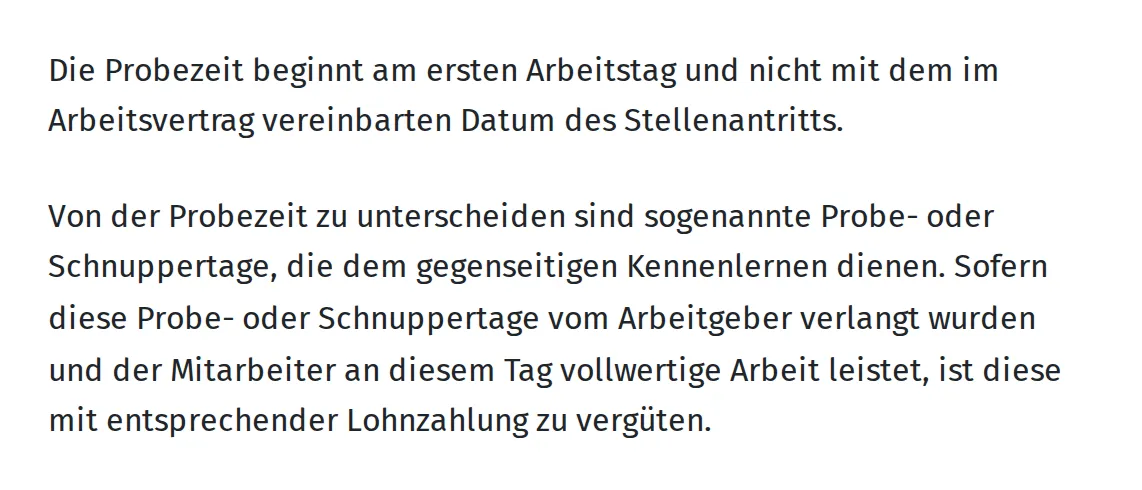
There are two conditions in that sentence: the business asked for the trial day, and you did full work. If you're invited to a trial day after applying for a job, the first is almost always met. The second is met as soon as you serve guests, cook or take over a station.
That leaves the question of what an arrangement like "you only get paid if we hire you" is worth. In 2014, the SRF programme "Espresso" reported on a listener who spent a trial day at a Migros Aare catering business serving guests, clearing tables and carrying crates. She'd been told she would only be paid if she got the job. She didn't get it. Migros Aare said afterwards that the information had been wrong, that it normally pays 100 francs per trial day, and apologised (SRF Espresso, in German). According to SRF, a business that doesn't want to pay anything at all has to say so beforehand. Whether such an arrangement holds up at a business under the L-GAV for a full shift serving guests is another matter. In our reading it fits badly with the supervisory office's commentary, but we don't know of any ruling on it. If you ask about pay beforehand, the question never comes up. Then it's only about the amount.
How much is a trial day worth?
At least the L-GAV hourly wage for your level, plus supplements. The collective agreement applies to all employees in restaurants, hotels, bars, cafés, takeaways and catering businesses, "part-time employees and casual staff included" (Art. 1 L-GAV). Only a few businesses are excluded, such as staff canteens that essentially serve only their own staff and are run by them (Art. 2).
For work paid by the hour, the supervisory office divides the monthly wage by 182 hours, which matches the standard 42-hour week. Because you don't build up paid holidays or public holidays on a trial day, supplements are added: 10.65 percent for holidays, 2.27 percent for public holidays and 8.33 percent for the 13th-month pay (the supervisory office's questions and answers). In the 2026 wage fact sheet, that gives 24.96 francs an hour for the lowest level, staff without an apprenticeship. With a completed apprenticeship (EFZ) it's 30.43 francs. So eight hours of trial work cost the business around 200 francs, and at least 184 francs without the share of the 13th-month pay. A business may only lower the minimum wage with a written agreement in the employment contract, during an induction period and by 8 percent at most (Art. 10 L-GAV).
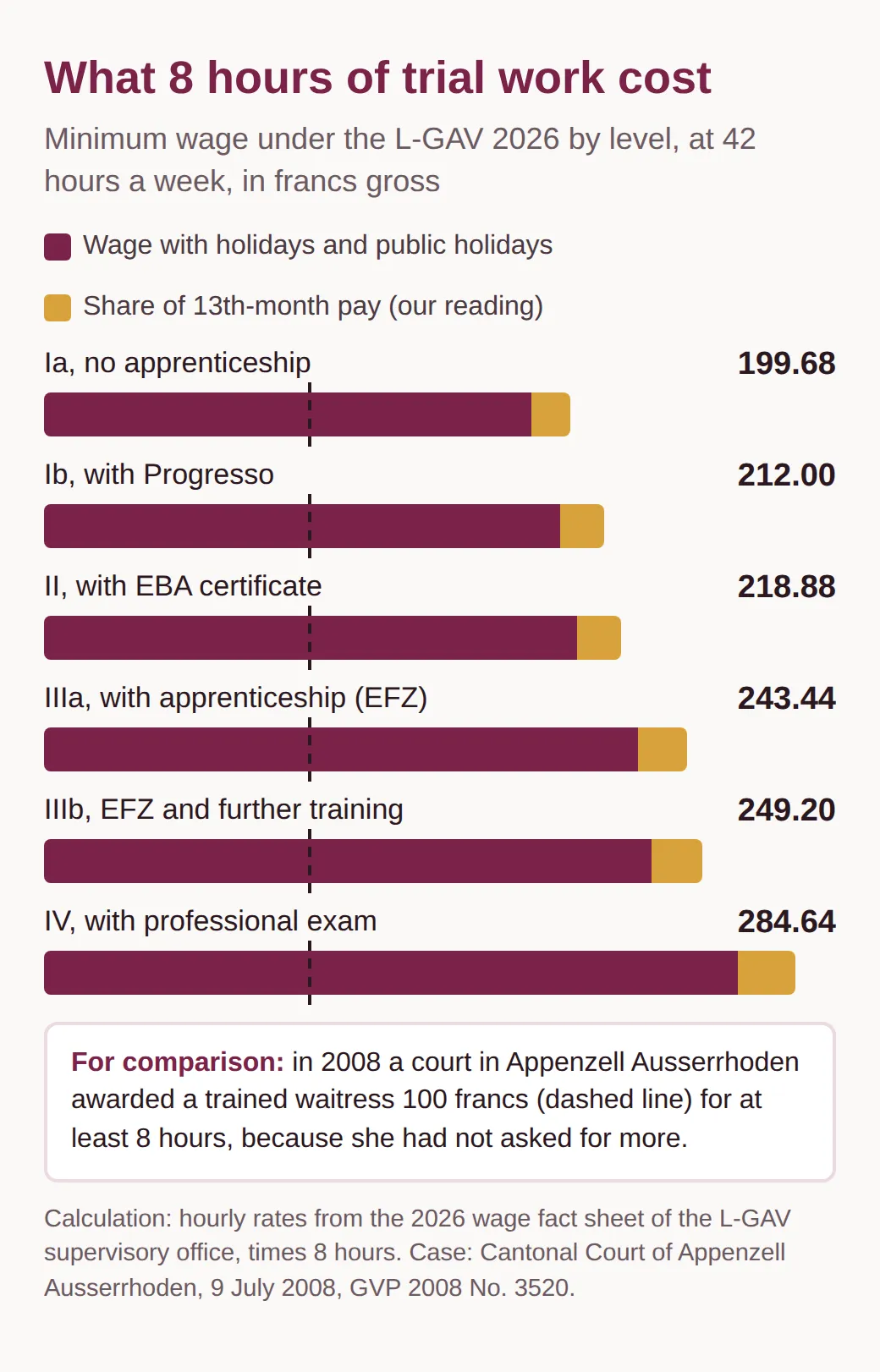
Which level applies to you depends on your training, not on the job you're applying for. We work through the levels and the hourly wage in detail in our post on L-GAV minimum wages. In seasonal businesses with 43.5 hours a week, the hourly rate is a little lower, 24.03 francs without an apprenticeship. All these rates apply to 2026. From 1 January 2027 the minimum wages rise slightly: for staff without an apprenticeship, from 3,713 to 3,735 francs a month.
One caveat concerns the 13th-month pay. If an employment contract ends during probation, the L-GAV says it isn't owed at all. But a single trial day isn't a probation period: the court in Appenzell Ausserrhoden called it a trial employment limited to one day, and a fixed-term contract has no probation period unless one is agreed in writing. So we include the share, although the L-GAV doesn't expressly deal with this case. It's marked in yellow in the chart.
And the 100 francs from the 2008 case? For a business without a collective agreement, the court awarded exactly that amount, because the woman hadn't asked for more. The court itself noted that this came to 12.50 francs an hour, well below the L-GAV minimum wage at the time. A court never awards you more than you claim. So work out beforehand what you're owed. What your pay is worth, though, also depends on what happens if something goes wrong.
Are you insured against accidents on a trial day?
Yes, through the business's accident insurance, and that holds even if you're not paid. Under the Federal Act on Accident Insurance (UVG), all employees working in Switzerland are compulsorily insured, expressly including trainees and volunteers (Art. 1a UVG, in German). An employee is anyone who works in an employed capacity, meaning on someone else's instructions and in someone else's business. For taster placements, the Federal Council has also made a rule of its own: people who work for an employer to help them choose a career are compulsorily insured as well (Art. 1a UVV, the Ordinance on Accident Insurance, in German). Suva states in its factsheet on taster placements (in German) that this applies whether or not they're paid during the placement.
A case decided in 1998 by what was then the Federal Insurance Court shows how much can depend on it. In November 1989, a 16-year-old started an unpaid taster placement (Schnupperlehre) as an operations employee with SBB, the Swiss railways. On his first day he suffered an electrical accident, and his lower left leg had to be amputated. Suva covered the treatment and granted him a disability pension. The court expressly found that he was insured even though he didn't earn a single franc: anyone who works in a business for the sake of training and is subordinate to the employer counts as an employee (BGE 124 V 301, in German). The only dispute left was the amount of the pension.
Usually it isn't Suva
You often read that you're insured through Suva on a trial day. For hospitality, that's usually not true. Suva insures the sectors the law lists, such as industry, construction, transport and beverage production (Art. 66 UVG). Restaurants and hotels aren't on the list. They insure their staff with another approved accident insurer, such as a private insurance company (Art. 68 UVG). For you, that changes little: the law and the benefits are the same. What matters is that you tell the business straight away if you have an accident, so that it can report it to its insurer.
Your journey to the trial day is covered too. If you work less than eight hours a week for an employer, you're not insured against accidents in your free time, but an accident on the way to or from work then counts as an occupational accident (Art. 7 para. 2 UVG and Art. 13 UVV). From eight hours a week, you're also insured in your free time, commute included. It's different on a pure taster day where you only watch: then, according to SRF, you're insured through the non-occupational accident insurance of your current employer or through the accident cover of your health insurance.
If you break a plate
You're only liable if you acted wilfully or negligently (Art. 321e CO). How much care you owe depends on the occupational risk and on the skills the business knew you had. If you're carrying a full tray through an unfamiliar restaurant for the first time, nobody can expect the routine of a chef de rang. That leaves the question of how long a test like this may last.
How long can a trial day be?
There's no fixed limit, but the law has a better tool for longer tests: the probation period. Neither the Code of Obligations nor the L-GAV sets a maximum length for trial work. The limit follows from the purpose. A trial day is meant to show whether you're a good fit. In almost every case one shift is enough, or perhaps two on a quiet lunchtime.
According to the ruling from Appenzell Ausserrhoden, even a single trial day is a fixed-term trial employment, with pay, and several days all the more so. If a business wants to see you for a whole week, it might as well hire you. In the first 14 days it can then let you go with three days' notice, and you can do the same. For the business that's hardly riskier than a trial week, and you get your full wage, holiday entitlement and insurance cover from day one. A week of "no-strings trial work" without pay, on the other hand, is a bad sign.
The normal working time rules, with breaks and maximum hours, apply to the trial day itself. What the L-GAV says about them is in our post on working hours and rest days. There is, by the way, a regulated route to longer trial work that the business doesn't pay for: through the RAV, the regional employment centre. For jobseekers entitled to unemployment benefit, the canton of Valais describes a taster placement or aptitude assessment lasting from one day to three weeks. The business pays nothing, you keep receiving your daily allowance, and you're insured against accidents through unemployment insurance. For this, the business, you and the RAV agree beforehand on goals: what is to be assessed (information for employers, RAV Valais, in German). Without such an agreement, a trial day is a normal working day. A short message helps make sure there are no surprises.
What to agree before your trial day
In the case from Appenzell Ausserrhoden, nobody had talked about money beforehand, and in the end a court decided. Five points are enough, ideally in writing by email or message so you can prove them later:
- the date, start time and rough end time
- which area you'll work in, for example lunch service or the cold kitchen in the evening
- whether the day is paid and how much per hour
- what to bring: clothes, shoes, knives
- who to report to
A message could look like this:
Dear Ms Meier, thank you for inviting me to a trial day on Saturday 14 November. I'd be glad to come at 10am and stay until after lunch service, around 3pm. May I quickly ask how the day will be paid? I'm assuming the hourly rate under the L-GAV, which for me is level Ia. And do I need black clothes or my own shoes? Kind regards
A reputable business answers that in two sentences. If it says the day is unpaid, at least you know where you stand and can decide whether to go anyway. On the day, note your start and finish times and the name of the person who gave you your tasks. If the money doesn't come, that's exactly what you'll need.
If you don't get paid
First ask politely and in writing, with the date, hours and amount. That's often enough. If the payment still doesn't arrive, the L-GAV supervisory office in Basel gives free advice in all of Switzerland's national languages. If you're a member of one of the unions that signed the L-GAV, namely Hotel & Gastro Union, Unia or Syna, ask there too.
You have plenty of time: wage claims from employment only become time-barred after five years (Art. 128 no. 3 CO). And the case from Appenzell Ausserrhoden shows that even a small amount is worth it. It was about 100 francs, and the court ordered the business to pay it. But the best outcome is when the question never comes up, because you asked it before your trial day.
Where to apply next
For casual and seasonal jobs, things can move fast from a trial day to a job offer. What else a winter job involves is in our post on the winter season.
Before you say yes, it's worth checking the conditions: how tips are shared is in our post on tips.
You'll find more jobs by region, for example in Bern or in the canton of Aargau.
Common questions
- Do I get paid for a trial day if I turn the job down?
- Yes. The pay is for the work you did, not for the job. In the case from Appenzell Ausserrhoden, the waitress turned the job down herself after the trial day and still won.
- Is anything deducted from my trial day pay?
- The amount you ask for is a gross wage. The court in Appenzell Ausserrhoden noted that any social insurance contributions are deducted from it. So expect a little less to arrive in your account.
- I'm registered with the RAV (regional employment centre). What happens if I'm paid for a trial day?
- Income from work while you're unemployed counts as interim earnings. The business reports it to your unemployment insurance fund on the interim earnings certificate, so declare the day there too. A taster placement arranged through the RAV is something else: in Valais, for example, the business pays nothing for it and you're insured against accidents through unemployment insurance.
- Can teenagers do a taster placement in a restaurant kitchen?
- Yes, from age 13 and only for light work that doesn't put their health and safety at risk. Dangerous work is banned during a taster placement too, and an adult professional must supervise them for the whole placement. That's what Suva's factsheet on safe taster placements says.
More posts
All posts
Notice Period in Swiss Hospitality 2026: The L-GAV Rules
Notice periods under the L-GAV: 3 days during probation, then 1 month, 2 months from year 6, always to month end. With a sample letter and protected periods.

Restaurant Jobs in Switzerland With No Experience: 2026
Waiting tables in Switzerland with no experience: the 2026 minimum wage, the free Progresso course, what restaurants expect and how career changers apply.

Board and lodging deduction 2026: what employers can take
Board and lodging in Swiss hospitality: 33 francs a day, only for what you actually use, less for a shared room. How to check the deduction, payslip and room.