Notice Period in Swiss Hospitality 2026: The L-GAV Rules

Notice periods in brief
Under the L-GAV, the collective employment agreement for Swiss hotels and restaurants, you can give notice with three days' warning during the probation period. After that, the notice period is one month in your first to fifth year of employment and two months from the sixth, always to the end of a month. Your notice must reach the other party no later than the last day before the period starts.
The same rules apply to you and to your employer, and they apply to an open-ended job, meaning a normal employment contract with no end date. A seasonal contract with a fixed end works differently: it can only be terminated early if that was agreed in writing. We cover that in our post on the winter season. This post is about everything that matters when you resign from a year-round job or are dismissed from one: which notice period applies, when the letter has to arrive, what illness and holidays change, and when someone can really walk out or be fired on the spot.
The notice periods in the L-GAV
After the probation period, the scheme is simple. Art. 6 L-GAV says the contract can be terminated with one month's notice in the first to fifth year of employment and with two months' notice from the sixth year, in each case to the end of a month. The L-GAV is published only in German, French and Italian, so we link the German text. The articles on probation and notice are among the parts of the agreement that have been declared generally binding. That declaration was extended in February 2026 and, according to the list published by SECO (in German), runs until the end of 2027. So these articles apply to almost every business that accommodates or serves guests for payment, from the hotel to the bar to the pizza delivery service, whether or not the owner belongs to an employers' association (Art. 1).
If you know the rules in the Code of Obligations, this may surprise you. The Code provides for one month in the first year of service, two months from the second to the ninth year and three months after that (Art. 335c CO). So the L-GAV is shorter in two phases: from the second to the fifth year, and from the tenth year on. That's allowed, because the law expressly lets a collective employment agreement change the periods. It may only cut them below one month in the first year of service.
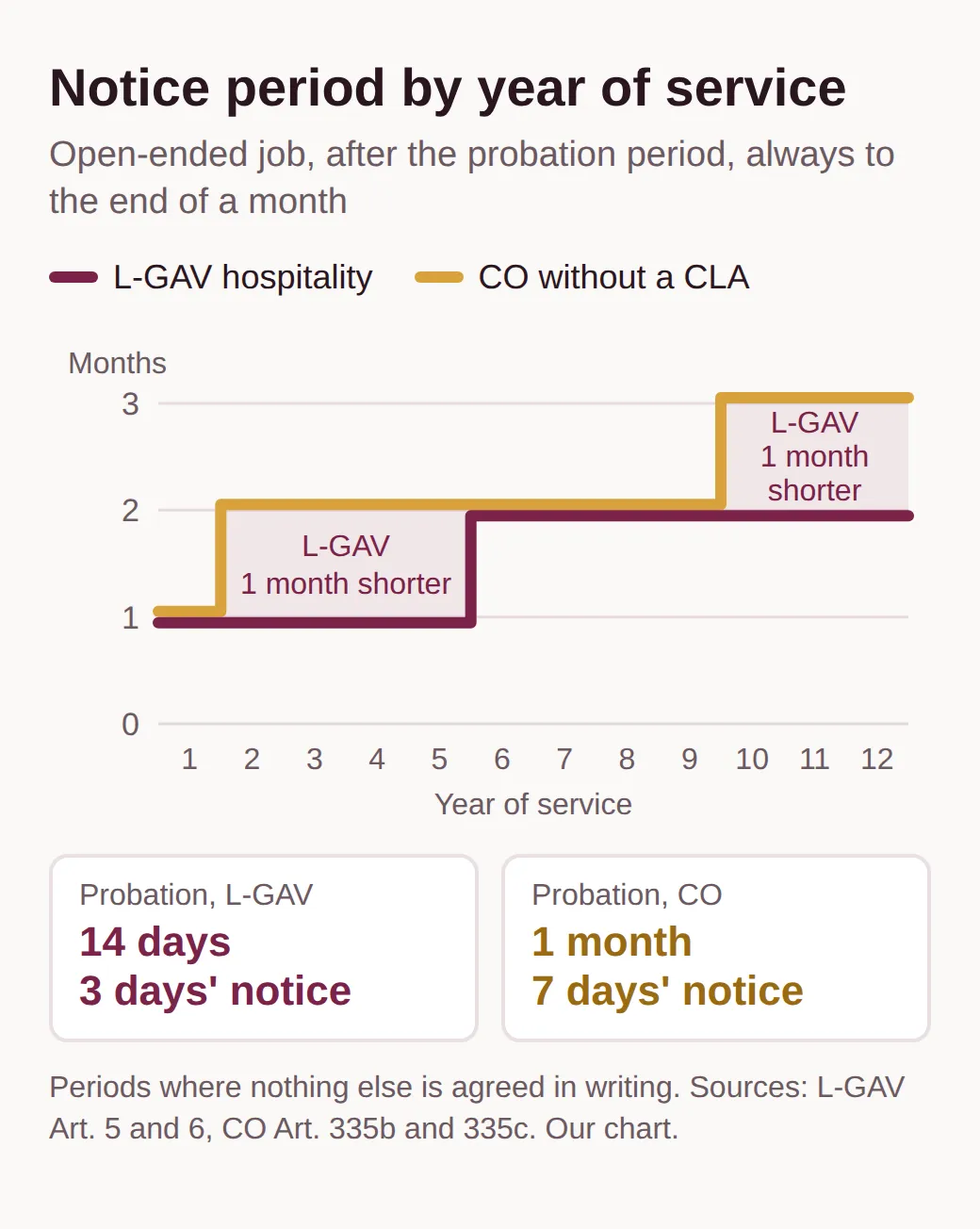
The periods in the L-GAV are minimums. Your contract may set longer ones. The L-GAV supervisory office (Kontrollstelle für den L-GAV), the industry's point of contact for questions about the agreement, even advises in its commentary that the period should match the job. So if your contract says "notice period as per the CO", the statutory periods apply, which means the longer ones from the second year. Two limits always apply. The same period must apply to you and to the business, and if different periods were agreed, the longer one applies to both (Art. 335a CO). And no individual contract may set shorter periods than the L-GAV.
Which year of employment counts depends on the day the notice arrives. The supervisory office works this through in its commentary on Art. 6: if you receive notice in your fifth year of employment, you have one month's notice, even if your sixth year begins when the notice period starts. That leaves the probation period, which has rules of its own.
Notice during probation: three days, ending on any day
During the first 14 days, either side can give notice with three days' warning, and it can end on any day, not just at the end of a month (Art. 5 L-GAV). If your boss gives you notice on a Tuesday, you're finished on Friday. The probation period starts on your first working day, not on the start date written in the contract.
Some templates online get this wrong. They give a probation period of one month and seven days' notice. That's the rule in the Code of Obligations (Art. 335b CO), and in hospitality it only applies if it was agreed in writing. Without a written agreement, it stays at 14 days with three days' notice. The supervisory office gives an example: if a boss and an employee agree a one-month probation period verbally, it is still 14 days, because it wasn't put in writing (commentary on Art. 4).
In writing, the probation period can be extended to three months at most, and the notice period during it can be extended too. For longer probation periods, the supervisory office recommends around seven or 14 days. If you fall ill or have an accident during probation, it is extended by those days. There is no protection against dismissal for illness, accident or pregnancy during probation, but even then the dismissal must not be abusive.
Ending the job during probation also costs you money you may not have thought about: you lose the pro rata share of your 13th-month pay. There's more on that in our post on L-GAV minimum wages. Once probation is over, the date the notice arrives becomes what matters.
When the letter has to arrive
What counts is not the date on the letter or the postmark, but the day the notice reaches the other party. The L-GAV requires it to arrive no later than the last day before the notice period begins. So if you want to leave at the end of November with one month's notice, your notice has to reach your employer by 31 October at the latest. If it arrives on 2 November, your job only ends at the end of December.
Registered letters come with a rule that catches people out. If nobody is home, the post office leaves a collection slip in the letterbox. The notice then counts as delivered on the first day it can be collected at the post office, not on the day it is actually collected. The supervisory office answers a typical case in its questions and answers: the business gives notice on the 29th to the end of the following month, and the employee only collects the letter on the 2nd. The notice still stands, because it was ready for collection on the 30th.
The reverse follows from this too. A registered letter you post on the last day of the month arrives too late. The safest way is to hand over your notice in person and have receipt confirmed on a copy, with the date and a signature. Whoever gives notice has to prove it. The next section shows what such a letter looks like.
How to resign
You don't need a reason. Either side can terminate an open-ended employment relationship, and only has to give reasons in writing if the other party asks for them (Art. 335 CO). A short letter is enough, as long as it gets the date right:
Resignation from my employment contract
Dear [name of your manager],
I hereby give notice to terminate my employment contract of [date of the contract] in accordance with the notice period, so that it ends on [last day of the month, for example 30 November]. Please confirm receipt briefly in writing, and send me a reference and a final statement showing the balance of my holidays, rest days and overtime.
Thank you for our time working together. Kind regards,
[First name Last name], [place, date], [signature]
Write out the end date rather than just "in accordance with the notice period": that way you work out the period in advance and avoid arguments. You can also resign while you're sick or on holiday, by the way. The protected periods covered further down only bind the employer, as the supervisory office expressly states.
Before you hand in the letter, think about unemployment insurance. If you resign without being promised a new job, you count as unemployed through your own fault (Art. 44 AVIV, the Unemployment Insurance Ordinance, in German). If you gave up a suitable job without a valid excuse, the ordinance treats that as serious fault, and the fund then suspends your benefits for 31 to 60 days, which means it pays no daily allowance for that time (Art. 45 AVIV). The exception is when you couldn't reasonably be expected to stay. So it's best to sign the new contract first and resign afterwards.
You don't have to sneak off to job interviews during your notice period. Once notice has been given, your employer must allow you the time you need to look for a new job (Art. 329 para. 3 CO). This works both ways, so it also applies if the business dismissed you.
When your employer gives you notice
Your employer doesn't need a particular reason for an ordinary dismissal either. But you can ask for the reasons in writing, and that's worth doing if you suspect something isn't right. What is forbidden is an abusive dismissal (the official English text of the Code calls it "unlawful"). The law lists cases such as dismissal because of a personal characteristic that has nothing to do with the job, because of your union membership, or because you assert "claims under the employment relationship in good faith" (Art. 336 CO). So if you claim overtime you're owed and get dismissed for it, take a close look. Our post on working hours explains how to keep a record of your hours.
An abusive dismissal is still valid. Your job ends anyway, but you can claim compensation of up to six months' pay (Art. 336a CO). There are two deadlines you must not miss. You have to object to the dismissal in writing to your employer before the notice period ends, and you have to take the case to court within 180 days of the job ending (Art. 336b CO). A sentence like "I object to the notice of [date] because I consider it abusive" is enough for the first step.
It's different when the employer gives notice at the wrong time. Then the dismissal is void, which means it has no effect at all.
Sick, injured or on holiday
After the probation period, your employer may not dismiss you while you're ill or injured through no fault of your own. This protected period lasts 30 days in the first year of service, 90 days from the second to the fifth year and 180 days from the sixth year (Art. 336c CO). Other protected periods include pregnancy and the 16 weeks after the birth, and military, civil defence or civilian service. A dismissal that falls within a protected period is void. The employer has to give notice again once the period is over.
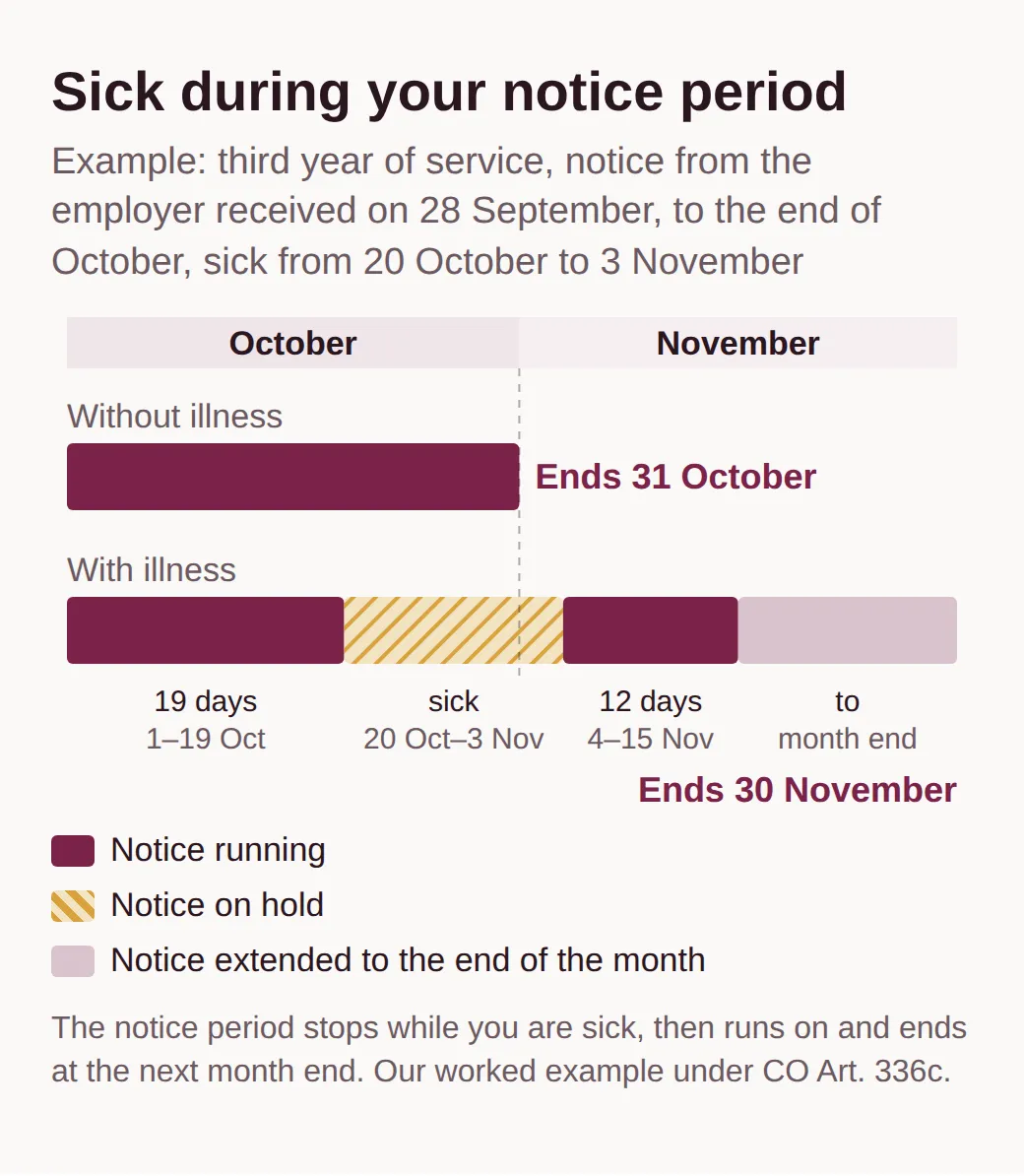
If you receive notice before you fall ill, it stays valid, but the notice period is put on hold. It only carries on after your illness, and if it then doesn't end at the end of a month, it is extended to the next one. In our example, you're in your third year of service and receive notice on 28 September to the end of October. You're sick from 20 October to 3 November. Twelve days of the notice period are then still left. They run from 4 to 15 November, and because that isn't the end of a month, your job ends on 30 November, a month later than planned.
The L-GAV also protects you on holiday. After the probation period, your employer may not give you notice while you're taking your contractual holidays (Art. 7 L-GAV). Such a dismissal is void, and notice has to be given again after the holidays. The Code of Obligations has no such protection. However, holidays don't extend the notice period if the notice arrived before them. The supervisory office describes the case of a cook with two months' notice who is given notice on 20 March for the end of May, even though she's on holiday from 15 April to 7 May: the notice stands and the job ends at the end of May. Unpaid leave doesn't count as holidays and isn't protected.
How long you keep getting paid when you're sick depends on the daily sickness benefit insurance that the L-GAV requires. It pays 80 percent of your gross wage for 720 days within a period of 900 days, and these benefits continue even if the job ends before you recover (Art. 23 L-GAV). A special case arises when your employer doesn't want to see you at all once notice has been given.
Garden leave until the last day
Some businesses send people home as soon as notice has been given. This is called garden leave, and it's allowed. But the contract carries on until the end of the notice period, on full pay. If your employer won't accept your work, it still has to pay you, and you don't have to make up the time (Art. 324 CO). What happens to your staff room when the job ends is covered in our post on board and lodging.
Two things can be set off against this. The first is what you earn in a new job during that time. If you start somewhere else while you're on garden leave, your old employer may deduct that pay, unless you've agreed otherwise. The second is your unused holiday. The Federal Supreme Court has ruled that an employee on garden leave must take their outstanding holidays during that time as far as possible, even without being told to by the employer (BGE 128 III 271, consideration 4, in German). Looking for a new job comes first, and what matters is the ratio between the length of the garden leave and the number of holiday days still owed. The case involved a caretaker who was on garden leave from March and started a new job on 1 July. His 40 outstanding days of holiday counted as taken, because four months left him enough free days alongside his job search. If there isn't enough time before the end to take the holidays, on the other hand, they are paid out.
Ordering you to take holidays is also easier for the employer during the notice period. Normally it has to announce them a month in advance, but that does not apply once notice has been given (Art. 17 L-GAV). According to the supervisory office, it still has to take your wishes into account. There is only one situation in which a job can end with no notice at all.
Termination without notice: when it is really allowed
Either side may terminate with immediate effect only for good cause, meaning the job can no longer reasonably be continued in good faith (Art. 337 CO). The Federal Supreme Court sets the bar high. Summary dismissal is only justified for particularly serious misconduct. If the misconduct is less serious, it must have happened repeatedly despite a warning. Under the law, illness or an accident that isn't your fault is never good cause.
A case from Thurgau shows what this looks like in a restaurant (ruling 4C.117/2005, in German). A waiter was responsible for opening the restaurant in the morning and was repeatedly up to half an hour late. Guests had to wait or went elsewhere. The owner warned him several times between May and October 2002, most recently on 14 October, and dismissed him without notice on 19 October. The Federal Supreme Court ruled in the owner's favour. What decided it was not any single late arrival, but that the waiter changed nothing despite clear warnings. A warning has to be recognisable as one and state clearly which behaviour will no longer be tolerated.
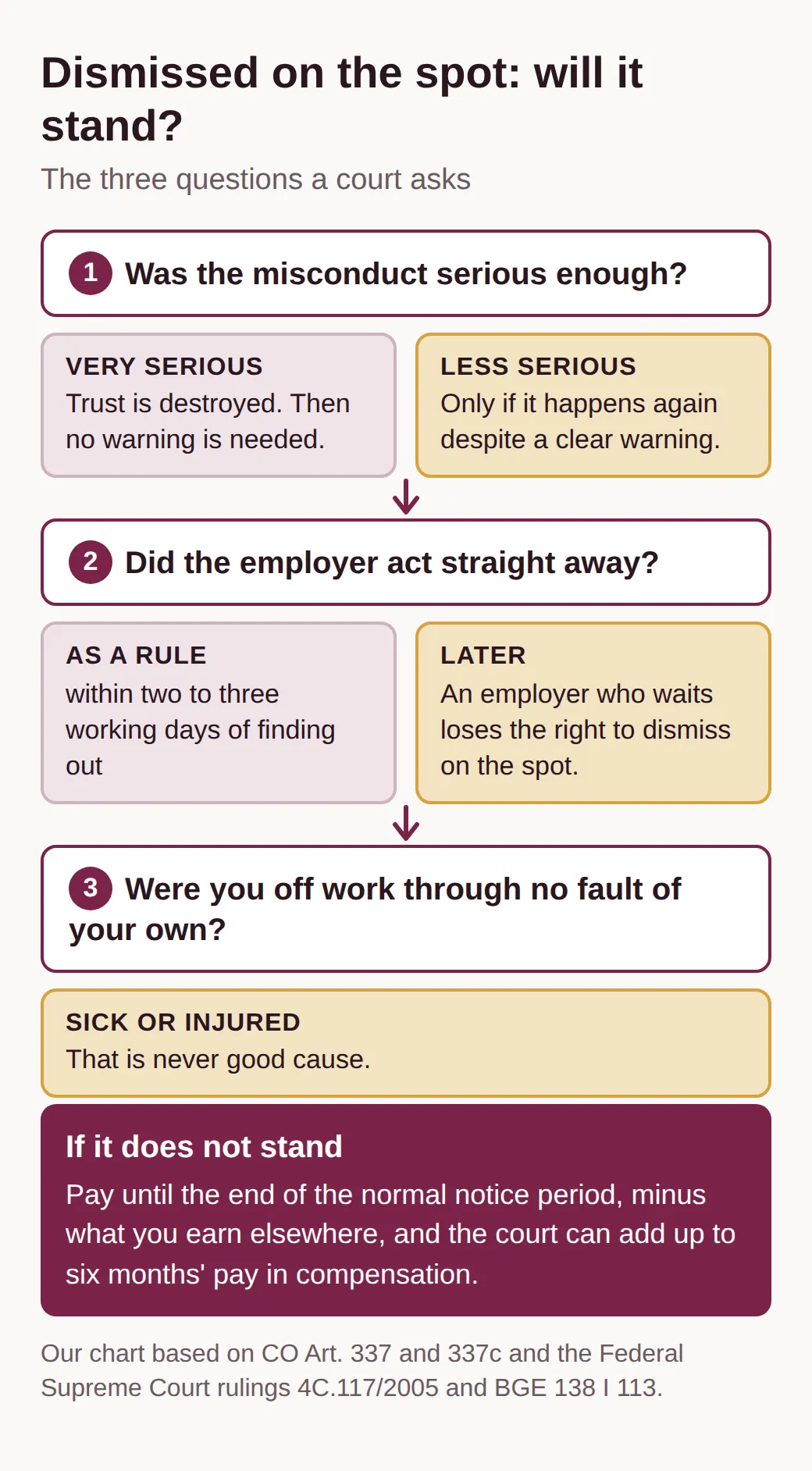
Anyone who wants to dismiss without notice also has to move fast. Two to three working days to think it over and get legal advice are generally considered reasonable (BGE 138 I 113, consideration 6.3.2, in German). According to the case law, anyone who waits longer shows that they could have put up with working together until the ordinary end after all, and loses the right to dismiss without notice. A little more time is only allowed if the facts first have to be established or a board has to decide.
If a summary dismissal doesn't stand up in court, the job still ends immediately. But you're entitled to the pay you would have earned until the end of the ordinary notice period, minus what you earn elsewhere during that time or deliberately choose not to earn. On top of that, the court can award compensation of up to six months' pay (Art. 337c CO).
The rule applies to you too. If you walk out from one day to the next without good cause, you owe the business a quarter of a month's pay, and it can claim further damages (Art. 337d CO). The L-GAV allows the business to deduct this compensation straight from your pay (Art. 13). You can only leave without notice and without consequences if you have good cause, and the law names one expressly: if your employer becomes insolvent and doesn't provide security for your pay within a reasonable time, you may leave immediately (Art. 337a CO). So if you're leaving a job after a dispute, get advice first. With or without notice, it all ends with your last working day and its final statement.
The last day: pay, holidays and reference
On the last day of your employment, the L-GAV says you must receive all wages owed, the final statement and your reference (Art. 14). According to the supervisory office, the final statement settles the balances of holidays, public holidays, rest days and overtime. Untaken holiday days are paid at one thirtieth of your gross monthly wage each. The supervisory office adds that you're also owed the pro rata 13th-month pay on holidays and rest days paid out. Your employer may not offset negative hours against your holiday entitlement at the end.
Don't sign a statement in which you waive outstanding claims. While you're employed and for one month afterwards, you can't validly waive mandatory claims under the law or a collective employment agreement anyway (Art. 341 CO). In its commentary on Art. 14, the supervisory office states that the common clause «per Saldo aller Ansprüche», meaning in full and final settlement of all claims, is therefore not binding. Claims arising from your employment become time-barred after five years (Art. 128 CO).
You can ask for a reference at any time, not just at the end (Art. 330a CO). If it turns out worse than you expected, you can ask instead for a confirmation of employment that only states the type and length of the job. So if you're leaving at the end of the month, bring up the reference during your notice period, not on your last evening after service.
Before you hand in your notice
Work out your end date first. How many years of employment will you have on the day the notice arrives? Does your contract set a longer period than the L-GAV? And by which day at the latest does your notice have to reach the business? Then secure your new job before you leave, and get written confirmation that you handed over the letter. If anything is unclear, the L-GAV supervisory office in Basel gives legal information by phone from Monday to Friday. Hotel & Gastro Union advises its members free of charge. Its legal service (rules in German) only takes up your case with the employer after one year of membership, though, and never in a dispute that began before you joined.
So if you want to resign, the best first step is to find your next permanent job.
Many businesses hire all year round, not just before the season, for example in the city of Lucerne.
If you'd rather look in a bigger city, you'll also find vacancies in Basel or the canton of Bern.
Common questions
- Can I resign by WhatsApp or verbally in Switzerland?
- A resignation is valid in any form, including verbally or by message. The L-GAV supervisory office still strongly recommends putting it in writing, because the person giving notice has to prove that it arrived and when. A letter with a signed acknowledgement of receipt is the safest way, and if your contract requires written notice, stick to that.
- Is the notice period the same for part-time or hourly paid staff?
- Yes. The L-GAV also covers part-time and casual staff, and they have the same rights as full-time staff in principle. For years of service, what counts is how long the employment contract has run, not how many days you worked. So if you work 50 percent, you move into your second year after twelve months, just like anyone else.
- Do previous seasons with the same employer count towards my notice period?
- No. The L-GAV adds earlier jobs together for some entitlements if there are no more than two years between them, but it expressly excludes the notice period. So if you take a year-round job at the same hotel after ten seasons, your notice period is counted from the first year again, unless the contract provides for something longer.
- Does the L-GAV apply to managers and apprentices?
- No. General managers and directors with far-reaching powers, such as hiring and firing staff themselves, are excluded, and so are apprentices. Senior managers then fall under the Code of Obligations, with one, two or three months' notice, and apprentices under their apprenticeship contract. A job title alone is not enough for the exception.
More posts
All posts
Working hours in Swiss hospitality: L-GAV rules for 2026
L-GAV working hours: 42, 43.5 or 45 hours a week depending on the business, two rest days, overtime at 100 or 125 percent. How to check your own hours.

Trial Day in Swiss Hospitality: Pay, Insurance and Length
Trial day or trial shift at a Swiss restaurant or hotel? You're owed L-GAV pay and the business's accident insurance covers you. What to agree first.

Restaurant Jobs in Switzerland With No Experience: 2026
Waiting tables in Switzerland with no experience: the 2026 minimum wage, the free Progresso course, what restaurants expect and how career changers apply.