Swiss Winter Season Jobs 2026/27: Contract, Room, Off-Season
The short answer
A winter season job is a fixed-term contract, usually from December to April, in a hotel or restaurant in the mountains. It ends automatically, without anyone giving notice, and it can only be ended earlier if that's written into it. If you live and eat at the hotel, that comes off your pay. Unemployment benefit for the off-season is only paid under strict conditions, and if you only work winters, you won't meet them.
What your contract says decides more than your pay: when you may leave, what's on your final payslip, whether you get a daily allowance in the off-season and which permit you need. The rules are in the hospitality industry's national collective labour agreement (L-GAV), in the law and in the directives of the State Secretariat for Economic Affairs (SECO). But first, where the jobs actually are.
Where the winter season jobs are
In Graubünden, Valais and the canton of Bern. The clearest sign is when hotels open. According to the Federal Statistical Office's accommodation statistics, 3,420 hotels were open in Switzerland in November 2025 and 3,920 in December, 500 more. Graubünden alone added 204, Valais 173 and the canton of Bern 98, 475 between them. Wherever a hotel opens for the winter, it needs staff for exactly those months.
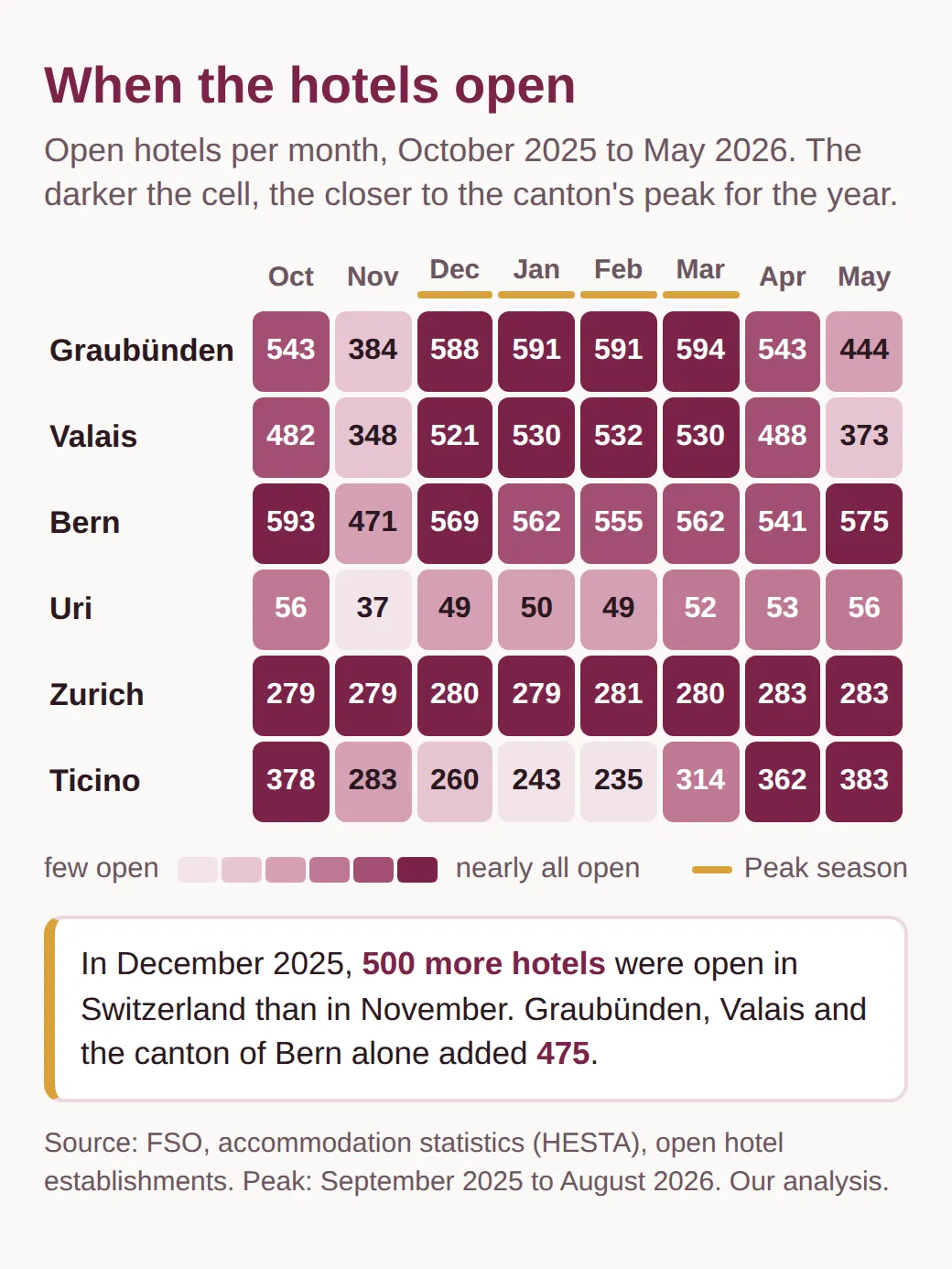
Guest numbers alone tell you little. From November 2025 to April 2026, the statistics counted 3.03 million overnight stays in hotels in Graubünden, and almost as many in the canton of Zurich, 2.99 million. But Zurich's hotels are open all year, and their number moves by only a handful. Where nothing ever closes, there's no end of season either. Ticino is the other way round: in February 2026 only 235 hotels were open, in summer 2026 more than 380. If you work there, your season is the summer.
The chart also shows when the off-season falls. Measured against the year's peak, a good third of the hotels in Graubünden and Valais were closed in November 2025. In May 2026 it was around one in four in Graubünden and one in three in Valais. These are the weeks your contract ends, and the weeks you have to plan for: where you'll live, what you'll live on, whether you register as unemployed. The answers all depend on the contract.
The seasonal contract: fixed-term and usually no early termination
A seasonal contract ends on the agreed date without anyone having to give notice (Art. 334 CO). Neither the business nor you can end it earlier unless you've agreed that in writing. Otherwise the L-GAV treats the contract as one that can't be terminated early (Art. 6 item 3, in German). The collective agreement applies throughout Switzerland and, with a few exceptions, to every business that accommodates guests or serves them food and drink for payment, from the hotel to the bar to the mountain hut (Art. 1).
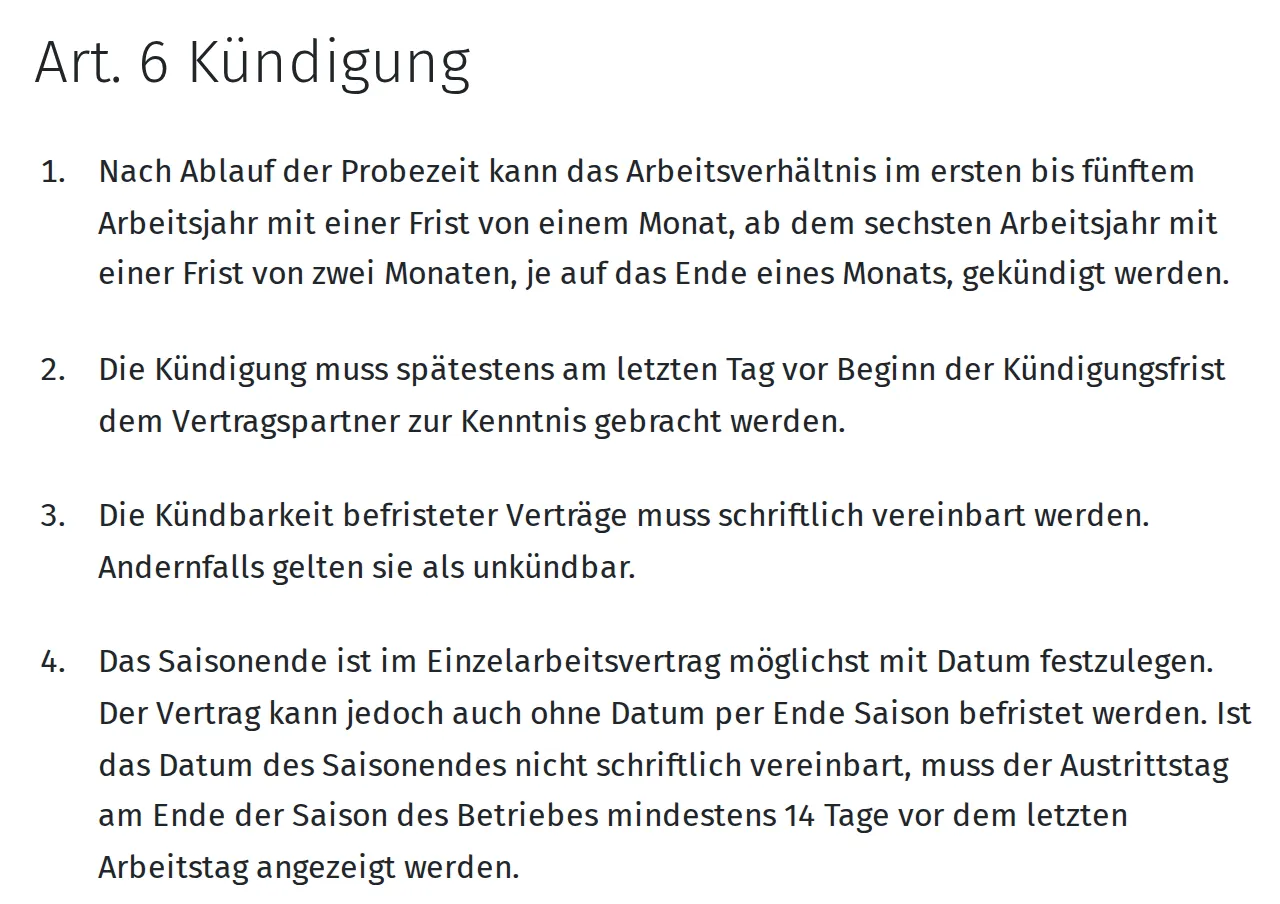
The end of the season should be in the contract as a date. But the business may also simply set the contract to run “until the end of the season”. It then has to tell you your last working day at least 14 days in advance (item 4). According to the commentary on the article on l-gav.ch, that day must be the same for all staff, and because closing usually depends on the weather, the courts accept it as a fixed term too. Something similar applies to the start: your first working day is in the contract, with a date if possible, or you're told in writing at least a month ahead (Art. 4).
A fixed-term contract only has a probation period if one is agreed in writing (Art. 5). If you come back the next season to do the same work, a new probation period isn't allowed. And while an employer can't otherwise string fixed-term contracts together at will, seasonal contracts are an exception. Each season is a new contract.
Not being able to give notice protects both sides, and it costs both sides something. If the business dismisses you before the end without good cause, it owes you your pay until the agreed end, minus what you earn elsewhere in that time (Art. 337c CO). If you don't start the job, or you walk out mid-season without good cause, the business can claim a quarter of a month's pay, plus any further damages (Art. 337d CO). The L-GAV expressly allows this compensation to be deducted from your pay (Art. 13). So once you've accepted a winter job, you're bound by it, even if a better offer comes along in October.
Before you sign, make sure these points are in the contract in writing:
- first working day and end of season, as a date or as “end of season”
- whether either of you can end it early, and with how much notice
- whether there's a probation period
- room and board, with the amounts deducted from your pay
- weekly working hours
That last point works differently in the season. Seasonal businesses may agree an average of 43.5 instead of 42 hours a week. These are businesses that are only open at certain times of the year, and year-round businesses with a marked high season that hold a permit for it from the L-GAV supervisory office (Art. 15). It has to be in the contract. What this means for overtime and rest days is a topic of its own. For the season, what matters more is what's on your final payslip at the end.
Pay, holidays and 13th-month pay at the end of the season
The L-GAV minimum wages apply during the season, with one exception around New Year, and you get a pro rata share of your 13th-month pay. The exception is in the commentary on Art. 10: if you work in a seasonal business on a fixed-term seasonal contract and start by 31 December, you may be employed at the previous year's minimum wages for the whole winter season. The new ones then only apply from the summer season, as long as the winter season ends by 30 April at the latest. So if you start on 15 December 2026 without a completed apprenticeship, your minimum wage may stay at 3,713 francs all winter instead of rising to the 3,735 francs for 2027 in January. For people without an apprenticeship who have never worked four months in an L-GAV business, the minimum wage may also be up to 8 percent lower during an induction period of at most twelve months, if that's agreed in writing. Consecutive seasons with the same business count together for this.
The L-GAV gives you one extra full month's pay a year, and a matching share for part of a year. It's due with your December pay at the latest, or when the employment ends (Art. 12). If the contract ends during the probation period, you get no share.
You build up holidays with every month: 2.92 calendar days, which comes to five weeks over a year (Art. 17). As a rule, you take them during the season. In the last two months of a fixed-term contract, the business may also order holidays at short notice; otherwise it has to announce them a month ahead. Whatever you haven't taken by the end is paid out, at one thirtieth of your monthly pay per day. Paying holiday as a percentage on top of each wage is only meant for short, irregular jobs, not for a season with fixed hours.
The commentary on Article 17 works through an example. An employee worked from 20 December to 15 March, 86 days, on 4,000 francs a month. He had taken seven days of holiday, no public holidays and 19 rest days. At the end he was still owed 1.25 days of holiday, 1.41 public holidays and 3.57 rest days, 1,072.10 francs in total. Public holidays and rest days are paid at one twenty-second of monthly pay, holidays at one thirtieth. That's over a quarter of a month's pay, and an amount like that is easily forgotten if nobody does the sums.
So keep your own record of rest days, public holidays and holidays during the season. The payslip only shows what the business recorded. And one of the biggest items on it is usually your room.
What staff accommodation and meals may cost
What you agreed in writing or, without an agreement, the tax authorities' minimum rates, and only for what you actually receive (Art. 29 L-GAV). These rates are set in the AHV ordinance (old-age and survivors' insurance, in German): 11.50 francs a day for accommodation, 33 francs for accommodation with full board. A 30-day month with room and meals therefore comes to 990 francs. Under Art. 4 L-GAV, an agreement on room and board is only valid in writing. The L-GAV recommends a separate contract for it alongside the employment contract.
If you share a room, lower rates should usually be charged, the L-GAV says. As a rule, only the meals you actually eat are deducted. When you're on holiday or off sick, flat-rate deductions go down too, unless you've agreed something else in writing that you can check.
One sentence in Article 29 affects you on the last day of the season: unless agreed otherwise, board and lodging end with the employment. So when your contract ends, so does your right to the staff room. If you want to stay in the resort over the off-season, or register as unemployed here, you'll need an address of your own. That has consequences beyond the rent.
Unemployment benefit in the off-season?
Only if you've worked at least twelve months in the two years before you register, and you aren't looking only for seasonal jobs. The first condition is in the law (Art. 13 AVIG, the Unemployment Insurance Act, in German). The unemployment insurance fund counts every full calendar month as a contribution month and converts part months by days, every 30 days making a month (Art. 11 AVIV, in German). By this count, a season from 20 December to 15 April gives you just under four contribution months.
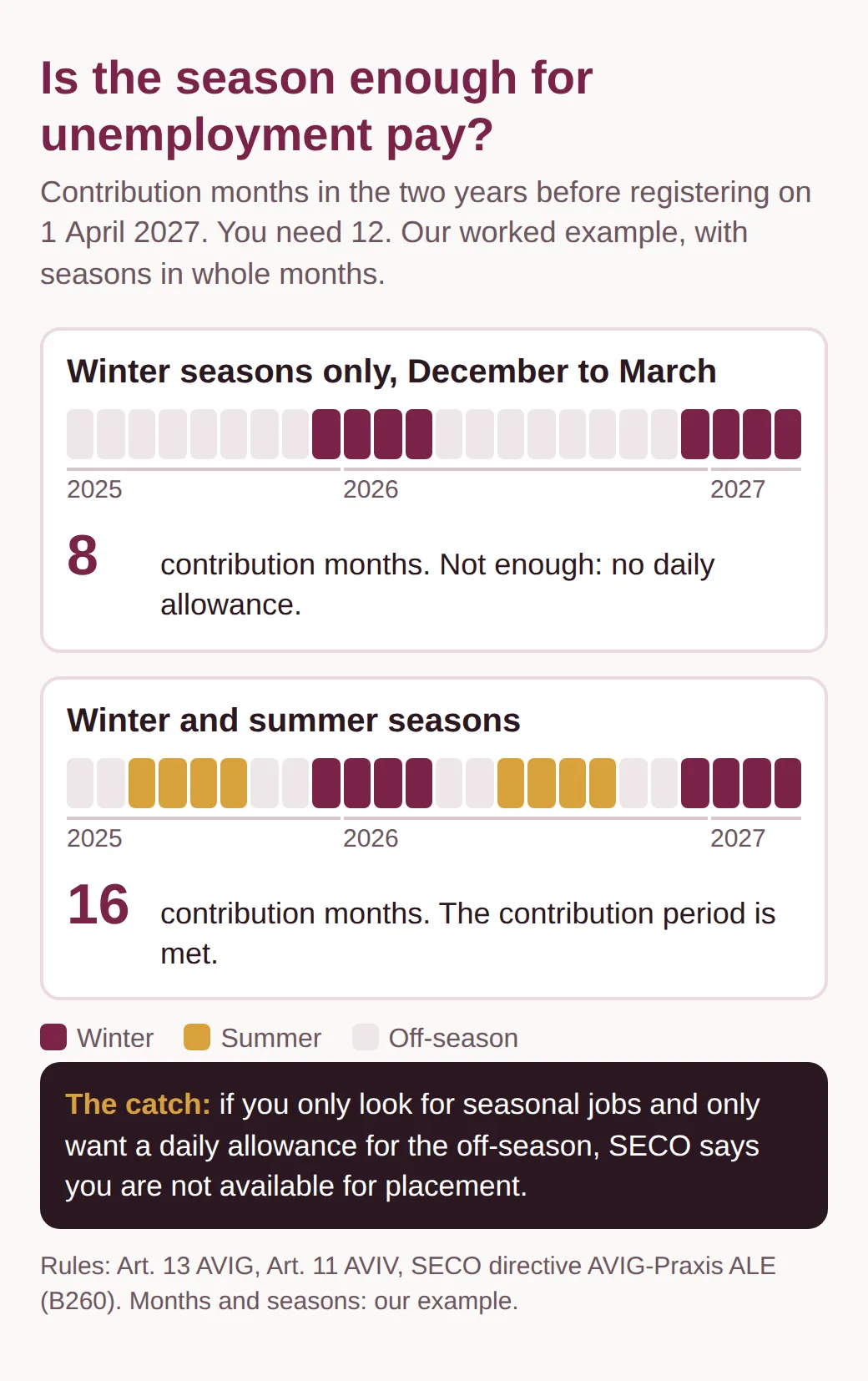
So if you only work winters, you won't reach twelve months. With winter and summer, the numbers add up. Then the second condition kicks in. SECO's directive to the unemployment insurance funds states that anyone who only takes seasonal jobs and only ever applies for fixed-term jobs is not available for placement (AVIG-Praxis ALE, marginal no. B260, in German). The directive refers to a 2007 ruling: insured people who deliberately work only in summer and winter, and claim a daily allowance only for the short off-seasons in between, are not entitled to it. To get the daily allowance, the same directive says, you also have to apply for permanent jobs, outside your own trade if need be.
If you meet both conditions, there are deadlines. The fund expects you to apply for jobs before a fixed-term contract ends, at least during its last three months (marginal no. B314). With a season until the end of March, you start applying in January and keep copies. You must register with the regional employment centre (RAV) no later than the first day you want benefits for, online or in person (guide for insured persons 2026, in German). After a seasonal job, one special waiting day is added to the general waiting days (Art. 6 AVIV). You have no general waiting days if your insured earnings are 36,000 francs a year or less. Without children and with higher earnings, there are at least five.
The daily allowance is 70 or 80 percent of your insured earnings, depending on your pay and whether you have dependants (Art. 22 AVIG). And the fund only pays as long as you actually live in Switzerland. For many seasonal workers from abroad, that's what decides it.
Working a winter season as an EU citizen
For a whole winter season you need an L permit; for up to three months, a notification is enough. Citizens of the EU and EFTA are entitled to an L permit if they have an employment contract of between three months and one year. It's valid for as long as the contract and can be extended up to a total of less than twelve months, according to the State Secretariat for Migration (SEM). A season from December to April is therefore covered by the L permit.
For shorter jobs there's the online notification procedure. A job of no more than three months in a calendar year needs no permit, and your employer registers you by the day before your first working day at the latest. That no longer applies to British citizens: since 2021, they too need a work permit under Swiss immigration law, even for a short job. For people from countries outside the EU and EFTA, the bar is higher. According to SEM, only well-qualified workers are admitted, and the business must show that it can't find anyone in Switzerland or the EU. As we read it, that closes this route for most seasonal jobs.
An L permit comes with two obligations. You have to take out Swiss health insurance. If your permit is valid for more than three months, you're subject to compulsory insurance from the day you register with the municipality, and you have three months to join a health insurer. You pay yourself for any treatment before you join, and if you're late, you risk a premium surcharge (Federal Office of Public Health). There are exceptions, for example for people who live in Germany, Austria, France or Italy and go back there at least once a week. And because you don't have a settlement permit, your employer deducts tax straight from your pay, as tax at source (Art. 83 DBG, in German).
At the end of the season, the question of money for the off-season comes back. Swiss unemployment insurance requires that you have your habitual residence and the centre of your life here. As a foreign national without a settlement permit, you also need a valid permit that allows you to work. Once it expires, SECO says this condition is no longer met, even if you stay in the country (marginal nos. B136 and B137). If your L permit ends with your seasonal contract and you go home, Switzerland usually pays nothing.
What counts then is what your home country pays, under its own rules. To have your months in Switzerland counted there, you need form PD U1. The unemployment insurance provides the application for it (in German). The back of the form lists how far back each country needs information: Germany five years, Italy two, Portugal three. Apply before you leave, while it's still easy to get the employer certificates.
Before you sign for the winter
A good seasonal contract leaves little to chance. At the interview, ask how the end of the season is set, by date or by rule, about the room and what's deducted for it, and whether the business counts as a seasonal business with a 43.5-hour week. Ask how tips are shared, too. We've set out what you're entitled to in our post on tips in Switzerland.
Plan the off-season when you sign. If you're hoping for a daily allowance afterwards, count up your contribution months for the last two years beforehand. You'll then know whether a summer season or a year-round job is the better next step.
Fixed-term jobs for the winter are mainly in the three cantons where most hotels open in December.
Common questions
- What happens if there's no snow and the hotel closes early?
- If your contract runs until the end of the season, the business may tie the end to the day it actually closes, even if that depends on the weather. It then has to tell all staff their last working day at least 14 days in advance. If it wants only some people to leave early, it needs a contract that can be terminated with one month's notice, or your agreement.
- Can I keep working after my seasonal contract ends?
- Yes, but then the contract changes. If you simply carry on working after the agreed end, the employment counts as open-ended under Article 334 of the Code of Obligations. From then on, it can only be ended by giving notice. If you only want to add a few weeks, put that in writing.
- Do my previous seasons with the same employer count?
- For some entitlements, yes. If there are no more than two years between two seasons with the same employer, the L-GAV adds the work periods together, for example for the induction period on the minimum wage and for training leave. They don't count for the notice period, which stays at one month unless the contract says otherwise.
- Do EU citizens need a work permit for a short seasonal job in Switzerland?
- Not if the job lasts no more than three months in a calendar year. The online notification procedure is then enough, and your employer registers you by the day before your first working day at the latest. If the contract is longer, you need an L permit.
More posts
All posts
L-GAV Minimum Wage 2026: All Levels, Hourly Pay and 2027
Swiss hospitality minimum wage 2026 under the L-GAV: 3,713 francs without an apprenticeship, 4,528 with an EFZ. Hourly rates, the 8% rule and 2027.

Tips in Swiss Hospitality 2026: Who Do They Belong To?
Tips belong to the team, not the business. What your boss may do with a tip pool and card tips, what the L-GAV says, and when AHV and tax apply.

Trial Day in Swiss Hospitality: Pay, Insurance and Length
Trial day or trial shift at a Swiss restaurant or hotel? You're owed L-GAV pay and the business's accident insurance covers you. What to agree first.