L-GAV Minimum Wage 2026: All Levels, Hourly Pay and 2027

The figures first
In Swiss hospitality, the minimum wage in 2026 is 3,713 francs gross a month without an apprenticeship, 4,070 francs with a Federal VET Certificate (EBA) and 4,528 francs with a Federal VET Diploma (EFZ). These figures apply to a full-time job from the age of 18, and a full 13th-month pay comes on top. Paid by the hour, the lowest level works out at 24.96 francs with all supplements on a 42-hour week.
Most overviews stop at the monthly table. We take the sums further: the least an hour can cost, when your pay may be 8 percent lower in your first months, what applies from January 2027 and how to get back money you're owed. The supervisory office's own figures show why checking is worth it: in its 2025 spot checks, the minimum wage was wrong in 275 of the 2,217 businesses inspected.
The 2026 minimum wages by level
Which amount applies to you depends only on your training, not on the job on the rota. The hospitality industry's National Collective Employment Agreement, the L-GAV for short, has six levels. The amounts are in Art. 10 L-GAV (in German; l-gav.ch has no English version). We've multiplied them by 13, because the full 13th-month pay is part of your wage:
| Level | Training | per month | per year |
|---|---|---|---|
| Ia | no apprenticeship | 3,713 | 48,269 |
| Ib | no apprenticeship, with Progresso | 3,943 | 51,259 |
| II | VET Certificate (EBA) | 4,070 | 52,910 |
| IIIa | apprenticeship (EFZ) | 4,528 | 58,864 |
| IIIb | EFZ and 6 days' further training | 4,635 | 60,255 |
| IV | federal professional exam | 5,293 | 68,809 |
All amounts are in francs and gross, that is before AHV, pension fund and other deductions. They apply to a full-time position. If you work part-time or step in as casual staff, you get the minimum wage pro rata: at 60 percent in level Ia, that's 2,227.80 francs a month.
Progresso is a five-week course run by Hotel & Gastro formation in Weggis for people without an apprenticeship. It moves you from level Ia to level Ib, which is 230 francs more a month. The L-GAV pays the course fees out of its training contributions if your job falls under the agreement.
The increase on 2025 was small. Level Ia went from 3,706 to 3,713 francs, up 7 francs. In May 2025, the social partners, the employers' associations and unions behind the agreement, decided to raise wages for 2026 and 2027 only in line with expected inflation (press release of 20 October 2025, in German). Before you look for your amount in the table, it's worth checking whether the agreement applies to you at all.
Does the L-GAV apply to your workplace?
Very likely, yes. It covers every business in Switzerland that accommodates guests for payment or sells food and drink for consumption on the premises, and delivery services for ready-made meals too (Art. 1 L-GAV). The commentary names hotels, hostels, mountain huts, restaurants, bars, clubs, takeaways, food trucks, pizza couriers, catering and festival catering. Whether the business belongs to an association makes no difference, because the Federal Council has declared the agreement generally binding.
Only a few are excluded (Art. 2 L-GAV): staff canteens that mainly serve their own staff, certain restaurants in hospitals, care homes and shops, and catering on trains, plus members of the owner's family, musicians, apprentices and managers. For managers, the title doesn't count. Only someone with far-reaching powers, such as hiring and firing staff and setting pay policy, is left out. A “general manager” without those powers is covered by the agreement.
Two groups are excluded from the minimum wages only, not from the agreement (Art. 10 item 2 L-GAV): students aged 18 and over who are enrolled at a Swiss school or university in full-time education, and people on state reintegration programmes. So if you wait tables alongside full-time studies, you're not entitled to the rates in the table.
There was one quirk in 2026. In February, the Federal Council reinstated the agreement's generally binding status from 1 March 2026 until the end of 2027 (Federal Gazette, BBl 2026 311, in German). With a second decision, it made the new 2026 wages binding on all businesses from 1 May 2026 (BBl 2026 908, in German). Since then, they've applied everywhere. That leaves the question of which level you belong in.
Which level applies to you?
Your level depends on your qualification, and the qualification has to fit work in hospitality. A trained cook, restaurant specialist or hotel specialist with an EFZ is level IIIa. Kitchen, restaurant and hotel assistants with an EBA are level II. The supervisory office lists the recognised qualifications in its commentary on Art. 10. A commercial apprenticeship counts there for hotel reception and back-office work.
Level IIIb takes an EFZ plus six days of job-specific further training, such as the courses the industry associations run. Level IV requires a federal professional examination, for example as a head chef, restaurant manager or chef de réception with a federal diploma. Here too, the actual responsibility decides, not what the job is called.
If you trained abroad, your employer assesses your qualification. According to the L-GAV commentary, the State Secretariat for Education, Research and Innovation (SERI) generally treats two years of training as equivalent to an EBA and three years as equivalent to an EFZ. If you and your employer don't agree, you can have SERI assess the equivalence. Disputes over the level are decided by the L-GAV's joint supervisory commission.
A tip for the interview: bring copies of your certificates. Your employer has to check your level, and you have to provide the proof. If a document is missing, you can easily end up in level Ia although you'd be entitled to more. If you're paid by the hour, you're placed in a level the same way; only the amount looks different.
What is your minimum hourly wage?
In level Ia, it's 20.40 francs basic pay, or 24.96 francs with all supplements. To get there, the supervisory office divides the monthly wage by 182 hours, which matches the standard 42-hour week. Paid by the hour, you don't get holidays, public holidays and the 13th-month pay as paid days off or an extra payment, so three supplements go on top: 10.65 percent for five weeks of holiday, 2.27 percent for six public holidays and 8.33 percent for the 13th-month pay. That's how the supervisory office sets it out in its wage fact sheet for 2026 (in German).
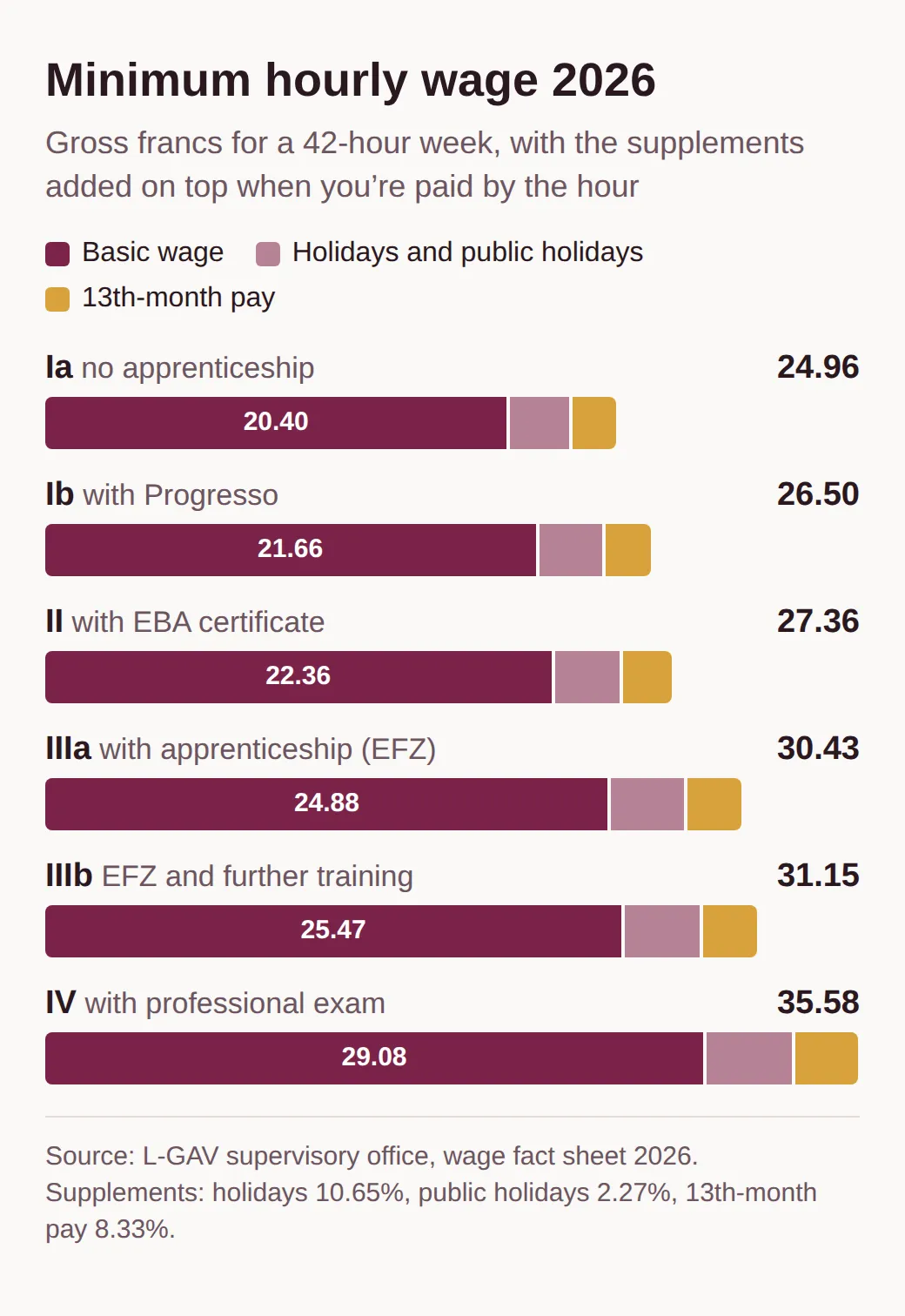
An example: a trained cook helps out at a restaurant at weekends. He's level IIIa. His basic wage must be at least 24.88 francs, or 30.43 francs an hour with supplements. The L-GAV requires the supplements for holidays and public holidays to be shown separately, and the 13th-month pay too. A contract saying “28 francs including holidays” isn't allowed, even if the total were right.
Seasonal businesses work a 43.5-hour week, small businesses 45 hours. The monthly wage is then spread over 189 or 195 hours, so the hourly rate comes out lower: in level Ia, it's 24.03 francs in a seasonal business and 23.29 francs in a small business, each with all supplements. A business only counts as seasonal with a permit from the supervisory office, and it has to apply again before the permit runs out. The rules on working hours themselves are a topic of their own.
According to the L-GAV commentary, the 10.65 percent holiday pay is only meant for short, irregular assignments. If you work part-time on a regular basis, your workplace should employ you on a monthly wage and give you real holidays. The third supplement, the 13th-month pay, has rules of its own that staff on a monthly wage should know too.
13th-month pay under the L-GAV
You're entitled to a full 13th-month pay, that is 100 percent of one gross monthly wage (Art. 12 L-GAV). It isn't a bonus your boss can drop on a whim. If you only work part of the year, you get a pro rata share. The business has to pay it with your December wage at the latest, or when you leave.
One exception costs some people money without them noticing. If the employment ends during the probation period, the pro rata 13th-month pay is lost entirely. Under the L-GAV, the probation period is 14 days, and it can be extended in writing to three months at most (Art. 5 L-GAV). If seasonal contracts for the same work follow each other closely, the business may not agree a new probation period.
The 13th-month pay is based on your average gross wage, which includes paid-out holidays, rest days and public holidays. Overtime only counts if it's paid out regularly. Casual staff working only a few hours are entitled too, as the supervisory office confirms on its questions and answers page. If you're ill or have an accident, the entitlement continues and is covered by the daily allowance insurance.
If your workplace pays the 13th-month pay monthly, it has to appear as a separate line on every payslip. Without that line, as we read it, the business will struggle to prove later that it paid it. There's only one situation in which a business may pay you a little less than the full minimum wage: at the start.
The induction period: up to 8 percent less
If you're new to the industry, you can earn up to 8 percent below the minimum wage in level Ia or Ib for up to twelve months. In 2026, that's 3,415.95 instead of 3,713 francs, about 297 francs less a month. This cut isn't automatic. It only applies if it's written into your employment contract or an addendum to it.
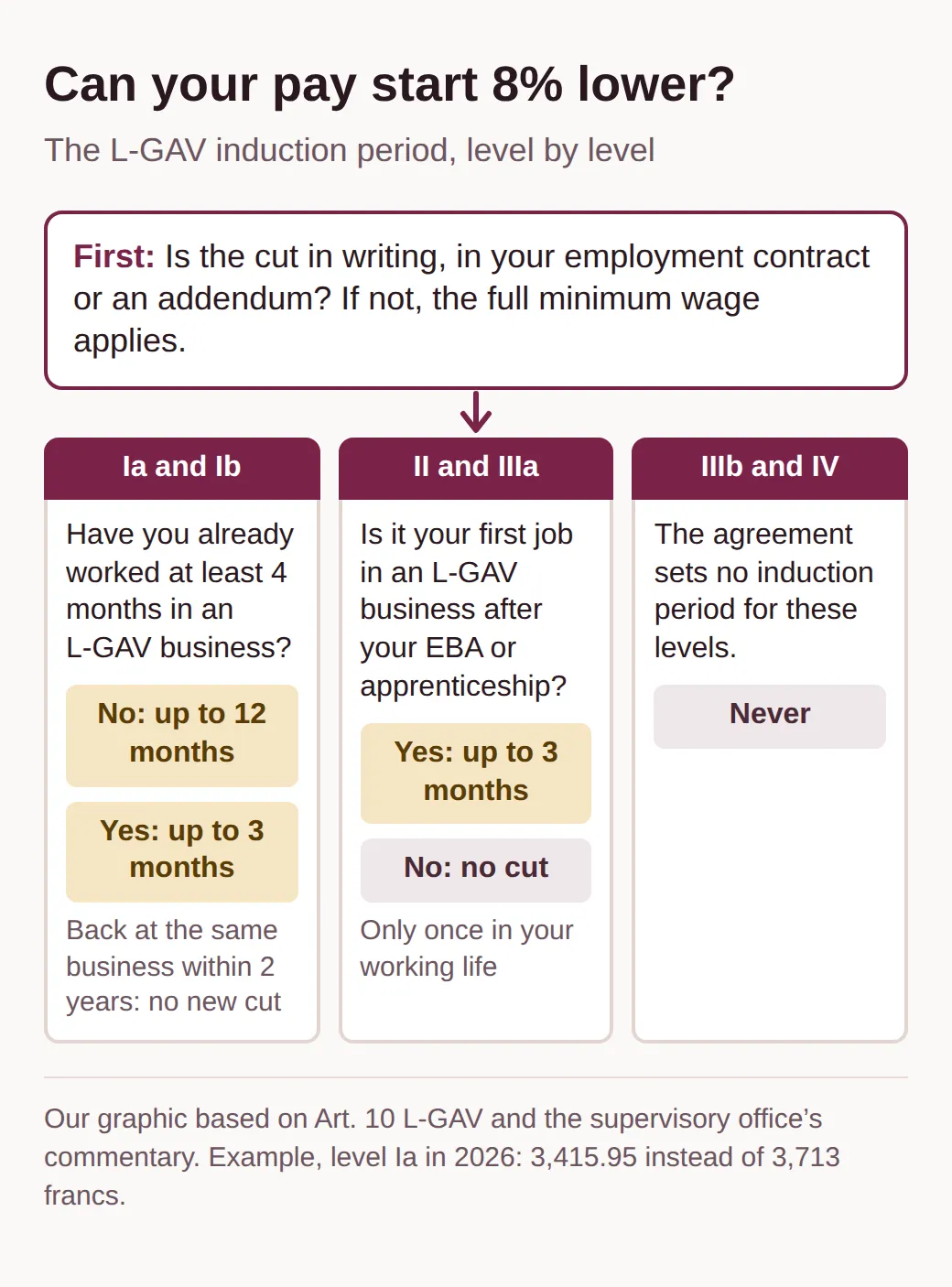
The twelve months only apply if you've never been employed for at least four months in an L-GAV business before. If you've already been in the industry that long, each new employer may cut your pay for three months at most. If you go back to the same employer after a break of less than two years, they may not cut your pay again once your induction period is over. If you haven't used it up there yet, it carries on over several seasons, as long as you haven't worked elsewhere in hospitality in between.
In levels II and IIIa, the cut is allowed only once in your working life: in your first job at an L-GAV business after your EBA or EFZ, and for three months at most. For levels IIIb and IV, the agreement has no induction period at all. The supervisory office states in its commentary that these rules replace every earlier way of reducing pay.
Read your contract carefully. If it sets a cut for twelve months although you've already worked at least four months in another L-GAV business, it's invalid from the fourth month on, as we read it. The induction period carries on in 2027, on slightly higher amounts.
The 2027 minimum wages are already set
From 1 January 2027, all minimum wages go up by 0.6 percent. That matches the inflation forecast by the State Secretariat for Economic Affairs (SECO) in September. The social partners published the new figures on 28 September 2026 (press release, in German), and the supervisory office has already added them to Art. 10:
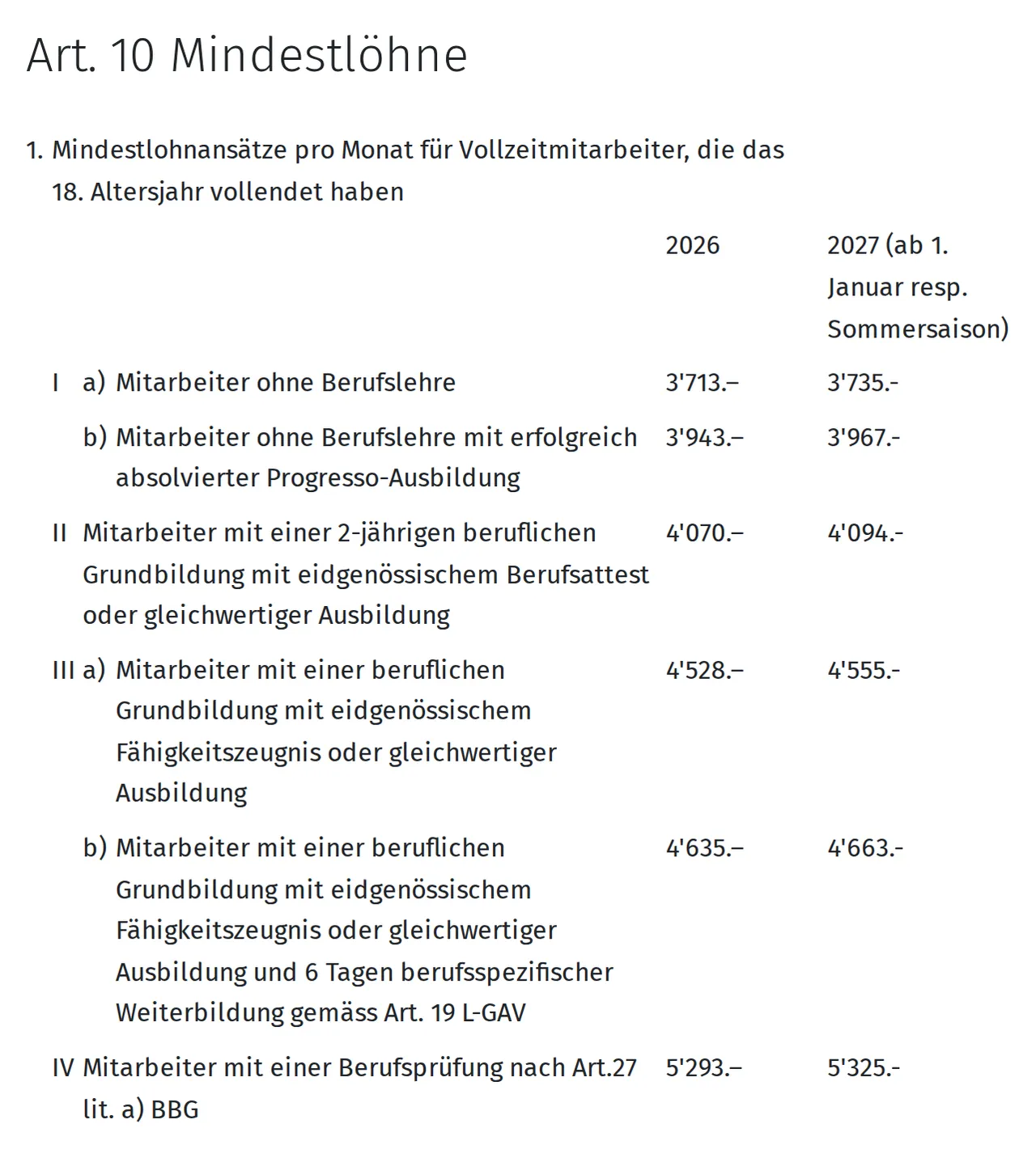
Level Ia rises to 3,735 francs, IIIa to 4,555 and IV to 5,325 francs. Using the fact sheet's method, we work that out at about 25.10 francs an hour in level Ia with all supplements. Interns from the recognised hotel management schools get at least 2,404 instead of 2,390 francs from 2027. For businesses outside the associations, the new figures become binding once the Federal Council declares them generally binding. For the 2026 wages, that was 1 May.
There's an exception for seasonal contracts in a seasonal business. If your winter season starts by 31 December, the business may still agree the 2026 rates until the season ends. The new wages then apply from the summer season, which starts on 1 May 2027. If you're on a year-round contract in a seasonal business, you get the new rates from 1 January. For more on planning a seasonal job, see our post on the winter season.
Bigger changes will come in 2028 at the earliest. Since autumn 2025, the social partners have been negotiating a new L-GAV to replace the 2017 agreement. According to their announcement of May 2025 (in German), the aim is a renewed agreement from 2028. In two cantons, different figures already apply.
Geneva, Neuchâtel and the new federal rule
In Geneva and Neuchâtel, the cantonal minimum wage applies where it's higher than the L-GAV. The footnotes to Art. 10 in the Federal Council's decision say so expressly. In 2026, Geneva requires at least 24.59 francs an hour (in French), with the supplements for holidays and public holidays added on top for hourly pay. If you get a 13th-month pay, the canton says the basic wage must be at least 22.70 francs an hour. That's well above the 20.40 francs basic wage of level Ia. From 2027, Geneva's minimum wage rises to 24.73 francs.
In 2026, Neuchâtel requires 21.35 francs an hour (in French), with the share of the 13th-month pay included. By our calculation, level Ia at 42 hours comes to just over 22 francs, slightly above that. But during an induction period with the 8 percent cut, or on the longer week of seasonal and small businesses, level Ia falls below the Neuchâtel amount, and then the canton's figure applies.
That could change. On 19 June 2026, Parliament amended the federal act on declaring collective agreements generally binding (BBl 2026 1770, in German). Under the amendment, the minimum wages in a generally binding collective agreement take precedence over cantonal law. In cantons like Geneva, though, the cantonal minimum wage stays frozen at the level in force when the change takes effect, until the agreement's wage overtakes it. For staff in Geneva, that would mean the wage floor stops rising every year until the L-GAV catches up.
The referendum deadline was 8 October 2026. Unions and parties say they handed in over 100,000 signatures to the Federal Chancellery on 7 October (Swiss Federation of Trade Unions, in German); 50,000 are needed. If the referendum qualifies, voters will have the final say. Until the change takes effect, the higher amount applies in Geneva and Neuchâtel. Everywhere else, there's an office in Basel whose job is checking that your pay is right.
What the supervisory office checks
The L-GAV supervisory office in Basel inspects around 2,200 businesses a year in spot checks and also follows up complaints from staff. The focus is on working hours and minimum wages. Its inspectors may enter businesses, look at records and question staff (Art. 35 L-GAV).
According to its 2025 annual report (in German), it inspected 2,217 businesses in spot checks in 2025. 1,384 passed without findings, 833 had at least one. In 275 businesses the minimum wage was wrong, compared with 289 the year before. One caveat: only 1,000 of the businesses were picked at random, and another 1,200 were chosen because of earlier breaches. So the rate of about 12 percent doesn't hold for the whole industry.
| Inspections 2025 | Number |
|---|---|
| Businesses in spot checks | 2,217 |
| of which minimum wage incorrect | 275 |
| Inspections following complaints | 601 |
| Contractual penalties | 304 |
If the supervisory office finds unpaid wages, the employer has 30 days to pay them and report back. If it reports nothing, the office tells the staff concerned how much they're each owed. A business that breaches the agreement repeatedly or deliberately pays a contractual penalty of 600 to 20,000 francs. For false statements about back pay, the penalty can go up to twice the unpaid wages.
Most important for you: the supervisory office gives free advice by phone on 061 227 95 55, Monday to Friday from 8.30 to 11.30 am and 1.30 to 5 pm (contact). In 2025, it answered over 15,000 queries about the L-GAV. Of the 583 complaints, 193 came from individuals and the rest from unions and cantons. Before it gets that far, though, you can sort out a lot yourself.
How to claim unpaid wages
Start with your payslip. Check your level, your gross wage and, if you're paid by the hour, the three supplements. If you're in an induction period, check that it's agreed in writing and how much longer it may run. Then ask in writing, calmly and with figures:
Hi, according to my contract I'm in level IIIa. My payslip for September shows 23.50 francs an hour, but the L-GAV minimum wage for 2026 is 24.88 francs plus supplements. Could you please look into this and pay me the difference? Thanks!
Getting you to waive the money doesn't help the business. While you work there and for one month afterwards, you can't waive claims under a mandatory collective agreement (Art. 341 CO). An agreement below the minimum wage is void and replaced by the L-GAV (Art. 357 CO). You have five years to claim unpaid wages (Art. 128 CO).
If you get no reply, call the supervisory office or lodge a complaint with it. The unions Hotel & Gastro Union, Unia and Syna, which negotiate the L-GAV alongside the employers, also advise their members. If it goes to court, there are no court costs in employment disputes worth up to 30,000 francs (Art. 114 CPC). Lawyers' fees aren't covered by this.
Check the numbers before you sign
The easiest pay dispute is the one you never have, because you settle it before your first day. At the interview, ask which level the business is putting you in, whether it plans an induction period and how it pays the 13th-month pay. Multiply the offer by 13 and compare it with the table above. If it's higher, that's a good sign. If it's lower, you now know where to ask.
If you're paid by the hour, put the hourly wage chart next to the offer. And if you work front of house, remember that tips never count towards the minimum wage: how that works is explained in our post on who tips belong to. You'll find open positions by region, for example in Zurich, Bern or the canton of Graubünden.
Common questions
- Does the L-GAV minimum wage apply to apprentices?
- No. Apprentices are expressly excluded from the L-GAV, and the hospitality industry has a separate apprenticeship agreement for them. Once you've finished your apprenticeship and stay on at the business, level IIIa applies to you with an EFZ, or level II with an EBA.
- How much do hospitality interns earn in Switzerland?
- Under the L-GAV, at least 2,390 francs gross a month in 2026 and 2,404 francs from 2027. This only applies to students of the hotel management schools and universities of applied sciences in Switzerland and abroad listed exhaustively in the commentary on Art. 11 L-GAV. Other interns are placed in the normal levels according to their training, and payments to the school may not be deducted from their pay.
- Can my employer deduct room and board from the minimum wage?
- Yes. The L-GAV expressly allows deductions for rent and meals. The minimum wage is a gross wage, so the deductions come afterwards, just like AHV and insurance. Without a written agreement, Art. 29 L-GAV applies the tax authorities' minimum rates, and only for the meals and accommodation you actually use. In a shared room, the deduction has to be lower.
- Is there a minimum wage for under-18s in Swiss hospitality?
- The rates in Art. 10 only apply from your 18th birthday. If you're younger and not doing an apprenticeship, the L-GAV sets no fixed minimum wage for you. As we read it, the agreement's rules on holidays, public holidays and 13th-month pay still cover all staff; if in doubt, the supervisory office can advise you.
- What is the L-GAV deduction on my payslip?
- It's the enforcement cost contribution of 99 francs a year, which your employer deducts from your pay. If you work less than half the normal hours or are employed for less than six months, you pay 49.50 francs. Ask for the receipt, so you don't pay twice if you move to another employer in the same year.
More posts
All posts
Swiss Winter Season Jobs 2026/27: Contract, Room, Off-Season
Winter season job in Switzerland: what the contract must say, what a staff room may cost, when unemployment pays in the off-season, what EU citizens need.

Trial Day in Swiss Hospitality: Pay, Insurance and Length
Trial day or trial shift at a Swiss restaurant or hotel? You're owed L-GAV pay and the business's accident insurance covers you. What to agree first.

Notice Period in Swiss Hospitality 2026: The L-GAV Rules
Notice periods under the L-GAV: 3 days during probation, then 1 month, 2 months from year 6, always to month end. With a sample letter and protected periods.