Tips in Swiss Hospitality 2026: Who Do They Belong To?

The short answer
In Switzerland, tips belong to the staff, not the business. Service has been included in the price since 1974, so every franc on top is a gift from the guest to you and your team. Your boss may decide how you share it. They may not keep it or offset it against your pay, and that holds for card tips too.
In practice, it doesn't always work that way. Guests in Switzerland tip around a billion francs a year, according to a ZHAW study commissioned by Bank Cler (in German). Almost half of the hospitality staff surveyed said they had seen tips paid out only in part or not at all. We show you which rules you can point to, and we answer the question many people only ask when it's too late: do tips count for AHV, tax and your pension?
Why tips belong to the staff
Because a tip is a gift, not pay. There is no law on tips as such, and the Code of Obligations doesn't even mention them. The answer comes from the industry's history. Until the 1970s, guests paid for service separately, as a surcharge on the price. That service charge really was pay. Since “service included” became the rule, anything a guest gives on top is voluntary.
The Federal Supreme Court said so in a 2019 tax case: since service has been included, a tip is “a voluntary payment by the guest and is therefore closer in nature to a gift”. Counting it as part of the pay system would be “inadmissible under employment law” (ruling 2C_703/2017, consideration 3.2.3, in German; quotes from German sources here are our translations). So the guest is making a gift to the staff, not to the owner.
At first glance, one article of the law seems to say otherwise: Art. 321b of the Code of Obligations. It says you must hand over to your employer everything, money included, that you receive from third parties in the course of your work; the official German text adds “for the employer”. But a tip is precisely not meant for the employer, because the guest has already paid for service with the price. That is how we read the law, and VAT draws the same line. In 2018, answering postulate 18.3790, the Federal Council wrote that VAT is due on tips that go to the employer, but not on tips that go straight to the staff. If the boss keeps the tips, for VAT purposes they count as the business's turnover.
What this means day to day is set out in the industry's collective agreement.
What the L-GAV says about tips
The National Collective Employment Agreement for the hospitality industry, known as the L-GAV, needs just one sentence: “Including voluntary payments by customers (e.g. tips) in the pay system is not permitted.” That is Art. 9 item 3 (in German). The Federal Council has declared the agreement generally binding, most recently extending it in February 2026 until 2027. With a few exceptions, it therefore applies to every business that accommodates guests or sells food and drink for consumption on the premises, including part-time and casual staff (Art. 1), whether or not the business belongs to an employers' association.
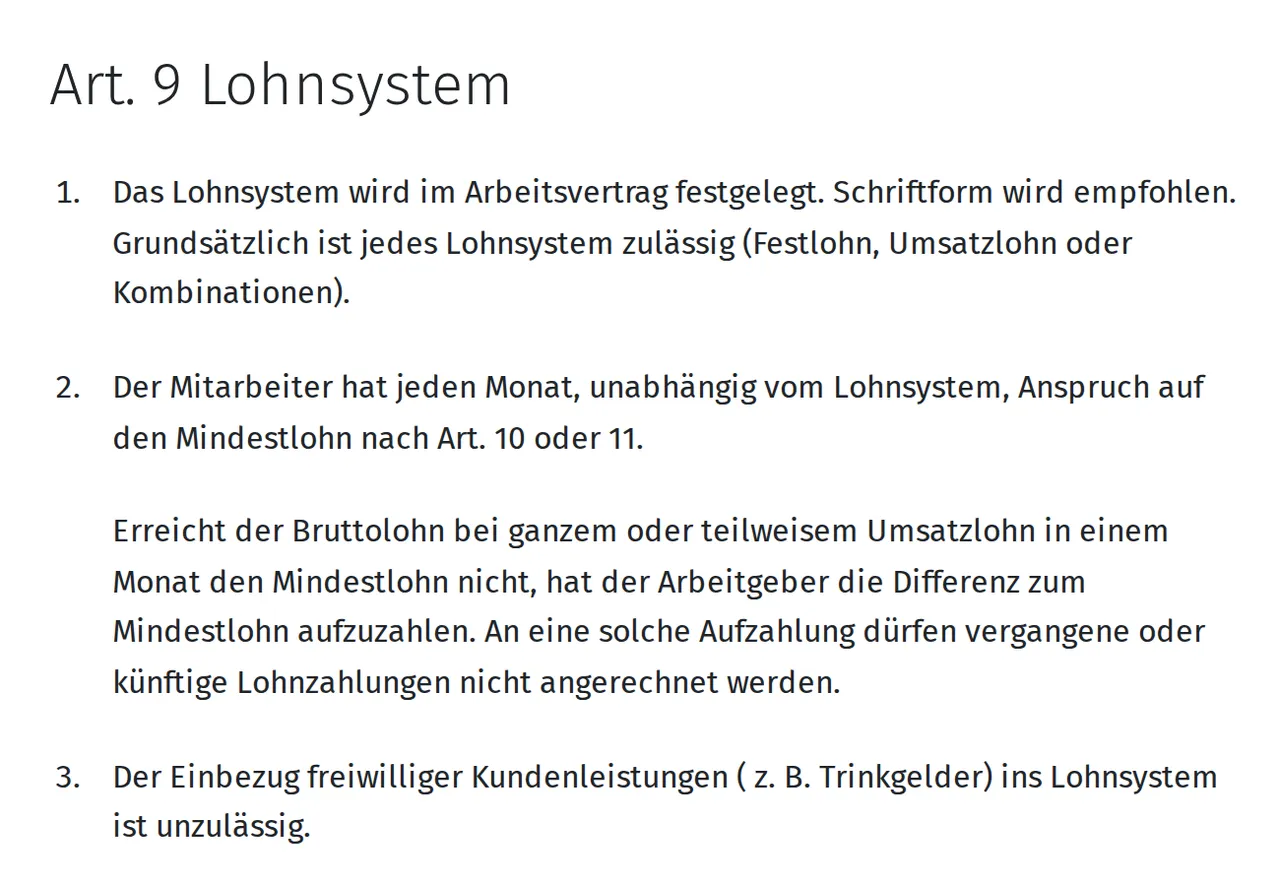
In concrete terms, your pay has to add up without tips. Your employer can't argue that tips get you to the minimum wage. They can't pay you a lower fixed salary because your station brings in a lot of tips, and they can't fold tips into turnover-based pay. On its questions and answers page, the L-GAV supervisory office answers the question “Can tips be counted as part of pay?” with one word: “No”.
The rule is old. Back in 2007, the Federal Supreme Court quoted the same sentence from the 1998 version, in a case that shows the flip side. More on that further down. First, the question that causes the most arguments at work.
Can your boss pool and split the tips?
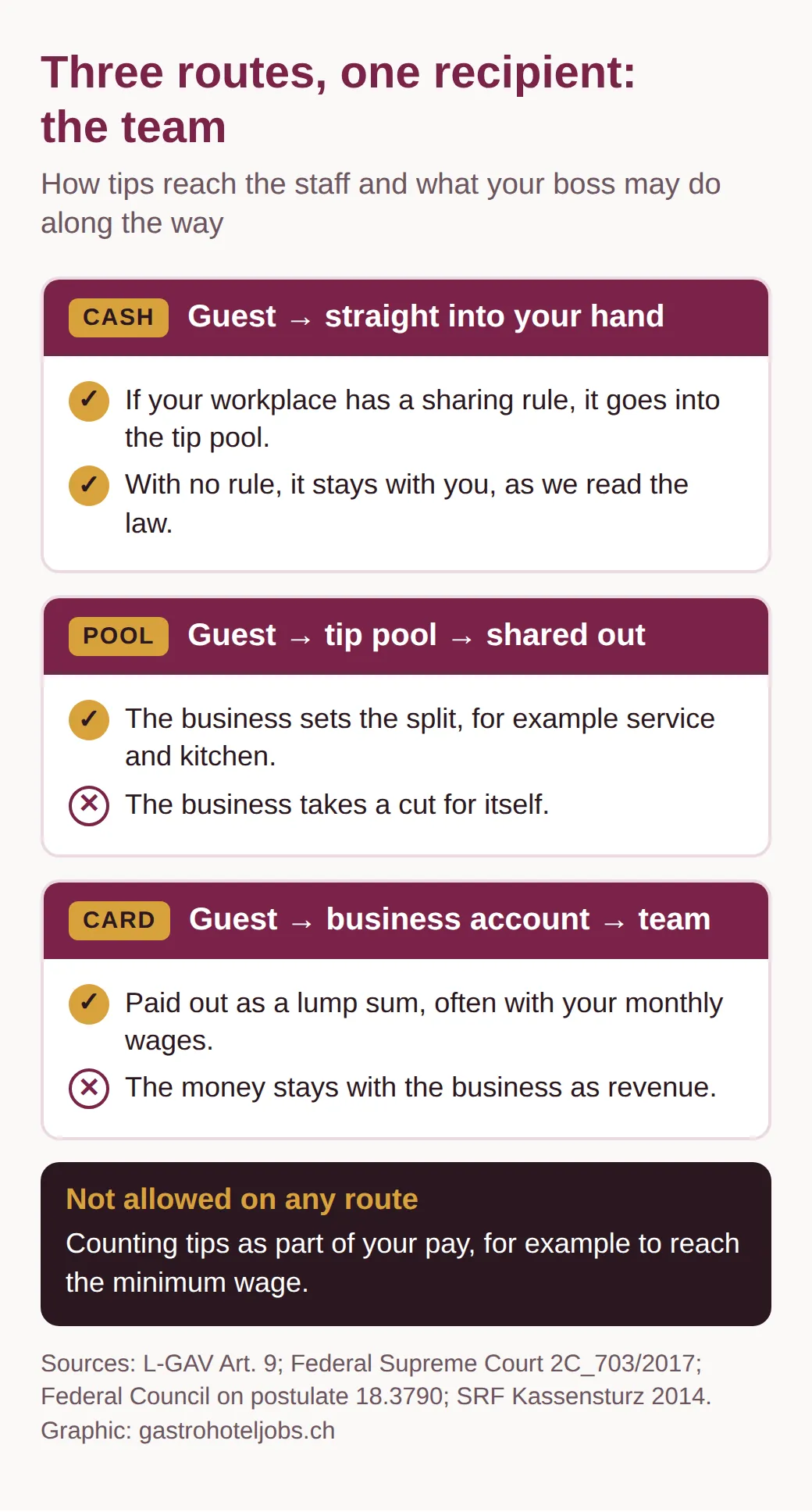
Yes. A business may decide that tips go into a shared pool and are split by a set formula, for example between service and kitchen. As we read it, the basis is the employer's right to issue general directives on how work is done in the business (Art. 321d CO). SRF's consumer programme Kassensturz reported that the Federal Supreme Court upheld a rule under which tips benefit all employees (2014 report, in German). The report gives no case number. According to SRF, staff have to be involved in setting the rule. And the limit stays the same: the money has to reach the staff.
Where such a rule applies, cash a guest presses into your hand also goes into the pool. Pocketing it anyway breaches your duty of loyalty, SRF says, and you risk a warning or dismissal. Where there's no rule, there's no one you'd have to hand it to. The gift then stays with the person the guest gave it to. That is our reading of the Federal Supreme Court's view that a tip is a gift; we know of no ruling on this exact question.
Nearly every business splits its tips. In the ZHAW survey, staff said that in 95 percent of businesses the kitchen or other areas also get a share. More than half of businesses split by fixed percentages, and on average 75 percent or more stays with service.
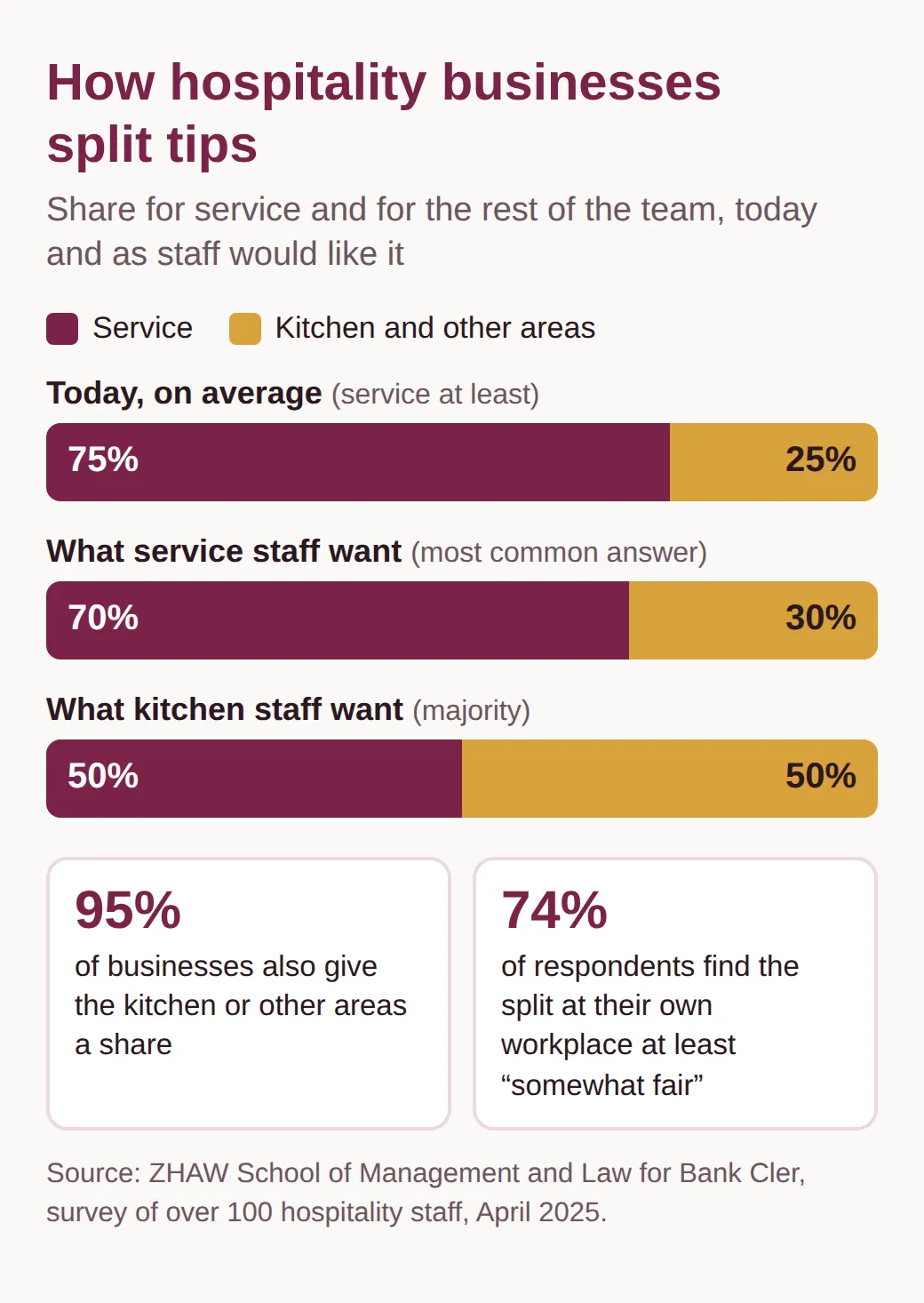
Service and kitchen don't agree on the right split. Most kitchen staff think a 50-50 split is fair, while 70-30 is the most popular answer among service staff. That means service would actually give up a little more than it does on average today. Guests are divided too: 90 percent want their tip to reward the person who served them, but only 40 percent want that person to get all of it. According to the survey, hardly anyone wants the business or its owner to take a share.
In the end, the business decides which split applies. What matters is that you know it. The ZHAW recommends putting the rule in writing, in the employment contract or the staff regulations. What the business may not do with the money takes less explaining.
Can your employer keep tips?
No, not even part of them. Your employer may manage the tip pool, but may keep nothing. That covers every way tips quietly turn into the business's money: paying wages, topping up the minimum wage, skimming off a “house share” or plugging a gap in the till. On till shortfalls, SRF Kassensturz answered this explicitly (in German): the boss may not cover a shortfall from the tip pool, because that money belongs to the employees. According to the same report, you're only liable for a shortfall if you were negligent, and then personally, not the whole team through its tip pool.
How the business runs the pool is up to the business. You can expect it to do so transparently. That matters most with tips that never cross the counter as cash.
Card tips: who owns the money in the business account?
The staff, just like cash. Technically, a card tip lands in the business's account first, together with the amount of the bill. Legally, that changes nothing: the guest meant to give the staff a gift, so the business has to pass the money on. According to the ZHAW survey, tips are usually paid out monthly, with wages.
For you, cards have an advantage. In 2018 the Federal Council noted that tips paid electronically can be “allocated more precisely, documented more easily and quantified better”. So you're entitled to ask how much came in as card tips in a given month and how it was shared out. Your employer has to give you a written salary statement anyway (Art. 323b CO). If tips are paid through it, make sure they appear on a line of their own and don't disappear into your salary.
Whether the business may deduct a share of the card fee from the tips is covered by neither the law nor the L-GAV, and we found no ruling on it. If your workplace deducts something, it belongs in the written rule so you can check the numbers. Once tips are visible on your payslip, though, a new question comes up: are they pay?
Are tips subject to AHV and tax?
Usually not, but not always. The AHV Act (old-age and survivors' insurance) only counts tips as salary “insofar as they form a substantial part of the remuneration for work” (Art. 5 para. 2 AHVG, not available in English). For hospitality, the Federal Social Insurance Office's directives on relevant salary (in German, marginal no. 2044 ff.) narrow it further: because the industry has officially abolished tipping, the AHV compensation office may assume tips only arise to an insignificant extent. “This is subject to obvious exceptions.” For businesses that aren't members of the industry association, the compensation office estimates tips case by case.
The law doesn't say what “substantial” means. In 2024, the Bern cantonal government wrote in an answer to the Grand Council (in German) that in hospitality practice, amounts from ten percent of salary upwards are treated as substantial, relying on information from the federal office as reported in a trade journal. On a monthly salary of 4,500 francs, that would be 450 francs in tips a month. In November 2024, answering motion 24.4202, the Federal Council described the practice like this: contributions are levied on tips only in exceptional cases, namely when the tips are recorded in the employer's accounts and obviously make up a substantial part of the salary. According to the Federal Supreme Court, tips also have to be verifiable to count as salary.
For tax, the starting point is stricter. The Federal Act on Direct Federal Taxation (DBG, not available in English) expressly lists tips as taxable income. In everyday practice, though, tax follows AHV, the Federal Council says. The guidance on the salary certificate (in German) only asks for tips under box 7 if they make up a substantial part of the salary. What happens after that on your tax return depends on the canton:
| Where | What applies |
|---|---|
| AHV, IV, EO | Counts as salary only if tips are a substantial part of it |
| Salary certificate | Declare only if substantial (box 7) |
| Canton of Bern | Taxes what is on the salary certificate or declared, no flat amount |
| Canton of Solothurn | Taxable “regardless of the amount” |
| Tax at source | Tips usually valued at the AHV rates |
According to the Federal Council (2018), cantonal tax offices often add a moderate flat amount typical for the industry when tips aren't documented. Bern expressly doesn't. Solothurn's position is in the canton's tax manual (in German), in the June 2026 version. If you're taxed at source, for example on a B permit, it helps to know Art. 84 para. 3 DBG (in German): there, tips are usually valued at the AHV rates, and under Art. 88 DBG your employer has to collect the tax on them from you. That sounds like a reason to keep tips as invisible as possible. A case at the Federal Supreme Court shows why that can be a mistake.
What you lose when tips are off the books
A server worked in the same restaurant from 1986. In April 2000 she fell ill and was then fully unable to work; the disability insurance (IV) granted her a full disability pension. She was in dispute with her employer's pension fund over how much she would have earned had she not fallen ill. She argued that on top of her contractual salary, she had received at least 1,100 francs a month in tips on average; in her claim she spoke of up to 1,500 francs.
In January 2007, the Federal Supreme Court rejected this (ruling B 83/06, consideration 7, in German). The amounts were not documented, the court said, nor was it clear how they could be. It pointed to the AHV directives, to the ban in the L-GAV and to a principle: it is not acceptable for substantial income to go unrecorded when contributions are paid, and then be claimed against the accident insurer or the pension fund once something goes wrong.
The lesson goes beyond the pension fund. Unemployment insurance bases its benefits on your AHV salary (Art. 23 AVIG, not available in English), and so, in principle, does accident insurance. Tips that never went through payroll therefore count neither for daily allowances nor for a pension. If you get a lot of tips, having them properly put through payroll can leave you better off than cash in your apron. This is exactly where Parliament now wants to change the rules.
What was decided in 2026 and what is still open
Parliament wants to exempt voluntary tips from AHV and tax altogether. Motion 25.4578 by Council of States member Beat Rieder is titled “Voluntary tips are not part of salary”. It calls for tips in industries that have officially abolished tipping and built service into their prices to count neither as AHV salary nor as taxable income. The Council of States adopted it on 2 March 2026, the National Council on 14 September 2026 by 125 votes to 51 with 21 abstentions (Parliamentary Services news item, in German).
The Federal Council was against it. Instead, it wanted to define more precisely in the AHV ordinance what “substantial” means, and to capture only tips that obviously make up a significant part of the salary and that the employer knows about. A general exemption would encourage abuse, it wrote in February 2026. Now it has to draft a change in the law anyway. It hasn't given a date, and until then current law applies.
The motion changes nothing about who the tips belong to. It deals with contributions and tax, not ownership. If it is implemented, tips would be free of contributions and tax, but they would then also not count towards unemployment benefits, accident cover or your pension.
What to do if tips go missing
Start with a question, not an accusation. Ask for the sharing rule in writing and for the total card tips for a specific month. A short message is enough:
Hi, I'd like to understand how our tips are shared out. Could you give me the rule in writing? And how much came in as card tips in September, and how much of that went to service and to the kitchen? Thanks!
If you get no answer, or the numbers don't add up, the L-GAV supervisory office (Kontrollstelle) in Basel offers legal advice by phone. The unions that negotiate the agreement also advise their members: Hotel & Gastro Union, Unia and Syna. Keep a record of what you see: receipts showing tips, your payslips, the rule you were told verbally.
You have time, but not forever. Claims arising from employment become time-barred after five years (Art. 128 no. 3 CO). If it comes to court, there are no court costs in employment disputes worth up to 30,000 francs (Art. 114 CPC). Lawyers' fees are not covered by this.
Ask about tips at the job interview
The easiest dispute is the one that never starts. Before you sign, ask how the business shares tips, how often it pays them out and where they show up on your payslip. A clear, quick answer is a good sign.
The same goes for seasonal jobs in hotels, where you only meet the team on your first day. Asking about the split takes a minute of your interview.
You'll find more open positions by region, for example in Bern or the canton of Lucerne.
Common questions
- Do the tip rules also apply to hotels, bars and food delivery?
- Yes, wherever the L-GAV applies. It covers every business that accommodates guests for payment or sells food and drink to be consumed on the premises, and it treats businesses that deliver ready-made meals the same way. Part-time and casual staff are expressly included.
- Can my boss spend the tip pool on a staff dinner?
- Not on their own. According to SRF Kassensturz, the business may decide that tips benefit everyone, but the staff decide how the pooled money is used. A team dinner or outing paid from the pool is fine if the team agrees.
- What is an overtip in Switzerland?
- It is the term used in parliamentary motions and in Federal Council answers for the voluntary tip a guest gives on top of the price. It sets the tip apart from the old service charge, which was added to the bill until the 1970s and counted as pay. In Swiss hospitality today, every tip is an overtip.
- Do I have to declare cash tips on my Swiss tax return?
- Federal tax law expressly lists tips as taxable income, but cantonal practice varies. Bern taxes what is on your salary certificate or otherwise declared, while Solothurn treats tips as taxable whatever the amount. If in doubt, ask the tax office of the canton you live in.