Board and lodging deduction 2026: what employers can take
The short answer
Your employer may deduct for your room and meals whatever the two of you agreed in writing. Without a written agreement, the minimum rates of the Federal Tax Administration apply: 33 francs a day for a room and full board, which is 990 francs for a 30-day month. And only for what you actually use. If you share the room, the deduction should normally be lower.
You can find these figures on plenty of websites. What they usually leave out is the rest: why a deduction can be smaller when nothing is signed, what happens during your holidays, what your payslip has to show and why a free room can end up costing you. Two court cases from the industry show where things go wrong in practice. The L-GAV and most of the official texts we link are only published in German, French and Italian, so where no English version exists, our links go to the German one. We'll start with the figures.
How much can your employer deduct for board and lodging?
Unless you agreed otherwise in writing, exactly what the AHV, the Swiss old-age and survivors' insurance, counts as the value of board and lodging. The rates are set in Article 11 of the AHV ordinance (AHVV) and have not changed since 1 January 2007. The Federal Tax Administration uses the same amounts in its leaflet N2/2007, and these minimum rates are what the collective employment agreement for hotels and restaurants, the L-GAV, refers to.
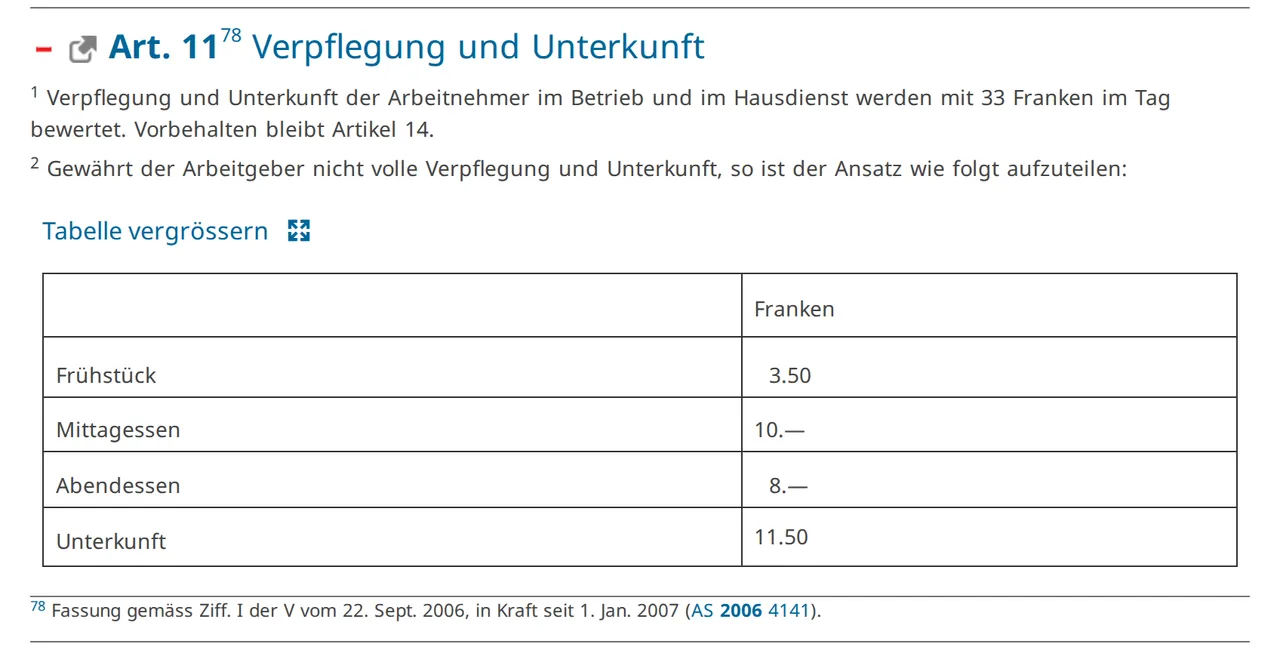
Per day, that is 3.50 francs for breakfast, 10 francs for lunch, 8 francs for dinner and 11.50 francs for the room. For full months, the AHV counts 30 days. A room on its own therefore costs you 345 francs a month, full board without a room 645 francs, and both together 990 francs.
What that means for your pay becomes clear next to the lowest minimum wage in the L-GAV. If you have no completed apprenticeship and work at level Ia, you earn at least 3,713 francs gross a month in 2026 (Art. 10 L-GAV). Full board and lodging takes a good quarter of that. We explain how the levels work in our post on L-GAV minimum wages.
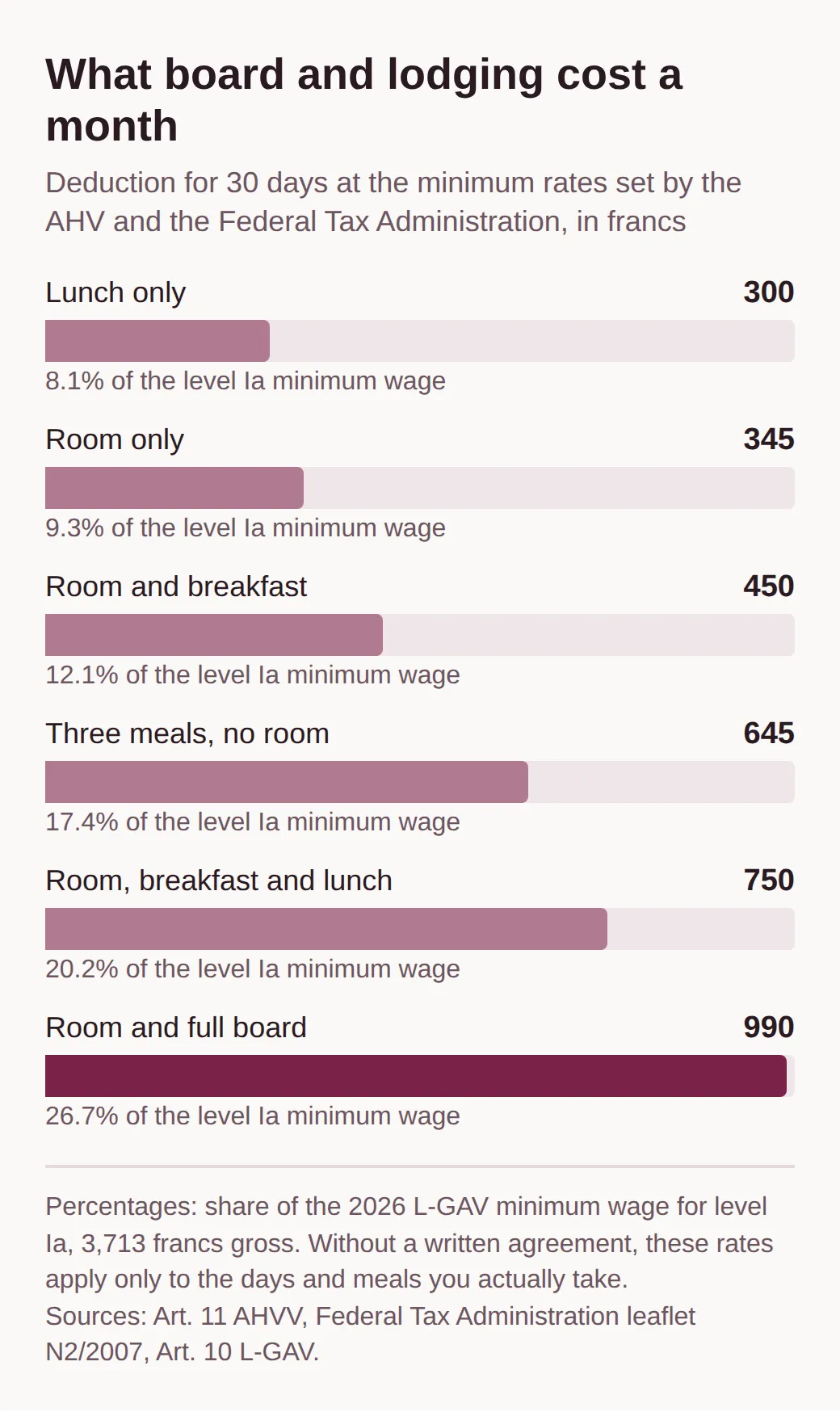
The key word is "minimum rates". It does not mean your employer may charge at most this much. It means the AHV counts at least this much as salary. How much you actually pay therefore comes down to one question: did you sign something?
Without a signature, the minimum rates apply
The L-GAV covers board and lodging in three sentences. The first reads, in our translation: "If there is no written agreement on accommodation and meals, the minimum rates of the Federal Tax Administration apply to the services actually used" (Art. 29 L-GAV). A verbal agreement doesn't count. Here the agreement expressly makes the written form a condition for validity, just as it does for a longer probation period or a fixed-term contract that can be terminated early (Art. 4 L-GAV).
With a written agreement, more is possible. On its questions and answers page, the Kontrollstelle für den L-GAV, the office that enforces the agreement, says other deductions can also be agreed. That works both ways. A hotel may give you the room for less than 11.50 francs a day. It may also charge more; the L-GAV sets no upper limit. The Kontrollstelle recommends a separate written contract for the room and meals, alongside the employment contract.
If an employer wants a lot more than 345 francs for a room, look at the principle the Federal Tax Administration applies. It values board and lodging at what you would have had to pay "elsewhere under the same conditions", in other words at market value. An attic room with a shared shower down the corridor is not worth as much as a studio in the village. So compare with the local housing market, ideally before you sign.
An agreement can also cover the days when you aren't there at all. Without one, there is a clear rule.
Holidays, sick leave, days off: when the deduction goes down
Without a written agreement, you only pay for what you actually use. On meals, the Kontrollstelle is clear: in its commentary on Art. 29 it states that, as a rule, only the meals actually eaten are charged, even where a flat-rate deduction is used. During holidays, illness and after an accident, a flat meal charge therefore has to go down too. Exceptions are only allowed with a written agreement that is clear to you as well. Without one, the Kontrollstelle says the employer may not deduct anything for meals on those days.
An example: you have a room and full board and take ten days of holiday in a month, which you spend at home. The meals for those ten days, at 21.50 francs a day, are then no longer charged, and the deduction falls from 990 to 775 francs. Neither the agreement nor the Kontrollstelle says anything explicit about the room. Whether you keep it during your holidays and keep paying for it is exactly the kind of question that belongs in the written agreement.
Flat rates as such are allowed. A 2017 case at the Social Insurance Court of Basel-Stadt shows this (AL.2017.20). A jobseeker would only sign a contract for a night auditor job at a hotel with changes, partly because of an automatic meal deduction, and the hotel withdrew the offer. The hotel's staff rules deducted 220 francs a month for one main meal and drinks from employees working 90 to 100 percent. The court found the amount in line with the L-GAV and on the low side, compared with the 300 francs a month the L-GAV commentary sets for lunch. Because the rules said nothing about holidays and illness, Art. 29 applied to those periods: the flat rate has to go down then. The job was therefore suitable, and the unemployment insurance fund was entitled to suspend his benefits for 31 days.
Only the paperwork shows whether the numbers add up. That is also where you see why a cheap room makes the payslip more complicated.
What your payslip has to show
Board and lodging go on the payslip as a separate line, after the gross salary. The L-GAV commentary strongly recommends agreeing gross wages and deducting the room and meals from them. The deduction is expressly allowed: rent and meal costs are on the exhaustive list of permitted salary deductions (Art. 13 L-GAV). You must get a clear payslip every month (Art. 14 L-GAV).
For the AHV, board and lodging is salary, even when you pay for it. It counts regular benefits in kind such as a room and meals as part of your relevant salary. If a gross wage is agreed and the employer deducts at least the official rates, contributions are simply calculated on the gross wage. If the employer deducts less, the difference from the official rates is added on and is subject to contributions. That is set out in margin number 2076 of the guidelines on relevant salary from the Federal Social Insurance Office. On your payslip, it looks like this:
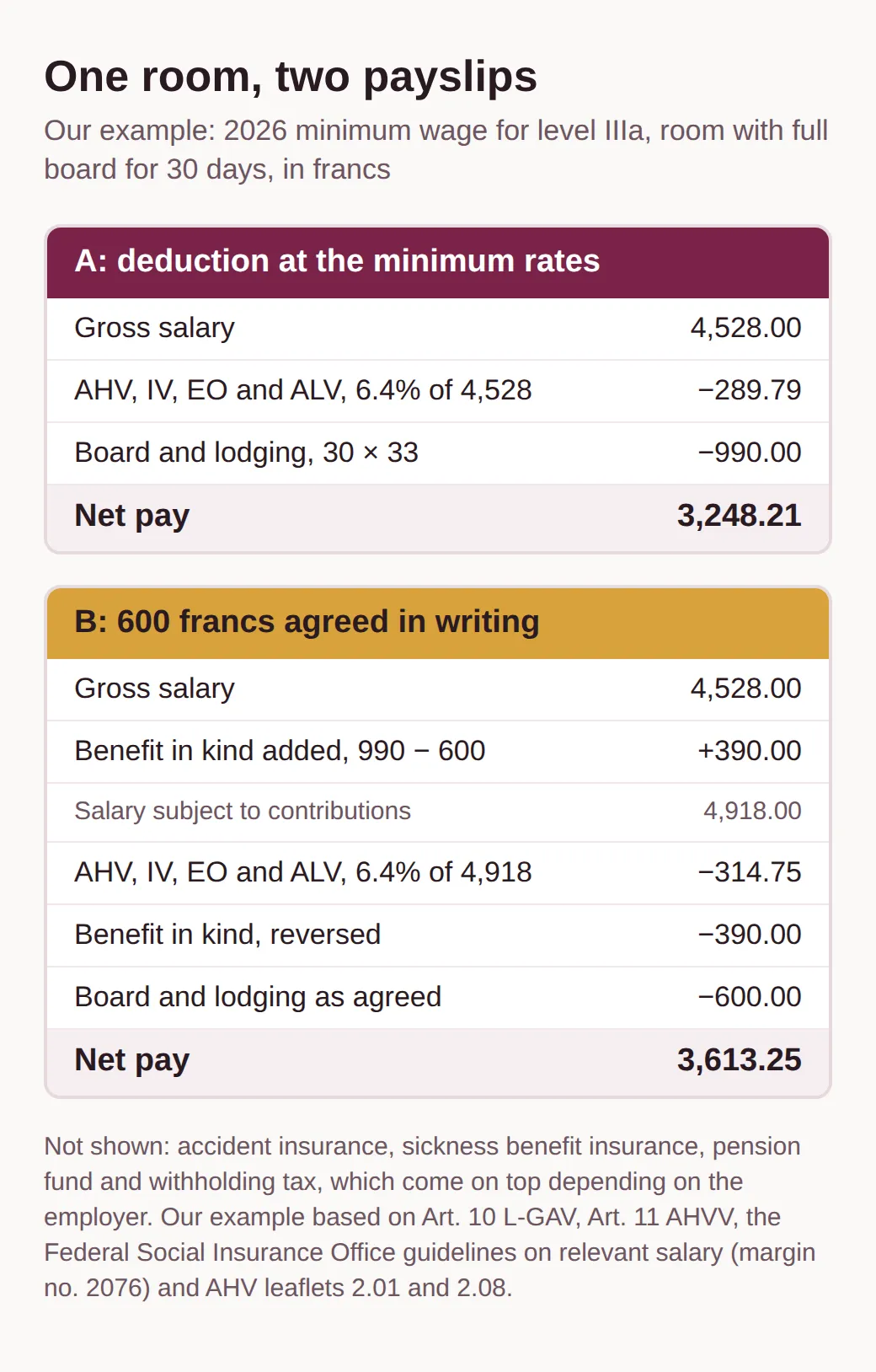
In case B you pay 390 francs less for the room and meals, but just under 25 francs more in AHV, IV, EO and ALV contributions (old-age, disability, income compensation and unemployment insurance). For the 6.4 percent, we added your share of AHV, IV and EO, 5.3 percent, to your share of unemployment insurance, 1.1 percent (AHV leaflet 2.08). That is by design. In its commentary on Art. 13, the Kontrollstelle writes that social insurance contributions are due every month on such benefits in kind. In return, the higher amount also counts towards your benefits. The L-GAV uses the AHV gross salary as the basis for social insurance benefits (Art. 8 L-GAV), and unemployment insurance works from the AHV salary (Art. 23 AVIG).
At the end of the year, the same thing shows up on your salary certificate. If your employer deducts at least the official rates, box 2.1, board and lodging, stays empty. If you get the room and meals free or cheaper, it shows the value you receive (salary certificate guidelines, margin number 20). If you can eat at a discount in the staff canteen, the employer also ticks box G. The trickiest case is the one where the payslip shows nothing at all.
Nothing deducted doesn't mean free
From October 1999 to June 2002, a cook worked as the only chef at an inn in the Prättigau/Davos district. He ate all his meals in the restaurant and lived in a two-room flat that the innkeeper had rented for him for 500 francs a month. None of his payslips showed a deduction for board and lodging. When the job ended, he claimed 24,224 francs for overtime, untaken rest days and public holidays, unused holiday and his 13th-month salary. The innkeeper filed a counterclaim: 24,957 francs for board and lodging, calculated at the tax authority's rates at the time.
The Cantonal Court of Graubünden ruled in her favour in March 2004 (judgment ZF 03 55). An empty field for deductions in the employment contract did not mean the room and meals were free, only that nothing was deducted from the salary. Because there was no written agreement, Art. 29 L-GAV applied with its minimum rates. The court set the claims off against each other, and the cook came away with nothing.
Today the Kontrollstelle sees such cases differently. Its commentary on Art. 13 L-GAV says that benefits in kind the employer did not account for as salary cannot be claimed after the fact or set off against the employee's other claims from the employment. Nobody can promise that a court will follow this in your case. A second limit is certain: your employer may only set counterclaims off against your salary to the extent that the salary can be seized (Art. 323b CO). What you need to live on stays yours, even then.
The lesson from Davos is simple. A free room has to be written into the contract as a free room, otherwise it isn't one. And the room itself deserves as much attention as its price.
The staff room: what it must be and what it may cost
The L-GAV sets no size or furnishing standard for staff rooms. What it regulates is the price. If you share the room, under Art. 29 point 2 L-GAV "correspondingly lower rates" should normally be charged. The agreement gives no figure. With two beds in a room, it stands to reason that not everyone pays the full 11.50 francs.
Here two sets of rules part ways. The Federal Tax Administration notes in a footnote to its leaflet that a room shared by several people is already allowed for in the flat rate. For the AHV and for tax, a shared room is still worth 11.50 francs a day. If your employer deducts less, as the L-GAV requires, the difference is added to the salary subject to contributions, as in case B above. On your payslip, that is correct and nothing to worry about.
It's a different matter if your employer gives you more than one room. The AHV then treats it as a flat, and the usual local rent applies instead of the flat rate. If you live under the same roof as your employer and as part of their household, say in a small family business, they must provide "adequate board and appropriate lodgings" (Art. 328a CO). The law doesn't say what appropriate means.
Because the rules settle so little, it pays to clarify the room in detail before you sign:
- a single room or shared, and with how many people
- your own bathroom, or a shower and toilet down the corridor
- a lock on the door and a lockable wardrobe
- heating, a window, internet and access to a kitchen
- who cleans, who washes the bed linen and what that costs
- whether visitors are allowed and whether a deposit is required
If anything doesn't match what you were promised, raise it early and put it in writing. That goes double at the end of the contract.
When the job ends, so does the room
The third sentence of Art. 29 is short. In our translation: "Unless otherwise agreed, the board and lodging arrangement ends when the employment ends." On your last working day you lose not just the job but the bed as well. If you want to stay on for a few days after the season, agree on it beforehand, including the price per night.
Then comes the final settlement. Under Art. 14 L-GAV, you must receive all salary owed, the payslip and your reference on the last day of employment. Check that no meals were charged on holiday and sick days. Everything else you need to know about the end of the season, from giving notice to the unemployment insurance fund, is in our post on the winter season.
What to clarify before you sign
Ask for the room and meals to be set out in writing, with a price per day or month and a rule for holidays and illness. A short addendum to the contract is enough, for example:
Accommodation: single room in the staff house, CHF 11.50 per day. Meals: breakfast CHF 3.50, lunch CHF 10.00, dinner CHF 8.00, only for meals taken. During holidays, illness and accident, only the room is charged. The room remains available at the same price until three days after the end of employment.
If a payslip doesn't add up, ask your employer first and request a breakdown of the days and meals. If that doesn't help, the Kontrollstelle für den L-GAV in Basel gives advice by phone on 061 227 95 55, Monday to Friday. The unions Hotel & Gastro Union, Unia and Syna also advise their members. How tips are handled on the same payslip is covered in our post on tipping in Switzerland.
For seasonal jobs, ask about the room in every interview, in Valais for example.
The same L-GAV applies in Ticino. There too, ask with every job whether a room is included and what it costs.
Common questions
- Do I have to live in staff accommodation and eat at work?
- No, unless you agreed to it. In 2004 the Cantonal Court of Graubünden held that, as a rule, every employee is free to rent a flat of their own and eat outside the workplace. Without a written agreement, you only pay for the meals and nights you actually take anyway.
- What applies if my employer gives me a whole flat instead of a room?
- Then the flat rate of 11.50 francs a day no longer applies. As soon as you have more than one room, the AHV treats it as a flat, and the Federal Tax Administration values it at the usual local rent. If you get it for less, the difference from the local rent counts as salary and goes on your salary certificate.
- Can I deduct staff meals on my Swiss tax return?
- Partly. If a long commute, a short break or shift work means you have to eat away from home and you can eat at work, the federal ordinance on professional expenses allows half the deduction for the direct federal tax: 7.50 francs a day, up to 1,600 francs a year. If your employer charges you less than the official rates for meals, there is no deduction. The cantons set their own rules for cantonal tax.
- Does board and lodging count towards unemployment and sickness benefits?
- Yes, because it is part of your AHV salary. The L-GAV uses the AHV gross salary as the basis for social insurance benefits, and unemployment insurance also works from the AHV salary. A salary that correctly includes board and lodging is therefore better insured than a small cash wage with a free room that is recorded nowhere.
More posts
All posts
Trial Day in Swiss Hospitality: Pay, Insurance and Length
Trial day or trial shift at a Swiss restaurant or hotel? You're owed L-GAV pay and the business's accident insurance covers you. What to agree first.

Notice Period in Swiss Hospitality 2026: The L-GAV Rules
Notice periods under the L-GAV: 3 days during probation, then 1 month, 2 months from year 6, always to month end. With a sample letter and protected periods.
Restaurant Jobs in Switzerland With No Experience: 2026
Waiting tables in Switzerland with no experience: the 2026 minimum wage, the free Progresso course, what restaurants expect and how career changers apply.