Restaurant Jobs in Switzerland With No Experience: 2026

The short answer
You don't need any training to work as a waiter or waitress in a Swiss restaurant or hotel. Without an apprenticeship, the lowest pay level of the collective agreement applies to you: in 2026 that's 3,713 francs gross a month for a full-time job, and 3,735 francs from January 2027. Once you're employed, the agreement pays for a course called Progresso, which moves you up a pay level.
But an open door doesn't mean anything goes. Your pay can be lower in the first year, some courses are only open to you with a job and others only through the regional employment centre, and competition for simple service jobs is tougher than all the ads suggest. We take it step by step: what you earn, what employers expect, which course fits when, where it leads after a few years and what an application looks like without restaurant experience. The L-GAV and most of the official texts we link are only published in German, French and Italian, so where no English version exists, our links go to the German one.
What do you earn without experience?
At least the level Ia wage, pro rata if you work part time. The hospitality industry's National Collective Labour Agreement, the L-GAV for short, covers almost every restaurant, bar and hotel in Switzerland, casual staff included. Art. 10 L-GAV sets 3,713 francs a month for “employees without an apprenticeship”, rising to 3,735 francs in 2027. These amounts apply to full-time work from the age of 18, and you also get a full 13th month's salary.
An apprenticeship in another trade doesn't automatically put you higher. The commentary on Art. 10 says the training has to relate to work in hospitality. So if you trained as a hairdresser or a logistics worker and switch to service, you start in level Ia, like everyone else without a hospitality qualification.
The catch for newcomers is called the induction period. If you've never worked at least four months for a business covered by the L-GAV, your employer may cut your minimum wage by up to 8 percent for up to twelve months. In 2027 that's about 3,436 instead of 3,735 francs. The cut is only valid if it's written into your employment contract or an addendum to it. How the rule works when you change jobs later and what applies to hourly pay is in our post on the L-GAV minimum wages.
Two groups aren't entitled to the minimum wages: students aged 18 and over who are enrolled at a Swiss school or university and studying full time, and people with reduced capacity for work on state reintegration programmes. The rates don't apply under 18 either. And whatever guests slip you doesn't count as pay: Art. 9 L-GAV bans counting tips as part of the pay system, more on that in our post on tips. So what you earn depends on paperwork. What an employer expects from you on your first evening depends on you.
What employers expect from career changers
No diploma, but availability in the evenings and at weekends, good manners and a language you can use with guests and the team. For restaurant specialists who trained through an apprenticeship, the official careers guidance portal lists a sense of hospitality, teamwork, coping with stress, a sense of hygiene, a well-groomed appearance, physical stamina and a willingness to work irregular hours or night shifts. The same applies when you're starting out. The L-GAV sets out exactly how many hours you work and how many days off you're owed, and we've summed that up in our post on working hours and days off.
Which language you need is up to the business. The industry courses do assume German, though: for Progresso, Hotel & Gastro formation recommends level B1, and for its course for jobseekers it asks for “good German”. If you hardly speak German, there's no way round a language course in German-speaking Switzerland. Once you're employed by an L-GAV business, the agreement pays for that too, more on that below.
Two rules apply to you personally from your first evening. The first is protecting young people from alcohol. Beer and wine may not be sold or served to anyone under 16, and spirits not to anyone under 18, according to the Federal Office of Public Health (FOPH). Cantons may be stricter: in Ticino, the minimum age is 18 for all alcohol. If in doubt, you ask for official ID. Anyone who breaks the rules commits an offence. At the bar and at the table, that's first of all the person serving, so you and not just your boss.
The second rule is about allergens. If a guest asks whether there are nuts or milk in the sauce, there has to be a reliable answer. As a rule, allergens must be declared in writing. Giving the information verbally is only allowed if a written notice points this out and the staff have the details in writing or a specialist can provide them, according to the Federal Food Safety and Veterinary Office (FSVO). For you, that means: look it up or ask in the kitchen, never guess. Whether you need a course to learn all this before your first application depends on your situation.
Do you need a course before your first job?
No, none is required. Which course is worth it comes down to two questions: do you already have a job, and are you registered with the regional employment centre (RAV)?
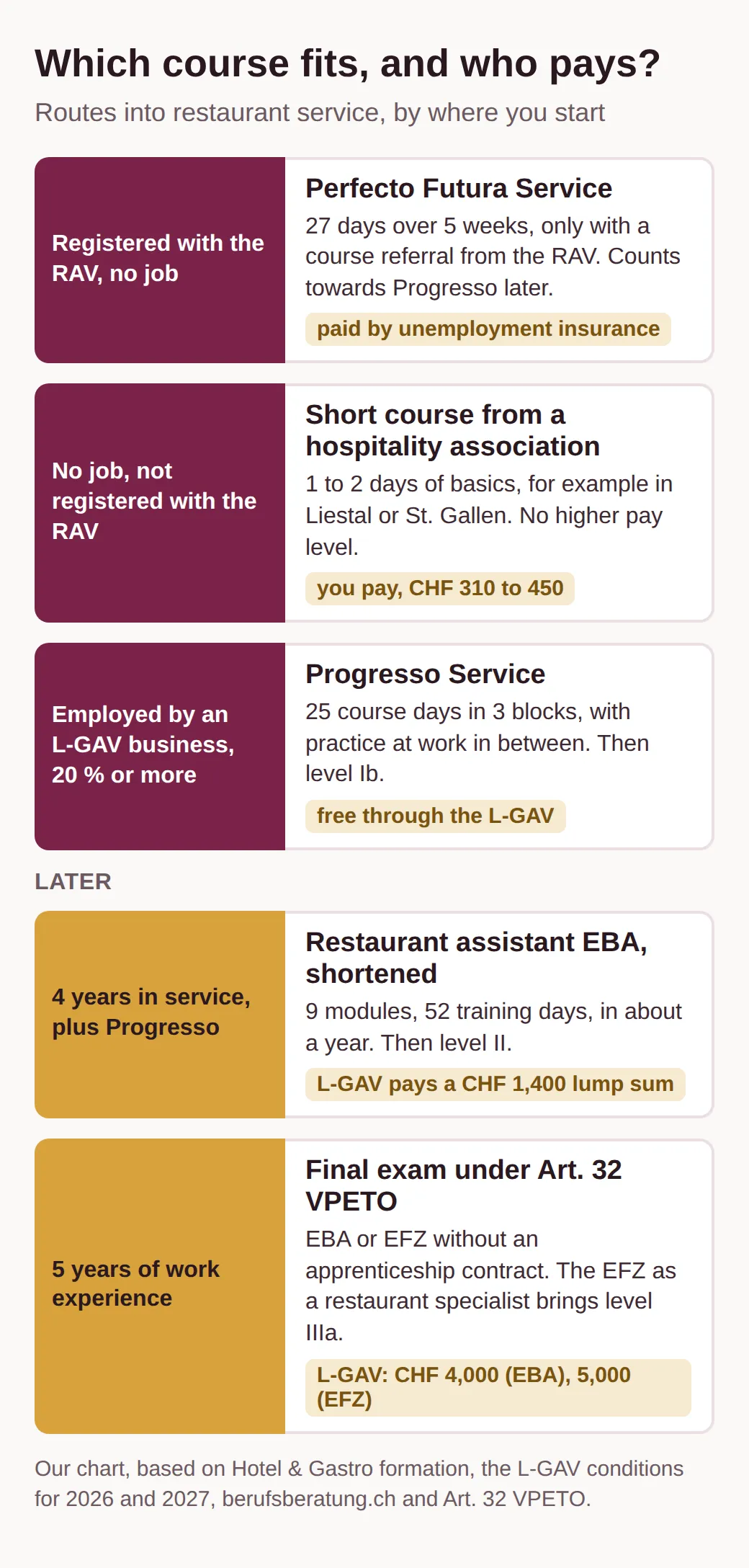
Without a job and without the RAV, you're left with the short courses run by the cantonal hospitality associations. In Liestal, Gastro Baselland offers a one-day Servicecrashkurs Quereinstieg, a crash course in service for career changers, for 310 francs for GastroSuisse members and 350 francs for everyone else. It covers the basic rules of service, banquet service, workflows, selling and looking after guests. In St. Gallen, the Servicekurs 1 für Einsteiger for beginners takes two days and costs 450 francs, and the course page lists no prerequisites. You get a certificate of attendance, but no higher pay level. Its real value shows in the interview: if you've carried three plates and laid a table before, you'll get through a trial shift more easily.
If you're registered with the RAV, there's a better route. Hotel & Gastro formation runs Perfecto Futura, a course for jobseekers without a vocational qualification, with a track in service among others. It lasts 27 days over five weeks, and you can attend at 60 percent. You need a course referral from the RAV, and the unemployment insurance fund or a cantonal office pays. The course counts towards Progresso later: according to the factsheet, if you've completed it, you only need to attend the second and third parts, three weeks instead of five. Ask your RAV adviser about it directly, because they won't always suggest it themselves.
If you have a job, things are simpler. Then the L-GAV pays.
Progresso Service: the course that moves you up a level
Progresso is the industry course for people without a vocational qualification: 25 course days, free for staff of an L-GAV business. With the certificate, you move up to level Ib, 3,943 francs a month in 2026 and 3,967 francs from 2027. That's 230 francs more than level Ia, or 232 francs from 2027, every month.
The course runs in three blocks. After the first comes an eight-week practical phase in your own workplace, where you complete tasks for the course, and then the second and third parts. Depending on the location, it's all done in four to five months. The content ranges from welcoming guests and active selling through drinks and food knowledge to service styles and technical terms. You're assessed in five parts worth 20 percent each: the two assessment interviews, the tasks from your workplace, an oral exam and two practical ones, a circuit of practical stations and one in classic table service.
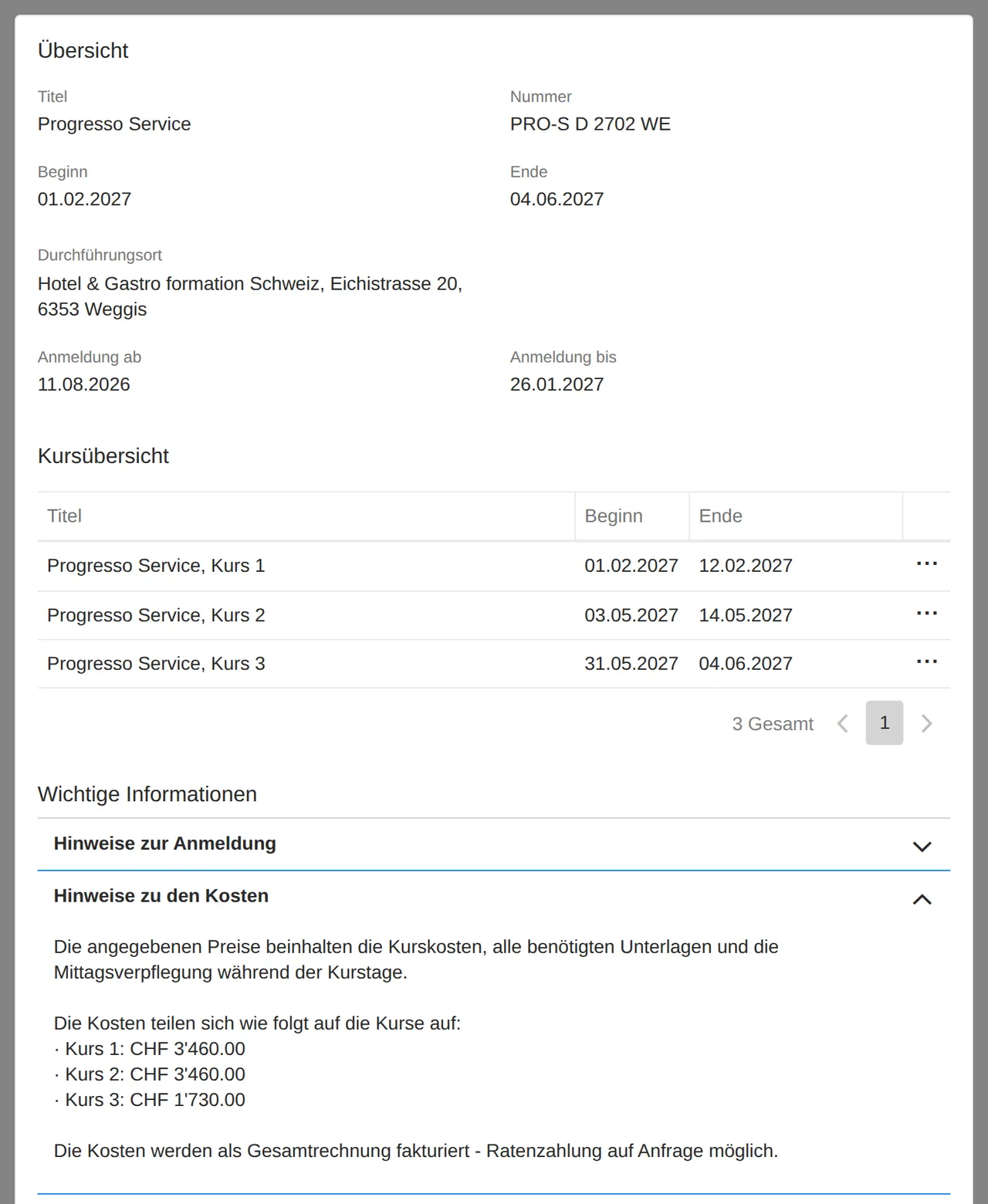
According to the course portal, the next service courses start in Bönigen on 9 November 2026, in Zurich on 11 January 2027 and in Weggis on 1 February 2027. Later in 2027, St. Gallen, Chur, Liestal and a second course in Zurich follow, among others. In French, Lausanne starts on 8 March 2027, and in Italian, Losone on 23 November 2026. Registration for Weggis is open until 26 January 2027.
It's paid for through the L-GAV, and quite generously. According to the social partners' training website, the course costs you nothing if your employer is covered by the L-GAV. Your employer also gets 120 francs per course day, up to 3,000 francs, pro rata for part-time staff. That's in the conditions for 2027. You don't have to give up holidays or days off for it. Without the L-GAV, the course is expensive: for the Weggis course, the portal lists 3,460 plus 3,460 plus 1,730 francs, 8,650 francs in total. The provider's factsheet and the social partners' page still give 5,750 francs.
There are three conditions to know before you sign up. You must be employed at 20 percent or more when you register, hourly pay included, according to the frequently asked questions. Places funded by the L-GAV are limited each year, and the funding is only secure once the supervisory office in Basel has approved your application. And the course has to match your work: the commentary on Art. 10 assigns Progresso Service to restaurant service. If you move to the kitchen later, it doesn't count there for level Ib. Only the Progresso Allrounder covers kitchen, service and housekeeping at once.
A simple calculation shows what the course is worth in francs. We assume your employer uses the full induction period and that you finish Progresso in your first six months.
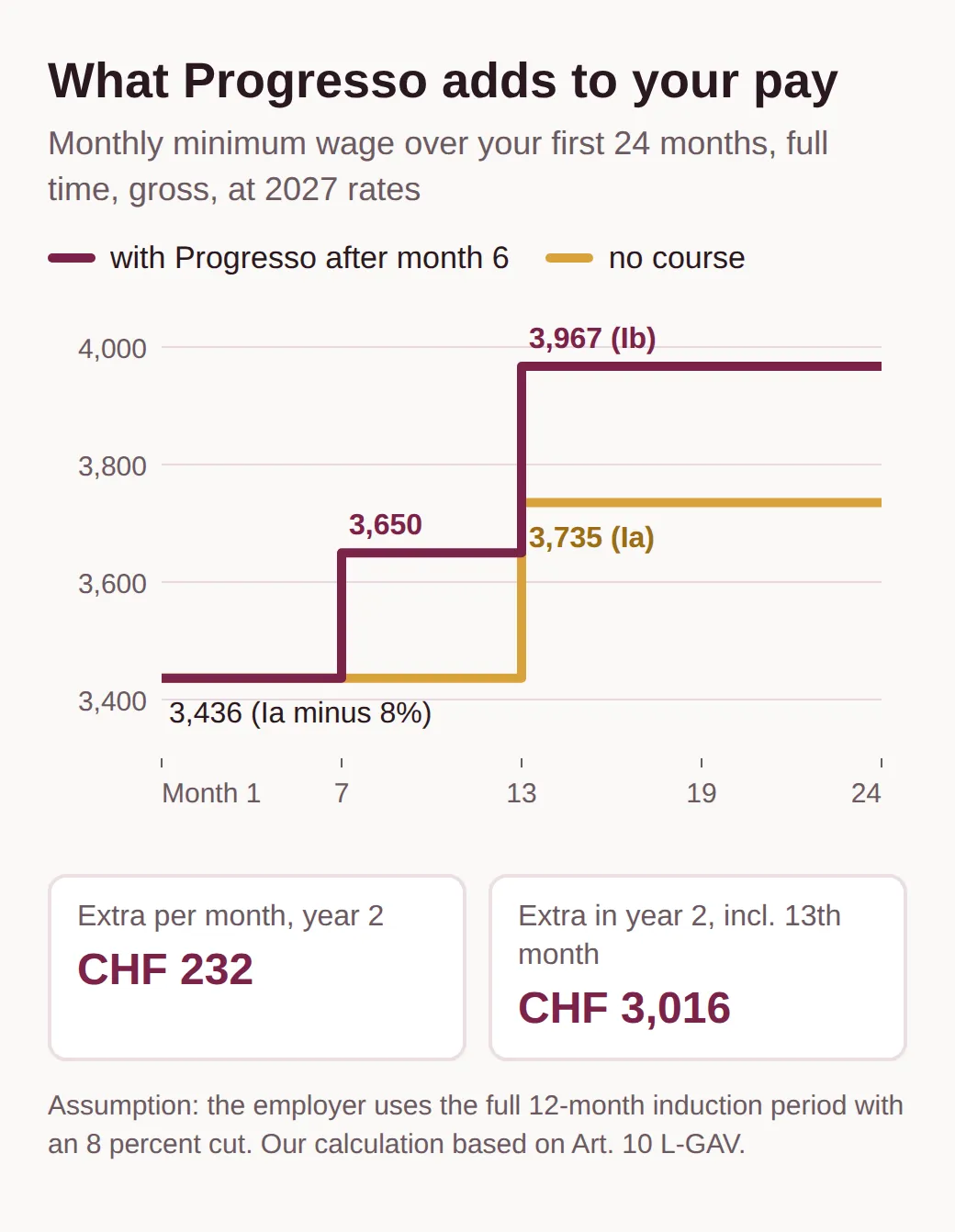
The 8 percent cut may carry on after the course, because it applies to the whole of level I, that is, to both Ia and Ib. From the second year, the difference is 232 francs a month, or 3,016 francs a year with the 13th-month pay. Progresso isn't the only course the L-GAV covers.
Other courses the L-GAV pays for
Besides Progresso, the agreement also covers a language course and shorter courses for service. The conditions for 2026 and 2027 list a course for waiters (Kurs für Kellner/Kellnerin) with ten course days and a sales course for hospitality (Verkaufskurs im Gastgewerbe) with five, with no course fees for you in either case. The conditions don't say where and when they take place. Ask Hotel & Gastro formation.
If your German is still shaky, the job-specific language course is worth a look. It's tailored to kitchen, service, housekeeping and reception, and it's offered in German, French and Italian, and since 2026 in English too for service and reception. Each of the three levels has 50 lessons, and without the L-GAV one level costs 1,370 francs. To move on to the next level, you have to have attended at least 70 percent of the lessons. Stay in service for a few years with courses like these, and a federal qualification isn't far off.
From career change to a vocational qualification
After four years in service, a shortened apprenticeship is open to you, and after five, the final exam without an apprenticeship contract. Thanks to the L-GAV, both cost you little and lead to a significantly higher pay level.
The shorter route leads to the Federal VET Certificate as a restaurant assistant EBA. For the shortened modular training, you need at least four years' experience in restaurant service, a current employment contract and a completed Progresso course. It's nine modules with 52 training days, which you can finish in about a year. According to berufsberatung.ch, your own costs are 355 francs at best. Under its conditions, the L-GAV pays a lump sum of 1,400 francs. With the certificate, level II applies, 4,070 francs a month in 2026 and 4,094 francs from 2027.
The second route is in Art. 32 of the Vocational and Professional Education and Training Ordinance (VPETO): if you gained your skills outside an apprenticeship, you're admitted to the final exam after at least five years of work experience. That works for the certificate and for the Federal VET Diploma as a restaurant specialist EFZ. According to the 2027 conditions, the L-GAV contributes a lump sum of 4,000 francs for the EBA and 5,000 francs for the EFZ. If you pass, you get another 1,000 francs, and your employer 2,000 or 2,500 francs. With the EFZ, you're in level IIIa, 4,528 francs a month in 2026 and 4,555 francs from 2027, so 815 or 820 francs more than in level Ia.
Our post on becoming a cook shows in detail how these routes work for adults, including the validation of prior learning, using the kitchen as an example. The same basic rules apply to service. Until then, though, the first job is the step that matters, and there the RAV has more say than you'd think.
Where the entry-level jobs are and who sees them first
There are plenty of vacancies, but simple service jobs are among the occupations with above-average unemployment. The list of occupations subject to the job registration requirement for 2026 shows it. For “restaurant service assistants”, the federal government counted an average of 1,985 unemployed people against 26,969 in work from October 2024 to September 2025, a rate of 7.4 percent. For chefs de service, it was 9.0 percent. The threshold for the registration requirement is 5 percent (2026 list). The list applies until the end of 2026, and the federal government recalculates it for 2027.
The registration requirement means the business has to report such a vacancy to the RAV first (Art. 21a FNIA). For five working days, only people registered with the public employment service can see it. Only after that may the business advertise it elsewhere (Art. 53b AVV). The job titles on the list include Servicehilfskraft and Chef de Rang. Whether a particular job falls under it is checked by the RAV, based on the requirements and tasks, according to arbeit.swiss; the title in the ad is only a first indication. If you're between jobs, it pays to register with the RAV early: besides any daily allowance, you'll see some entry-level jobs five working days before everyone else.
The RAV can also make it easier for an employer to choose you. If you're hard to place, unemployment insurance can pay familiarisation allowances while you learn the job (Art. 65 and 66 AVIG, the Unemployment Insurance Act). They cover the difference between the lower wage during the familiarisation period and the normal wage, but no more than 60 percent of the normal wage. They run for six months at most, up to twelve months in exceptional cases and from age 50, and decrease step by step. The employer pays them out together with your wage. Whether you qualify is something to clarify with the RAV, and it's worth mentioning to an employer who's hesitating.
How to apply without restaurant experience
Short, specific and with your availability right at the top. According to berufsberatung.ch, an application consists of a cover letter, your CV and your employment references and certificates, ideally as a single PDF file. If you're moving into a new field, the same page says, think about which skills you'll need to add for the new job.
In service, that means translating what you can already do. If you've worked at a till, you know rush hours and cash. If you've worked in care, you stay friendly when things get hectic. If you speak several languages, you can talk to tourists. Write that down in two or three sentences instead of talking about “motivation” in general. A short letter is enough:
Dear Sir or Madam, I'm applying for the 80 percent service position. I worked in retail for six years, three of them on the till at a busy grocery shop. I speak German and Portuguese and can work evenings and weekends. What I lack in service is experience, not a love of dealing with guests. I'd be glad to come in for a trial shift, and I'd like to do the Progresso course in my first year. Kind regards
An application is often followed by a trial shift. An hour in which you show how you lay a table is not the same as a whole evening in a full restaurant. Under Art. 320 para. 2 CO, an employment contract is deemed concluded as soon as the employer accepts work that, in the circumstances, could reasonably be expected only in exchange for pay. As we read it, a full shift with guests is therefore paid work. Ask beforehand whether the trial shift is paid, and note down your hours.
Before you sign, it's best to get five points clarified in writing:
- which pay level you're in and whether an induction period has been agreed, and for how long
- whether and when the business will sign you up for Progresso
- your weekly working hours and how days off are planned
- deductions for meals or staff accommodation, if you eat or live on site
- the probation period, which under the L-GAV is 14 days without a written agreement
There's more on the fourth point in our post on board and lodging. Under Art. 5 L-GAV, the probation period can be extended in writing to three months at most, and during that time the notice period is three days. After that, you know what you're getting into.
Your first year in service
Getting in only takes a few weeks: application, trial shift, contract. What counts is what you set in motion in the first months. If you take Progresso in your first six months, you're entitled to a higher minimum wage every month after that than a colleague without the course. And if you're still in service after four years, Progresso is already your ticket to the Federal VET Certificate. So bring up the course at the interview. An employer who answers with a clear date has often also thought about how it trains newcomers in general.
Many entry-level jobs are part-time or casual, which you can easily try out alongside other work. You'll find vacancies in Bern, for example, in the canton of St. Gallen or as temporary jobs in Lucerne.
Common questions
- Do students working in restaurants get the minimum wage in Switzerland?
- Not all of them. If you're over 18, enrolled at a Swiss school or university and studying full time, the L-GAV minimum wages don't apply to you. All three conditions have to be provable. As we read it, the agreement's other rules, such as those on days off and holidays, still apply.
- Do I have to take holiday for the Progresso course?
- No. The course days don't come out of your holidays or days off, and your employer gets 120 francs for each course day to make up for your absence, pro rata if you work part time. According to the factsheet, up to 20 nights near the course can also be co-funded on request, in a double room with breakfast.
- What happens to Progresso funding if I change jobs during the course?
- If you move to a business that isn't covered by the L-GAV, the L-GAV stops paying your employer's compensation from that point, and you can't apply again. If you move to another L-GAV business, a new application is possible. Check with Hotel & Gastro formation before you switch.
- Does restaurant experience from abroad count for the induction period?
- Under the L-GAV, the shorter three-month induction period only applies if you've already worked at least four months for a business covered by the agreement. As we read it, a restaurant abroad doesn't count. So even with experience abroad, an employer may pay you the lower rate for up to twelve months, as long as it's agreed in writing.
More posts
All posts
Trial Day in Swiss Hospitality: Pay, Insurance and Length
Trial day or trial shift at a Swiss restaurant or hotel? You're owed L-GAV pay and the business's accident insurance covers you. What to agree first.

Notice Period in Swiss Hospitality 2026: The L-GAV Rules
Notice periods under the L-GAV: 3 days during probation, then 1 month, 2 months from year 6, always to month end. With a sample letter and protected periods.

Board and lodging deduction 2026: what employers can take
Board and lodging in Swiss hospitality: 33 francs a day, only for what you actually use, less for a shared room. How to check the deduction, payslip and room.