Working hours in Swiss hospitality: L-GAV rules for 2026

At a glance
In Swiss hotels and restaurants, the L-GAV limits your working week to an average of 42 hours, 43.5 in a seasonal business and 45 in a small business. On top of that you get two rest days a week. Overtime is either compensated with time off or paid out, and it costs the employer a 25 percent surcharge if it doesn't record your hours properly, doesn't tell you your balance or pays late.
You'll find these figures on plenty of websites. What they leave out is the part that matters day to day: how to tell which weekly hours apply where you work, what exactly counts as a rest day, and how to check at the end of the month whether your balance is right. That's what this guide covers, step by step, with the wording of the L-GAV, the national collective employment agreement that covers almost every restaurant and hotel in Switzerland. The L-GAV is published only in German, French and Italian, and the English versions of the Employment Act and its ordinances on Fedlex are out of date, so we link the German texts. We also look at a Federal Supreme Court case that shows why a simple notebook can be worth a lot.
How many hours a week do you work?
That depends on the type of business, not on your job. The 42-hour week is the norm. It applies in every business that is neither seasonal nor small, to cooks just as much as to receptionists or dishwashers. Standby time at the workplace counts too, including the quiet hour you spend waiting for guests in an empty restaurant. Mealtimes, on the other hand, are not working time. Each meal break lasts at least half an hour. If you have to stay on call during it, it counts after all.
A small business may agree on 45 hours. According to the commentary of the L-GAV supervisory office (Kontrollstelle für den L-GAV), that is a business employing, besides the owner, no more than four full-time staff, or no more than six staff with a combined workload of at most 400 percent, part-timers and apprentices included. Up to three casual helpers a year on small contracts, earning up to CHF 2,500 a year, don't change that. So a small local restaurant with three full-time staff and a weekend helper qualifies. The annex to the agreement itself puts it more briefly: no more than four permanent employees, family members included.
A seasonal business may agree on 43.5 hours. That covers businesses open only at certain times of the year, such as a mountain hotel for the winter. A year-round business with a pronounced high season can also become a seasonal business, but only with a permit from the supervisory office. Pronounced means three to nine months a year in which turnover is on average at least 35 percent higher than in the other months. The business has to submit its monthly turnover for the past two years, and the permit is valid for two years. It doesn't renew automatically: the business has to apply again before it expires (annex to Art. 15).
What matters for you: the weekly hours that apply must be agreed with you, ideally in writing in your contract. If it says 45 hours but the business is not small and has no seasonal permit, the way we read it, the 42-hour limit still applies, because the L-GAV sets it as a maximum. The three hours above it would then be overtime every week. Ask at the interview whether the business counts as small or seasonal, and you'll know straight away how long your week will be.
The weekly figure alone doesn't tell you how much you have to work in a given month, though.
The week is an average: how to work out your target hours
The 42 hours are an average, not a limit for every single week. In a busy week you may work longer, in a quiet one shorter. What counts is your target working time over the whole period, and the supervisory office always calculates it the same way: calendar days divided by seven, times the weekly hours. In a year-round business, a 31-day October comes to 186 hours.
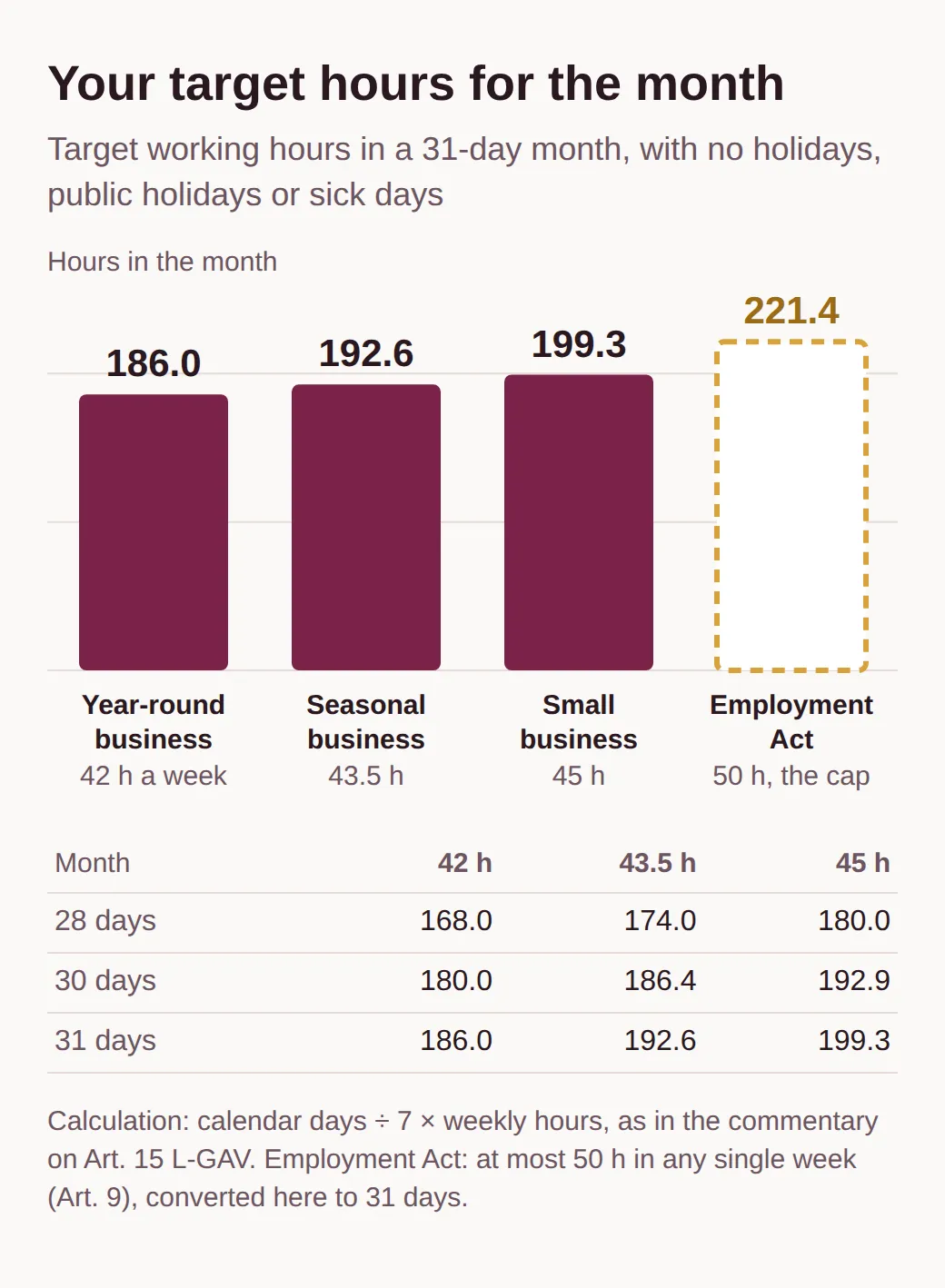
Holidays, illness, accidents and military service come off the calendar days first. A public holiday lowers the target in a 42-hour week by 8.4 hours, a fifth of the week. An example: you take a week's holiday in October. That leaves 24 days, divided by seven, times 42, which makes 144 hours. If your time records show 158 hours, you worked 14 hours of overtime that month.
Because the week is an average, it also works the other way round: you can work fewer hours first and make them up later. The commentary on Art. 15 gives the example of a seasonal worker who works only 35 hours instead of 42 for the first two weeks. The business may later offset those 14 hours against overtime. Within reason, you have to go along with swings like these, in both directions.
The Employment Act sets a hard limit. For hospitality staff, the maximum working week is 50 hours. Anything beyond that is excess hours (Überzeit). They are capped at two hours a day and 140 hours a year and cost a surcharge of at least 25 percent, unless you agree to take the same amount of time off instead (Art. 12 and 13 of the Employment Act). Before it gets that far, the problem is usually something else: your days off.
Two rest days a week, and what counts as one
You're entitled to two rest days every week, part-time too. At least one of them must be a full day, meaning 24 hours off in a row following your night's rest. If you go home at midnight and start again the next evening, you haven't had a rest day. The business may split the second one into two half days. That's what Art. 16 L-GAV says.
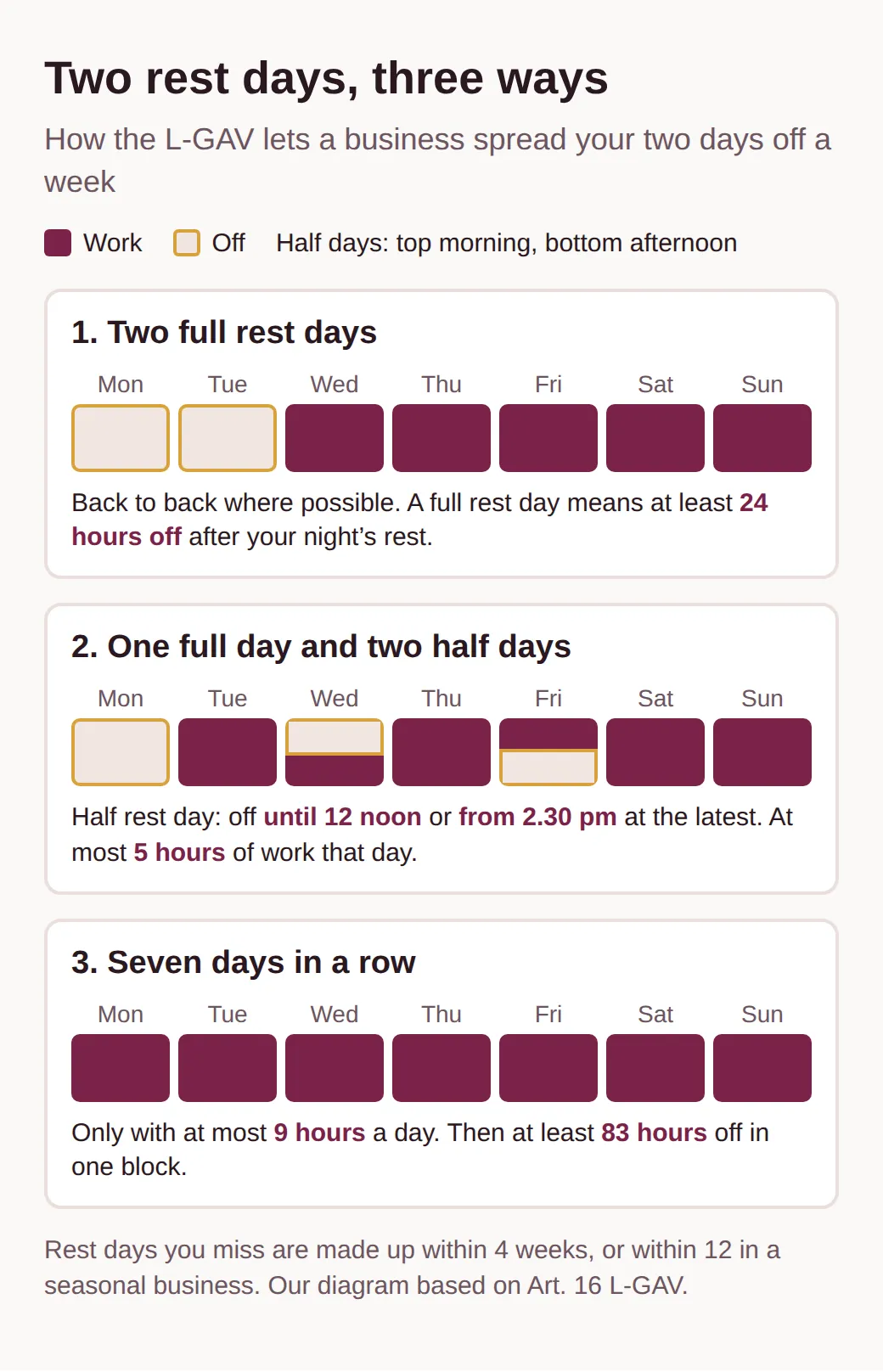
A half rest day has fixed limits. You must be off either until 12 noon or from 2.30 pm at the latest until your night's rest, and on that day you may work no more than five hours, broken only by a meal. A shift from 10 am to 3 pm is therefore not a half rest day, even though it lasts only five hours, as the supervisory office confirms. With your agreement, the business may save up half rest days over no more than four weeks and then give them in one block, or over twelve weeks in a seasonal business.
Seven days in a row are allowed in one case only: you work no more than nine hours on any of those days, and afterwards you get at least 83 hours off in a row. That's just under three and a half days. Almost the same rule appears in Ordinance 2 to the Employment Act, which has its own exceptions for hospitality businesses, such as night and Sunday work without a permit.
You need to know early when you're off. A year-round business plans rest days two weeks at a time and at least two weeks in advance, a seasonal business one week at a time and one week in advance, and it does so together with you. If a rest day is cancelled, it has to be made up within four weeks, or within twelve in a seasonal business. It can only be made up on a working day, so at most five days in any one week. A rest day is paid out only if making it up is impossible, and then at the end of your employment, at one twenty-second of the monthly wage per day. An agreement to pay out rest days regularly instead of giving them is not allowed, and the Employment Act prohibits it too (Art. 22).
Sundays are regulated too. If you work five days a week on average over the year, you're entitled to at least four Sundays off a year. If you have children up to the age of 15 or care for relatives, it's twelve (Art. 12 and 23 of Ordinance 2). Four Sundays isn't much, so the breaks within each day matter all the more.
Breaks, split shifts and rest time
Breaks are compulsory, and you can't waive them. The Employment Act requires a quarter of an hour for more than five and a half hours of work, half an hour for more than seven and a full hour for more than nine (Art. 15). If you aren't allowed to leave your workplace during a break, it counts as working time. The supervisory office states explicitly that the business has to make sure you actually take your breaks.
Between two shifts you need eleven hours of rest in a row. Once a week this may drop to eight hours, as long as the average over two weeks stays at eleven (Art. 15a). Split shifts with an afternoon break (Zimmerstunde), meaning lunch service, a few free hours in the afternoon and then dinner service, have one more rule: as long as you finish before 11 pm, your whole day including all breaks must fit within 14 hours (Art. 10). A shift from 9 am to 2 pm and from 5 pm to 10.30 pm only just fits. Work like that and you quickly rack up more hours than the rota planned.
Overtime: time off or pay, 100 or 125 percent
Overtime means every hour above your agreed weekly working time, on average. The business has to make it up within a reasonable period with the same amount of time off, or pay it. Which of the two applies should be in your contract. If it says nothing, the employer decides. How much it has to pay depends on how carefully it keeps its records.
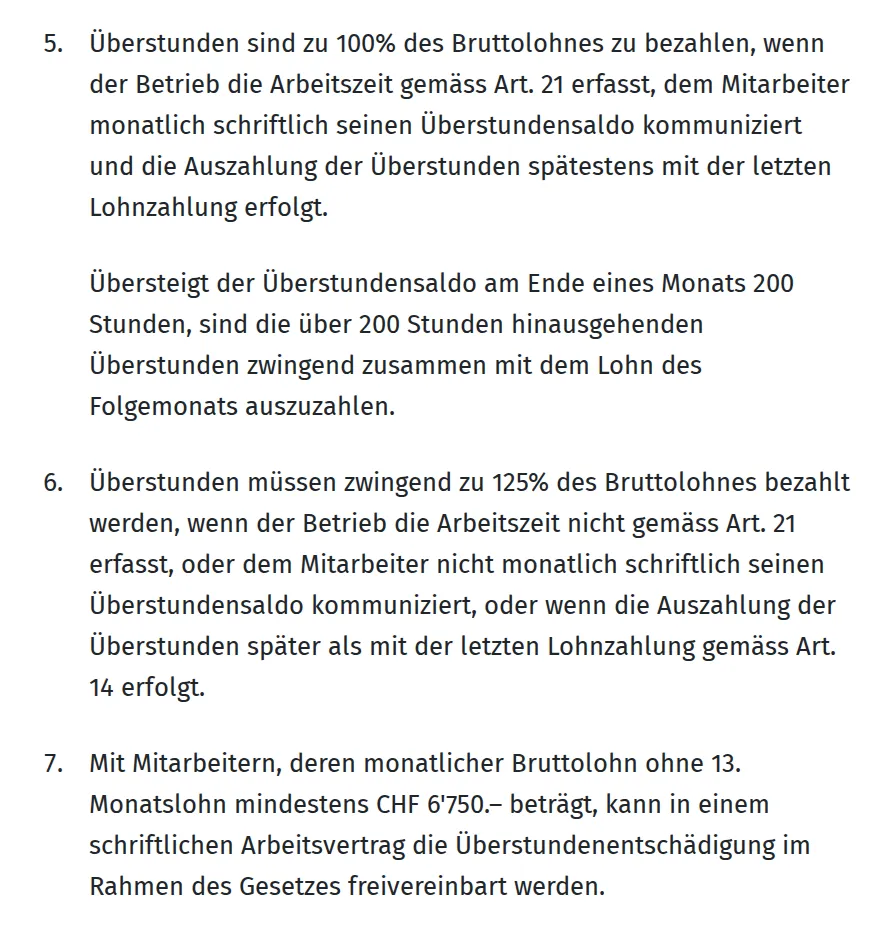
The business may pay overtime at the normal wage, so at 100 percent, only if it meets three conditions at once. It records your working time according to the L-GAV rules, it gives you your overtime balance in writing every month, and it pays out the hours with your final pay at the latest. If even one of these is missing, every hour of overtime costs 125 percent. The surcharge is above all a lever to make businesses keep proper time records.
Let's do the maths. In 2026 a cook who has completed an apprenticeship earns at least CHF 4,528 a month (Art. 10 L-GAV). For the hourly rate in a 42-hour week, the supervisory office divides by 182 hours, which gives CHF 24.88. Twenty hours of overtime are worth about CHF 498 at 100 percent and about CHF 622 at 125 percent. The minimum wages for each level are in our post on L-GAV minimum wages 2026.
The balance can't grow without limit. If it's above 200 hours at the end of a month, the business has to pay out everything over that with the next wage. Those hours can no longer be made up with time off. Below that, you and your employer are free to choose when to compensate. The business may not offset overtime against any extra rest days you took, nor against other negative balances (questions and answers on Art. 15).
There are exceptions at the top end. If you earn at least CHF 6,750 gross a month, excluding the 13th-month salary, a written contract may set the pay for overtime freely, within the law. And whatever the contract says, excess hours above 50 a week always cost at least 25 percent more, unless you agree to take time off for them instead. In the end, whether a balance is right comes down to a single document.
Time records: the employer's duty, your evidence
Recording your working time is always the employer's responsibility, even if it lets you enter the hours yourself. That is set out in Art. 21 L-GAV, based on Art. 46 of the Employment Act. Once a month you sign the record. If you kept it yourself, the employer signs. You can ask at any time for information about your working and rest times and how much holiday and how many public holidays you have left.
Art. 73 of Ordinance 1 lists what the records must contain: daily and weekly hours and when they fell, meaning when you started and finished, any excess hours, the rest days you were given and every break of half an hour or more. By law the business has to keep these records for at least five years, and under the L-GAV it must keep payslips and the documents behind them for ten.
A rota is not a time record. The rota says in advance when you're supposed to work; the record shows when you actually started and finished. The social partners explicitly advise against using one as the other. The supervisory office offers time-recording forms on its website, as an Excel file and for printing. By its own commentary, these simple forms meet the L-GAV but not every requirement of the Employment Act. The software from the associations that negotiate the agreement meets both.
Without any records, it gets expensive for the business. If an inspection finds no time records for all or some of the staff, a contractual penalty follows straight away, with a follow-up inspection within four months. Under Art. 35 L-GAV, penalties range from CHF 600 to CHF 20,000. More important for you is the last sentence of Art. 21: if the business keeps no records, your own notes count as evidence in a dispute. A ruling from Ticino shows what that means in practice.
What a diary was worth at the Federal Supreme Court
A waitress started work at a hospitality business in Ticino in June 2016, full-time on 45 hours a week for CHF 3,407 a month. In December 2017 she handed in her notice for the end of January 2018, and in May 2019 she sued, among other things, for pay for her overtime. Her evidence was her diary, in which she had written down her working hours day by day throughout her employment.
The employer countered with till reports and rotas. Neither convinced the courts. The till receipts only showed when the till was closed, not when the waitress finished work. The rotas listed days off and the shift, morning, afternoon or evening, but no hours. That was not time recording as the L-GAV means it. The Ticino judges, by contrast, found the diary credible, partly because witness statements and even the employer's own rotas indirectly confirmed the times.
The Federal Supreme Court dismissed the employer's appeal in August 2024 (ruling 4A_29/2023). It made clear that Art. 21 L-GAV does not reverse the burden of proof: whoever claims overtime still has to prove it. But, the court said, the employee's record has «valenza probatoria e non soltanto di allegazione di parte», the force of evidence and not merely of one side's claim. The court did not even consider the argument that she had claimed her overtime too late: the employer had raised it only before the Federal Supreme Court, not before the Ticino Court of Appeal.
The lesson is simple. Write down every day when you started and finished and when you took your breaks. A notebook will do, and so will a note on your phone, as long as you do it as you go and not after the fact. The Unia trade union offers a working-time calendar for hospitality to print out, in German, with columns for the start, end and breaks of each shift.
How to check your month
At the end of the month you need three figures: your target hours, your recorded hours and the rest days you took. Work out the target hours as above: calendar days minus holidays and sick days, divided by seven, times your weekly hours. Subtract that from your actual hours. Your rest-day entitlement works the same way, only times two instead of times your weekly hours: for the 24 days in the October example, that's 6.86 rest days. If you only got five, the business owes you nearly two, to be made up within the next four weeks.
Then compare your figures with your employer's statement. If you get a written balance every month and it matches your own figures, everything is in order. If the balance is missing, ask for it politely, ideally in writing:
Hi, could you please send me my overtime and rest-day balance as at the end of October in writing? By my notes I have 14 hours of overtime and two rest days still to take. Thanks!
If you get no answer or the figures don't add up, the legal service of the L-GAV supervisory office in Basel can advise you. The supervisory office inspects businesses not only at random but also following a complaint. Union members get help from Unia, Syna or Hotel & Gastro Union. You have time, but not unlimited time: claims arising from employment become time-barred after five years (Art. 128 no. 3 of the Code of Obligations). The waitress from Ticino sued more than a year after leaving and still won. Her diary made the difference.
Before you sign
The most important line in a hospitality employment contract is often not the one about pay but the one about working hours. Ask at the interview whether the business works on 42, 43.5 or 45 hours, and why. Ask how it records time, whether you get your balance in writing every month and how far ahead the rota is set. A business with clear answers to these questions usually pays overtime correctly too.
If you're doing a season at a seasonal business in the mountains, the 43.5 hours and the longer deadlines for rest days apply. What else to clarify there, from your room to your final payslip, is in our post on the winter season. You'll find open positions by region, for example in Zurich, Basel or the canton of Valais.
Common questions
- Do the L-GAV rules apply if I work part-time?
- Yes. Part-time staff are also entitled to two rest days a week, so if you are employed at 60 percent you work no more than five days. Your overtime is the hours above your agreed working time, which at 60 percent in a year-round business means, by our calculation, anything over 25.2 hours a week on average.
- Does waiting for guests in an empty restaurant count as working time?
- Yes. The L-GAV explicitly counts standby time at the workplace (Präsenzzeit) as working time, and the Employment Act counts any time you have to be at the employer's disposal. Mealtimes don't count, as long as you are really free for that half hour and don't have to stay on call.
- What happens to my overtime if I resign?
- If the business pays it out with your final pay at the latest, 100 percent is enough, provided it also recorded your time correctly and told you your balance every month. If the payment comes later, for example separately after your final pay, the business owes 125 percent, according to the supervisory office. The same applies if you are justified in leaving with immediate effect.
- Can my employer take negative hours out of my holiday?
- Not at the end of your employment. Negative hours, and any extra rest days or public holidays you took, may not then be offset against your holiday entitlement. Rest days and public holidays can be offset against each other, but that shifts your target hours.
- Do managers have to record their working hours too?
- Yes, if they fall under the L-GAV. The supervisory office states that working time must be recorded for every person, including managers earning CHF 7,000 a month. From CHF 6,750 gross a month, excluding the 13th-month salary, the contract can, however, set its own rules for overtime pay.
More posts
All posts
Notice Period in Swiss Hospitality 2026: The L-GAV Rules
Notice periods under the L-GAV: 3 days during probation, then 1 month, 2 months from year 6, always to month end. With a sample letter and protected periods.

Trial Day in Swiss Hospitality: Pay, Insurance and Length
Trial day or trial shift at a Swiss restaurant or hotel? You're owed L-GAV pay and the business's accident insurance covers you. What to agree first.

Restaurant Jobs in Switzerland With No Experience: 2026
Waiting tables in Switzerland with no experience: the 2026 minimum wage, the free Progresso course, what restaurants expect and how career changers apply.