Chef Apprentice Pay in Switzerland 2026: Year 1 to Head Chef

The figures first
As an apprentice cook (Cook EFZ) at a business that belongs to one of the industry associations, you get at least 1’020 francs in your first year, 1’300 in your second and 1’550 francs in your third year, gross per month. Once you hold the federal VET diploma, the 2026 minimum wage under the collective labour agreement rises to 4’528 francs, paid 13 times a year. If you have worked in a kitchen for years, you can also get the EFZ without a traditional apprenticeship.
You will find these three figures on plenty of websites. What they leave out is who actually has to pay them, because the collective labour agreement does not cover apprentices. On top of that, the cook apprenticeship has run under new rules since 2024, and the first exams under them take place in 2027. Since 2026, adults can get new funding from the collective labour agreement, and the federal PET diploma as a chef costs you less than one month's extra pay once its contributions are counted. We go through it in order, from the first year of the apprenticeship to head chef.
What an apprentice cook earns
The figures come from the Agreement for Apprentices in the Swiss hospitality industry (Vereinbarung für Lernende im Schweizer Gastgewerbe, in German). The employers' associations hotelleriesuisse, GastroSuisse and Swiss Catering Association signed it with the Hotel & Gastro Union, and the union links it on its page for apprentices. The text is dated 1 May 2013.
Article 4 sets the same amounts for every EFZ apprenticeship in hospitality, whether you train as a cook, a restaurant specialist or a hotel specialist:
| Year of apprenticeship | Minimum pay per month |
|---|---|
| 1st year | 1’020 francs |
| 2nd year | 1’300 francs |
| 3rd year | 1’550 francs |
These are gross amounts, and they may include any flat-rate expenses. The agreement provides for no 13th month's salary. The business may only deduct what Article 6 lists, such as social insurance, insurance premiums, withholding tax and, if you live or eat on site, rent and meals. Board and lodging need a written agreement, otherwise the AHV (old-age and survivors' insurance) rates apply. You are paid by the last day of the month at the latest, with a payslip you can understand.
The agreement also sets your hours. On average you work no more than 42 hours a week, 43.5 in seasonal businesses and 45 in small businesses. A full school day counts as a full working day, and after it you cannot be sent back to the kitchen. Overtime is compensated with time off, not pay. Our post on working hours and rest days explains how this works once you have qualified.
Article 2 is easy to miss: it limits all of this to apprentices in a member business of the associations named above. So what applies if your training business is not a member of any of them?
Does the apprentice wage apply in every business?
No. The amounts are only binding in member businesses of hotelleriesuisse, GastroSuisse and Swiss Catering Association. The national collective labour agreement for the hospitality industry, the L-GAV, does not help you as an apprentice, even though it otherwise covers almost every restaurant, member or not. It explicitly excludes you: the exceptions in Article 2 (in German) include apprentices as defined by the Federal Act on Vocational and Professional Education and Training (VPETA). As the commentary on the article explains, the separate agreement exists for them.
There is no federal law setting a minimum wage for apprentices. So what you earn depends only on your apprenticeship contract. It has to be in writing and must state the pay (Art. 344a CO), and your canton's vocational training office has to approve it (Art. 14 VPETA). The law does not set a lower limit for the pay. The official careers guidance portal, berufsberatung.ch (in German), lists the same three amounts as pay recommendations.
In practice, this means: at the interview, ask whether the business belongs to one of the associations. If it does, 1’020 francs in the first year is the minimum, and more can be agreed at any time, less never. If it does not, the same figures are your benchmark for negotiating. An offer below them is legal. In that case it pays to read the rest of the contract especially carefully. Look closely, too, at what you will learn in the three years, because that changed recently.
The new cook apprenticeship since 2024
A new training ordinance for Cook EFZ (in German) has been in force since 1 January 2024. If you started your apprenticeship in summer 2024, you learn under the new rules and finish in 2027. The new rules for the final exam also apply from 1 January 2027. Anyone still training under the old ordinance must finish by the end of 2028.
The ordinance describes cooks as generalists with a focus on craft. That covers more than cooking: helping to shape menus and picking up food trends, working out food costs and nutritional values, using digital ordering and planning systems. You prepare both animal-based and plant-based food, and you should be able to talk with guests and colleagues in a second national language or in English.
The framework is clear. You work four days a week in the business, plus 1’080 lessons at vocational school, which is 360 a year. Over three years you attend 20 days of industry courses, split into five blocks. At the end comes an eight-hour practical exam with a 30-minute professional interview. This practical part counts for half the final mark, general education for 20 percent and your vocational school grades for 30 percent. You need at least a 4 in the practical part; otherwise no school grade, however good, will help you.
That is the standard route straight after school. For everyone else, there are shortcuts and side doors.
Career change: Cook EFZ without a traditional apprenticeship
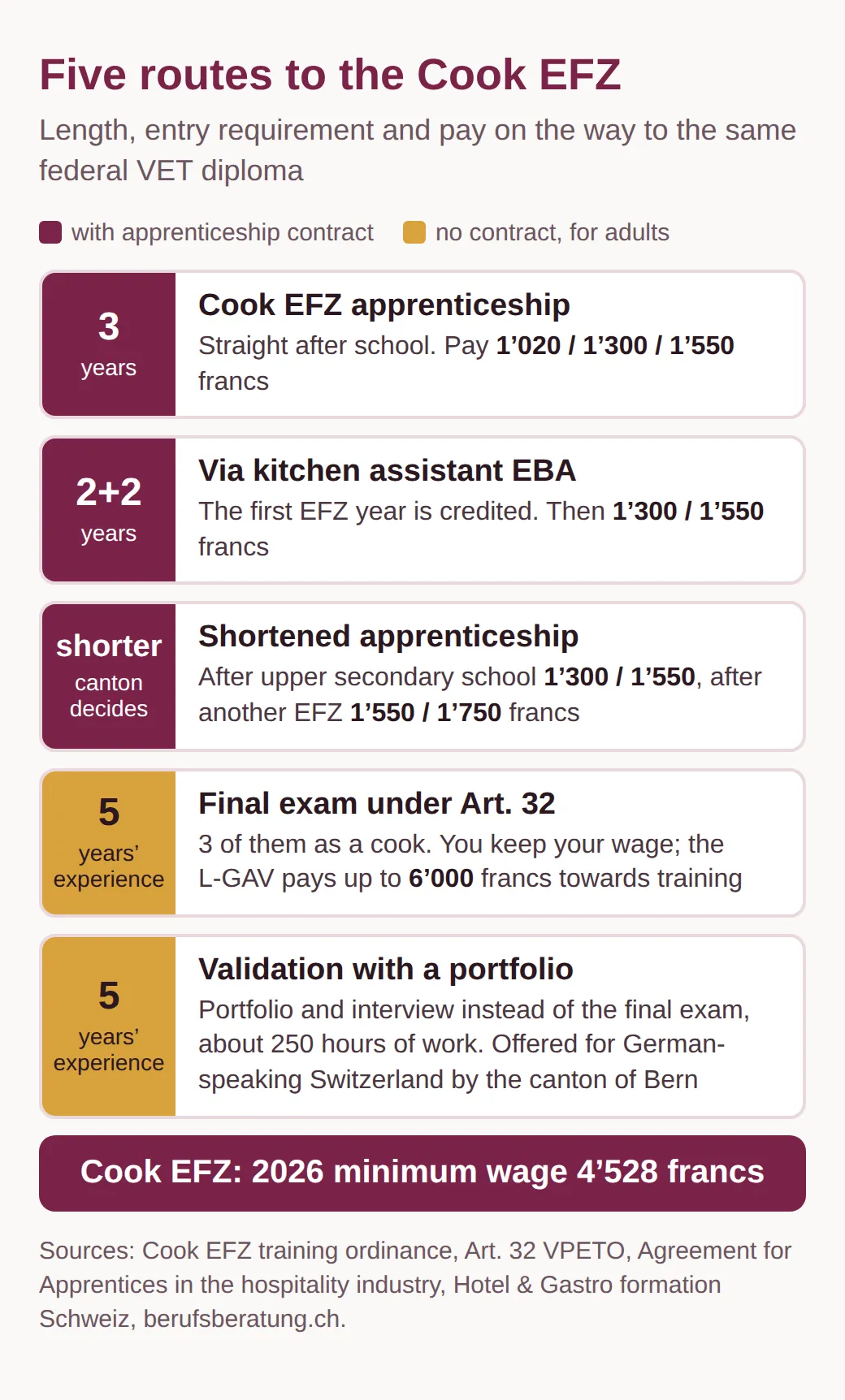
Five routes lead to the same federal VET diploma. Two of them need no apprenticeship contract at all, and those are the ones that matter for adults who already work in a kitchen.
Via the kitchen assistant EBA apprenticeship
The two-year apprenticeship as a kitchen assistant EBA (federal VET certificate) is the gentler way in, for example if school was hard for you. With the certificate, the first year of the cook apprenticeship is credited to you (Art. 2 of the training ordinance), so you need two more years for the EFZ. Your pay rises faster on this route: after the EBA, the agreement sets 1’300 francs in the first and 1’550 francs in the second year of the shortened apprenticeship.
Shortened apprenticeship after upper secondary school or another trade
If you are particularly able or already have relevant schooling or training, you can do a shorter apprenticeship (Art. 18 VPETA). Your canton's vocational training office decides how much shorter, and you still need an apprenticeship contract with an approved training business. The agreement gives pay for two cases: after upper secondary school it is 1’300 and 1’550 francs, after another EFZ 1’550 and 1’750 francs.
Straight to the final exam under Article 32
This is the route for people who have cooked for years but have no formal qualification. Under Art. 32 VPETO, you are admitted to the final exam if you have at least five years of work experience. The training ordinance requires at least three of those years to be spent working as a cook. According to Hotel & Gastro formation (in German), part-time work counts pro rata. Your canton of residence decides whether you are admitted and who pays. You fill gaps with vocational school or industry courses.
The big difference from an apprenticeship: there is no apprenticeship contract. You stay in your job and keep your wage instead of dropping back to 1’020 francs. Since 2026 the L-GAV has subsidised this catch-up training with up to 6’000 francs per person, and your employer receives 2’500 francs when you pass. The condition is that you stay employed there throughout the preparation. This is set out in a press release from Hotel & Gastro formation in May 2026 (in German). It also announced a class only for adults at the Allgemeine Berufsschule Zürich, planned for August 2026, so that you would not share a classroom with teenagers. Because you have no apprenticeship school grades, your practical exam counts for 80 percent and general education for 20 percent.
Validation of prior learning
Here you do not sit a final exam; instead you show in a portfolio what you can already do. Experts assess it and interview you, and you make up any missing skills with extra courses. As a rule, five years of work experience are required, two to four of them in the trade you are aiming for. For the portfolio, berufsberatung.ch (in German) estimates about 250 hours of work, and access to the online tool costs 90 francs. For cooks, the careers information centre (BIZ) of the canton of Bern (in German) runs the procedure, open to people from all of German-speaking Switzerland. You then have five years to fill any gaps.
The office for adult vocational qualifications in your canton of residence can tell you which route fits. Every route ends in the same diploma, and with it the same minimum wage.
Pay after the apprenticeship: what the L-GAV requires
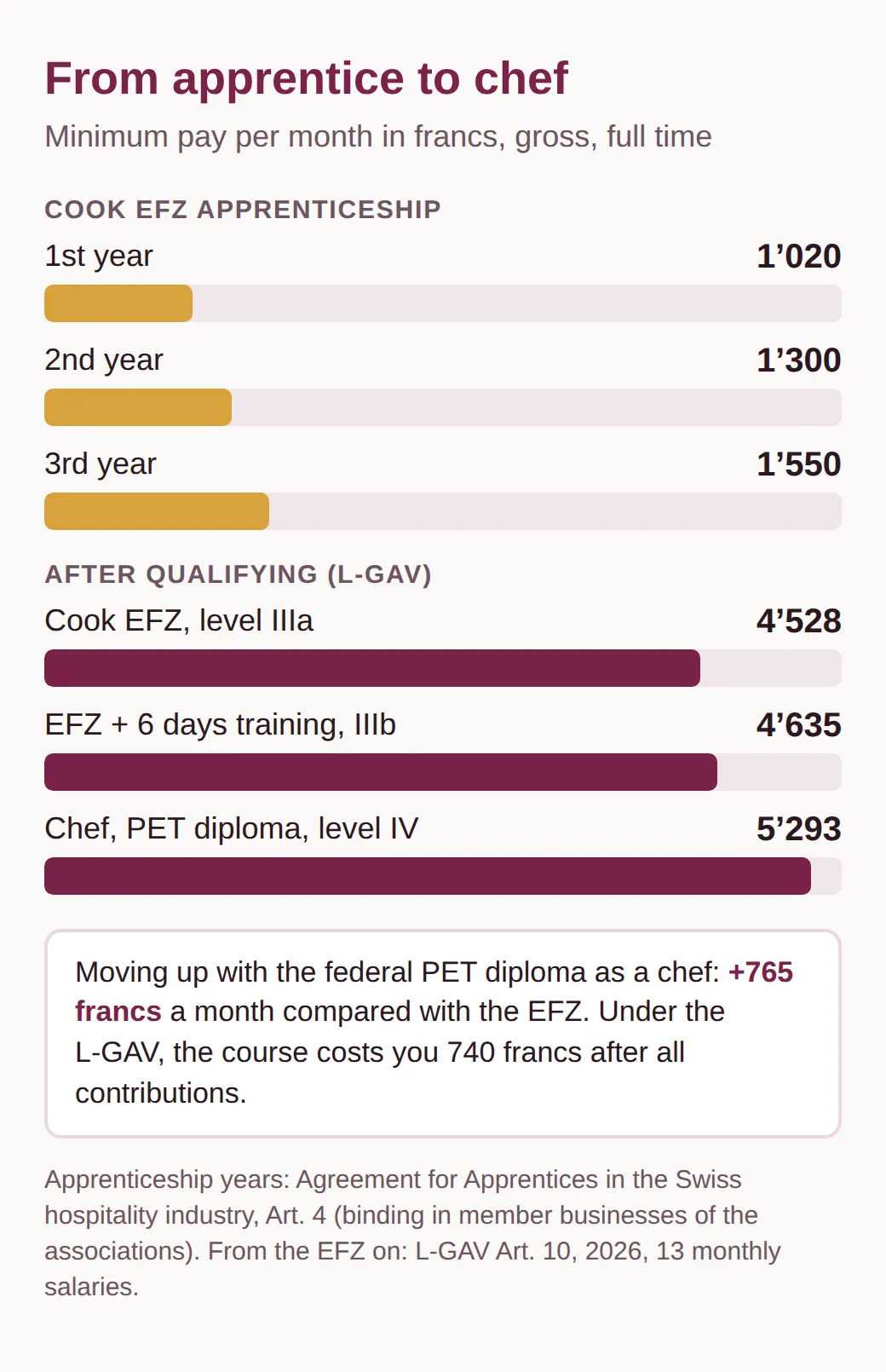
With the EFZ you fall under the L-GAV in almost every hospitality business, and the jump is big. Article 10 (in German) puts staff with a federal VET diploma in level IIIa: 4’528 francs a month for 2026 and 4’555 francs from 2027, full time and gross in both cases. On top of that, you get a full 13th month's salary (in German). Over a year that is at least 58’864 francs, compared with 18’600 francs in the third year of the apprenticeship, without a 13th month's salary.
There are two limits you should know about. In your first job in an L-GAV business, the employer may, with a written agreement, cut the minimum wage by up to 8 percent for no more than three months, to about 4’166 francs. And your training has to match the job: an EFZ as a cook does not automatically put you in this level if you work at reception.
The first step up comes cheap. With six days of job-related further training you move to level IIIb, 4’635 francs a month. Under Article 19 (in German) you are entitled to three paid training days a year once you have been with the business for six months, and you can claim them up to three years back. So two years with the same employer are enough for the six days, without giving up any holiday. Our post on the L-GAV minimum wages for 2026 covers all the levels and special cases.
The L-GAV sets a floor, not a pay scale. What a business pays above it depends on the region, the establishment and how you negotiate. The next fixed step only comes with professional education and training (PET).
Further training: chef, head chef and what they cost
The federal PET diploma as a chef (Chefköchin/Chefkoch mit eidg. Fachausweis) is awarded after a federal professional examination and puts you in level IV of the L-GAV: 5’293 francs a month, 5’325 from 2027. That is 765 francs more than with the EFZ, month after month. According to Hotel & Gastro formation (in German), you are admitted with the Cook EFZ and at least three years of kitchen experience after your apprenticeship. You also need the module certificates and a vocational trainer course. The course runs over 30 teaching days.
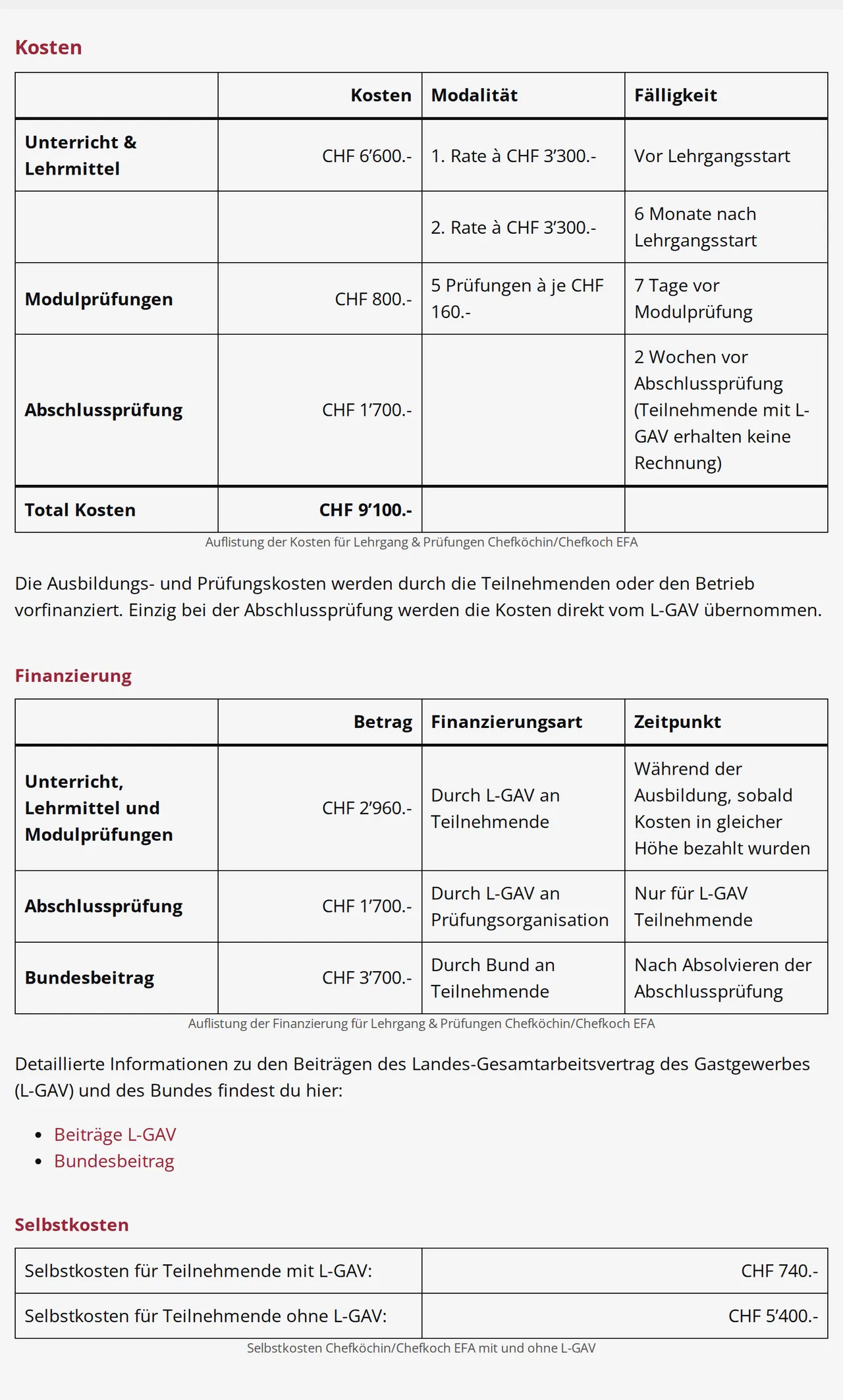
On paper, the course costs 9’100 francs. The L-GAV refunds you 2’960 francs for teaching and module exams and pays the 1’700-franc final exam directly. Once you pass, the federal government transfers 3’700 francs. If you are covered by the L-GAV, you end up paying 740 francs yourself; everyone else pays 5’400 francs. You do have to pay the money up front, though, or your employer does. For the preparation and the exam itself, the L-GAV gives you six extra paid days off.
Set the extra pay against your own costs, and under the L-GAV the PET diploma has paid for itself after your first month in the new level, based on gross minimum wages. If you would rather specialise in nutrition than in leading a team, the federal professional examination as a diet cook offers a second direction.
At the top is the advanced federal professional examination as a head chef (Küchenchefin/Küchenchef, in German), leading to an advanced federal PET diploma. For that you need a federal PET diploma in a cooking profession, such as chef, followed by at least three years of experience in a management role. The preparation takes 40 days in eight five-day blocks and costs 13’060 francs. After the contributions from the L-GAV and the federal government, you pay 1’136 francs yourself under the L-GAV, or 7’380 francs without it. The L-GAV has no pay level above level IV. From here on, you negotiate your pay yourself.
How to find an apprenticeship
Start with a taster placement (Schnupperlehre). A few days in a kitchen show you more about irregular hours, heat and pace than any brochure, and the business gets to know you. Ask directly at a kitchen you are interested in, or get advice at your canton's careers information centre (BIZ).
Before you sign an apprenticeship contract, check four things: whether the business is a member of an industry association, what pay applies in each year, whether a 13th month's salary is added, and what is deducted for board and lodging if you eat or live on site. Once that is in black and white in the contract, you know where you stand from day one.
Apprenticeships are available not only in restaurants but also in hotels and staff canteens. You can find vacancies, for example, in the canton of Lucerne, the canton of St. Gallen or in Basel.
Common questions
- Do apprentice cooks in Switzerland get a 13th month's salary?
- The Agreement for Apprentices in the hospitality industry does not provide for one. A business may still pay it, because terms that favour the apprentice are always allowed. Your apprenticeship contract says whether you get one. You only get the full 13th month's salary under the L-GAV once you have qualified.
- How long is the probation period in a chef apprenticeship?
- At least one month and at most three. If the apprenticeship contract says nothing, it is three months. With the canton's approval, the business and the apprentice may extend it to six months in exceptional cases, but only before it runs out.
- How much holiday do kitchen apprentices get?
- Five weeks a year. The Agreement for Apprentices requires this in member businesses of the industry associations, and the Code of Obligations guarantees five weeks to every employee up to their 20th birthday anyway. School days do not count as holiday; they count as working time.
- Is a foreign chef qualification recognised as equal to an EFZ?
- For the minimum wage, your employer places you mainly by how long your training lasted. The State Secretariat for Education, Research and Innovation (SERI) usually treats a three-year course like a federal VET diploma. You can ask SERI to assess the equivalence of your qualification individually. If you and your employer disagree about your level, the L-GAV supervisory commission decides.
- Can I do a chef apprenticeship with the vocational baccalaureate?
- Yes. If your school results are very good, you can also attend the vocational baccalaureate school. The minimum wage in the agreement is the same with or without the baccalaureate. It later opens the way to a university of applied sciences, for example in food science.
More posts
All posts
Trial Day in Swiss Hospitality: Pay, Insurance and Length
Trial day or trial shift at a Swiss restaurant or hotel? You're owed L-GAV pay and the business's accident insurance covers you. What to agree first.

Notice Period in Swiss Hospitality 2026: The L-GAV Rules
Notice periods under the L-GAV: 3 days during probation, then 1 month, 2 months from year 6, always to month end. With a sample letter and protected periods.

Restaurant Jobs in Switzerland With No Experience: 2026
Waiting tables in Switzerland with no experience: the 2026 minimum wage, the free Progresso course, what restaurants expect and how career changers apply.