Sick Pay in Swiss Hospitality 2026: What the L-GAV Pays

The short answer
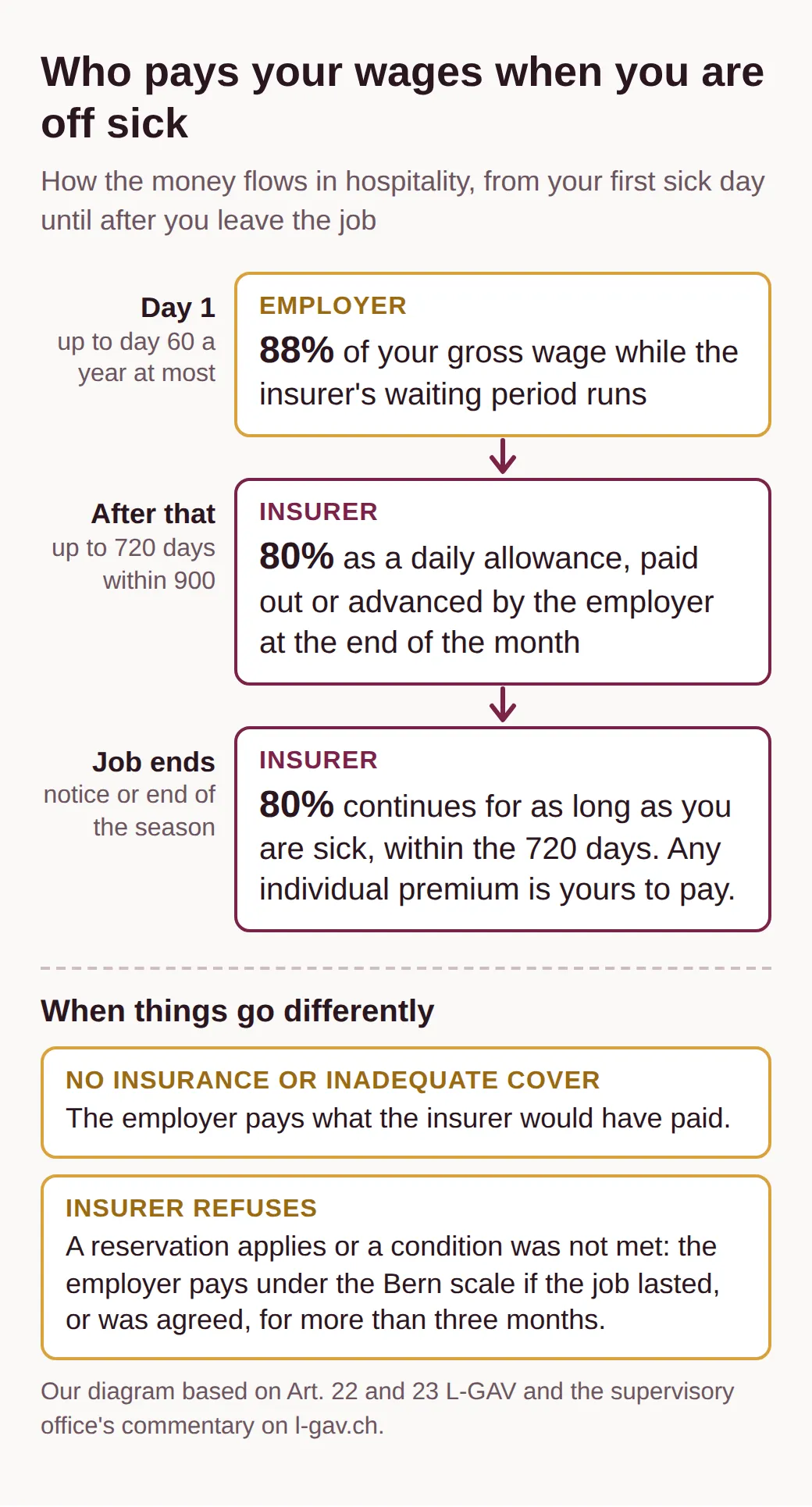
If you fall ill working in Swiss hospitality, you keep getting paid from your first working day. During the insurer's waiting period, at most 60 days a year, your employer pays 88 percent of your gross wage. After that, the daily sickness benefit insurance pays 80 percent, for up to 720 days within 900. The L-GAV has no unpaid waiting day.
Much of what you'll find online on this topic doesn't fit your job. The scales the courts use under the Code of Obligations only apply where no collective employment agreement says otherwise. Guides from Germany explain six weeks of continued pay, which is a rule of German law. And a 2004 Federal Supreme Court ruling on daily sickness benefit insurance concerns the furniture industry. In kitchens, service, reception and housekeeping, the rules come from the L-GAV, the national collective employment agreement for Swiss hotels and restaurants. We show what it requires, what that means in francs, and when the insurer still doesn't pay.
What the L-GAV says about sick pay
It requires every employer to take out daily sickness benefit insurance for you. Art. 23 L-GAV sets the terms: the insurance pays 80 percent of your gross wage for 720 out of 900 consecutive days, or for 180 days if you already draw an AHV pension (the state old-age pension). You and your employer each pay half the premium, and your share is deducted from your wages. The L-GAV is published only in German, French and Italian, so we link the German text. This article is among the parts of the agreement that the federal government has declared generally binding, so it also applies in businesses that don't belong to an employers' association.
720 out of 900 days means the insurer pays you no more than 720 daily allowances in total, and they have to fall within a window of 900 days. If you're ill several times, the days are added together. A daily allowance is based on one thirtieth of your monthly wage, because the L-GAV counts every month as 30 days (Art. 8). At 4,528 francs, the 2026 minimum wage with an EFZ (Federal VET Diploma) under Art. 10, that's 150.93 francs of wages a day and a daily allowance of 120.75 francs.
Pregnancy is covered too. If your doctor declares you unable to work during pregnancy, the same insurance pays under the same rules. An accident, on the other hand, falls under accident insurance and isn't covered here. That leaves the question many people ask first: who pays for the first few days?
Are there unpaid waiting days in hospitality?
Not at your expense. Many insurers only start paying after a waiting period, which the L-GAV calls a deferral period. An employer may choose a waiting period of up to 60 days a year, which lowers the premium. During that time, it pays you 88 percent of your gross wage itself. The L-GAV supervisory office (Kontrollstelle für den L-GAV), which oversees the agreement, explains the figure in its commentary on Art. 23: social security contributions are due on wages paid by the employer, but not on the insurer's daily allowance. So 88 percent gross gives you the same amount as 80 percent from the insurer later on.
The words that matter are "a year". The waiting period applies once per working year or calendar year, not again with every illness. If you're off sick for two weeks in March and again in October, only the rest of the waiting period runs in October. If one illness runs on without a break over the turn of the year, the waiting period applies only once. A policy with a 60-day waiting period for each illness breaches the L-GAV, the supervisory office writes, and can lead to sanctions.
An unpaid waiting day, as some agreements in other industries have, has no place here. Asked whether every employee is entitled to sick pay from the first working day, the supervisory office answers "Ja" ("yes") in its questions and answers on Art. 23. If your contract still includes an unpaid day, that clause is void and the L-GAV rule replaces it (Art. 357 CO).
The supervisory office shows how this looks on a payslip in its own commentary on Art. 8. An employee earning 4,120 francs a month is off sick for seven days in May, within the waiting period. The 24 working days bring 3,296 francs, and the seven sick days 845.95 francs: 4,120 times 7, divided by 30, and 88 percent of that. Together that would be 4,141.95 francs, because May has 31 days. Even so, only 4,120 francs are paid out, because nobody should get more for being ill than for working (Art. 22). The other way round, your employer can't deduct anything for meals you don't eat during that time. There's more on that in our post on board and lodging.
Your 13th-month pay keeps running too. You're entitled to it while you're ill, and your employer has to claim it from the daily sickness benefit insurance (commentary on Art. 12). That isn't a given. In ruling 4C.290/2004, the Federal Supreme Court ruled against a surface finishing specialist from the furniture industry who had been ill since November 1999. His daily allowance had been calculated without the 13th-month pay, and that was lawful, because his collective agreement reduced the 13th for absences of more than two months. It was undisputed in the same case that 80 percent for 720 out of 900 days, with at most two unpaid waiting days, is equivalent to statutory sick pay. Hospitality has the better rule: no waiting day, and the 13th is insured too.
Why the Bern scale hardly matters here
The Code of Obligations only sets a minimum, and it's a thin one. Under Art. 324a CO, an employer must pay wages during illness "for a limited time", and only once the job has lasted more than three months or was agreed for more than three months. In the first year of service that's three weeks, and after that "appropriately longer periods". How long that is, the courts decide using scales, among them the Bern scale and the Zurich scale. A collective agreement may set different rules if the result is at least equivalent for you.
The L-GAV replaces that calculation with insurance. It only needs a scale as a fallback, for cases Art. 23 doesn't cover or where the insurer rightly refuses to pay. Since July 2005 that has been the Bern scale (Berner Skala), which the supervisory office sets out in its commentary on Art. 22 as follows:
| Year of service | Full pay during illness |
|---|---|
| Year 1, after three months | 3 weeks |
| Year 2 | 1 month |
| Years 3 and 4 | 2 months |
| Years 5 to 9 | 3 months |
| Years 10 to 14 | 4 months |
| Years 15 to 19 | 5 months |
| Years 20 to 25 | 6 months |
The gap widens quickly once an illness drags on. Our worked example: you're in your second year, earning 4,528 francs a month, and you're off sick for six months. Under the Bern scale alone, you'd get one month on full pay and then nothing. Under the L-GAV, your employer pays 88 percent during a 60-day waiting period, and then the insurer pays 80 percent.
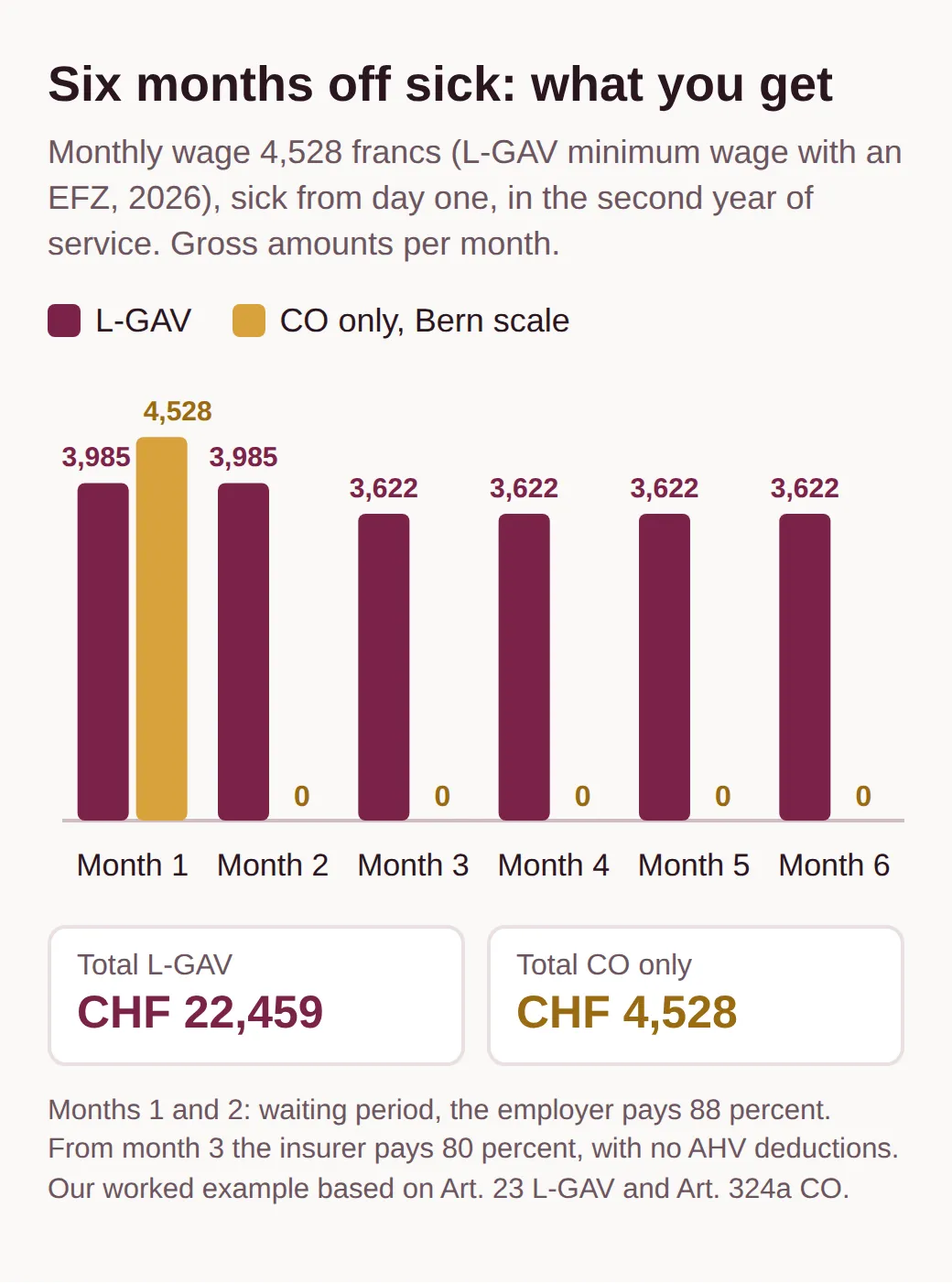
Over six months, that's 22,459 francs against 4,528. For short illnesses the sums look different: someone in their second year who misses three days would get full pay under the Bern scale and gets 88 percent gross under the L-GAV. That's the price of long-term cover. The advantage shows most clearly where the Code of Obligations gives you nothing at all: in the first weeks of a new job.
Off sick during your probation period
You're covered from your first working day. The three-month threshold from the Code of Obligations doesn't apply here. What counts, according to the supervisory office, is the day you actually start work, not the date in your contract. If you fall ill before your first shift, this obligation hasn't kicked in yet.
Under the L-GAV, the probation period lasts 14 days unless something else is agreed in writing, and three months at most (Art. 5). If you're ill during that time, it's extended by the days you miss. There's no protection against dismissal during probation: your employer can give you notice even while you're ill, with three days' notice unless you agreed a longer period in writing. According to the supervisory office, though, the reason can't be the inability to work itself, and the dismissal mustn't be abusive. Your daily allowance doesn't end with the job. The questions and answers on the probation period state expressly that the obligation under Art. 23 continues after the employment ends.
Once probation is over, your employer can't dismiss you at all for a certain time while you're ill. We explain these protected periods, and how an illness extends your notice period, in our post on notice periods. New jobs still hold one trap, the reservation we come to further down. First, the jobs that have an end date from the start.
Off sick in a seasonal job
If your season ends while you're ill, the insurer keeps paying. Art. 23 says so without any limit: benefits must also be paid if the employment ends before the illness does. If the insurer then asks for a premium for an individual policy, you pay it on your own.
The time between two seasons is trickier, when you leave a job healthy and only fall ill afterwards. You're then no longer insured through your old employer. That's why the L-GAV requires employers with seasonal contracts to tell you how you can keep up your sickness and accident insurance and your pension fund (Art. 22 clause 4). Ask about it on your last working day if nobody raises it.
You have a legal right to switch to an individual policy if the daily sickness benefit insurance runs under the Health Insurance Act (Art. 71 KVG, in German; the act has no current English translation). The insurer must then inform you in writing, and you have three months from that notice to use the right. If it runs under the Insurance Contracts Act (VVG), the law has no such rule. Whether and how you can switch is then only set out in the policy terms.
If you've registered as unemployed between seasons and fall ill, the unemployment insurance fund pays your full daily allowance until the 30th day of the illness, for at most 44 days within the framework period (Art. 28 AVIG, the Unemployment Insurance Act, in German). Whether you get unemployment benefit between seasons in the first place is covered in our post on the winter season.
Ill for longer than the job lasts
Without insurance, sick pay generally ends with the job. A case from another industry shows this. A machine operator was given notice in September 2019 and was ill from October. His employer had promised him sick pay for up to 720 days within 900, but as its own payment, not through insurance. The Aargau High Court ruled in 2022 that this promise ended with the employment at the end of February 2020. He got nothing for March to September 2020 (ruling ZOR.2021.56). In hospitality, Art. 23 closes exactly this gap: an insurer pays, and the L-GAV requires it to keep paying after the contract ends.
That doesn't guarantee the 720 days, though. A waitress in the canton of Lucerne, who had worked at the same country inn since 1992, fell ill in January 2008. The employer gave her notice to the end of September, and the insurer kept paying 109.10 francs a day until the end of November and then stopped. Doctors and the disability insurance (IV) found she could no longer work in service, but was fully able to work in a lighter, adapted job from October 2008. The policy terms required insured people without a job to take up other suitable work after 180 days.
The Hochdorf District Court held that this clause was compatible with the L-GAV, because every insured person has a duty to mitigate their loss. But it counted the 180 days only from October 2008, when other work first became possible, and awarded her another 119 daily allowances, 12,982.90 francs (ruling of 16 September 2010). She had claimed the remaining 403 days. So if you stay ill for a long time after leaving, expect the insurer to ask you at some point to move into other work. One detail of the case is worth knowing: the older version of the terms applied, because the insurer couldn't prove she had ever received the new one. That isn't the only reason an insurer pays less.
When the insurer doesn't have to pay
The insurer can't turn you down because of your health, but it can exclude particular illnesses. Art. 23 allows a reservation for illnesses you already have when you join and for past illnesses that experience shows can come back. The reservation must be in writing and lasts five years at most. When you start the job, you must be told which illness it covers and when the reservation ends. If you fall ill with exactly that illness, the insurer doesn't pay, and according to the supervisory office your employer has to pay for a limited time under Art. 324a CO, meaning under the Bern scale.
The second reason lies with you. The insurer can refuse or cut payments if you don't keep to its terms. With insurance under the VVG, you have to report the case as soon as you know about it (Art. 38 VVG, in German; the act has no current English translation), and the terms may require medical certificates within set deadlines. A waitress in Valais found out how strictly such deadlines apply. In January 2005 she handed in a certificate, written after the fact, covering February to December 2004, even though her health insurer's terms required a report at least every month. The Valais Cantonal Court sided with the insurer, mainly because the doctors described a conflict at work rather than an illness in the legal sense, but also because of the late report: the insurer didn't have to pay for the time without a timely certificate (ruling of 27 October 2008).
If the insurer refuses for one of these reasons, your employer no longer has to advance the daily allowance. But it still owes you wages under Art. 324a CO and the Bern scale, provided your job lasted longer than three months or was agreed for that long (Art. 22 clause 3 L-GAV).
Then there's fault. If you cause an illness on purpose, you get nothing, and for gross negligence the insurer may cut its payments (Art. 14 VVG). The supervisory office stresses in its commentary on Art. 22 that fault isn't assumed lightly: ordinary negligence still counts as not your fault. As an example of an absence without pay, it names cosmetic surgery without a medical reason, and its consequences.
And finally the case that shouldn't exist at all: your employer has no insurance, or cover that falls short. It then pays you itself what proper insurance would have paid, and it's liable for that with its own assets. To avoid a dispute in the first place, a medical certificate at the right time helps.
When do you need a doctor's note?
From the fourth day, and it must reach your employer no later than a week after it was issued (Art. 26 L-GAV). If the insurer requires a certificate from the first day, your employer may require one from the first day too. It can also send you to a doctor of its choice, at its own expense. If you don't go despite a reminder, or if there's no proof at all from the fourth day, the supervisory office says your employer may stop paying for the time being.
Call in sick on the first day, before your shift starts. If you're ill for longer, get a new certificate regularly rather than one covering several months after the fact. The Valais case shows what a single late piece of paper can cost. If the money still doesn't arrive despite a certificate, you have several levers.
When your daily allowance doesn't arrive
Your employer has to pay out or advance the daily allowance at the end of the month, even while the insurer is still looking into the case (Art. 22 clause 3). If it doesn't come, ask in writing: which insurer you're insured with, how long the waiting period is and where you can find the policy terms. Your employer must inform you about the essential content of the insurance (Art. 3 VVG), and you can ask for information about the premiums at any time (Art. 22 clause 1 L-GAV). A short message is enough:
Hi, I've been off sick since 3 March and you have my medical certificates. The pay for my sick days is missing from my March payslip. Could you please let me know which insurer I'm insured with and how long the waiting period is, and send me the policy terms? Thanks!
If your employer's group policy runs under the VVG, you have your own right to claim directly against the insurer (Art. 95a VVG). So you don't have to wait for your boss to deal with it, least of all after you've left. Watch the deadline, because it's shorter than for other insurance under this act:
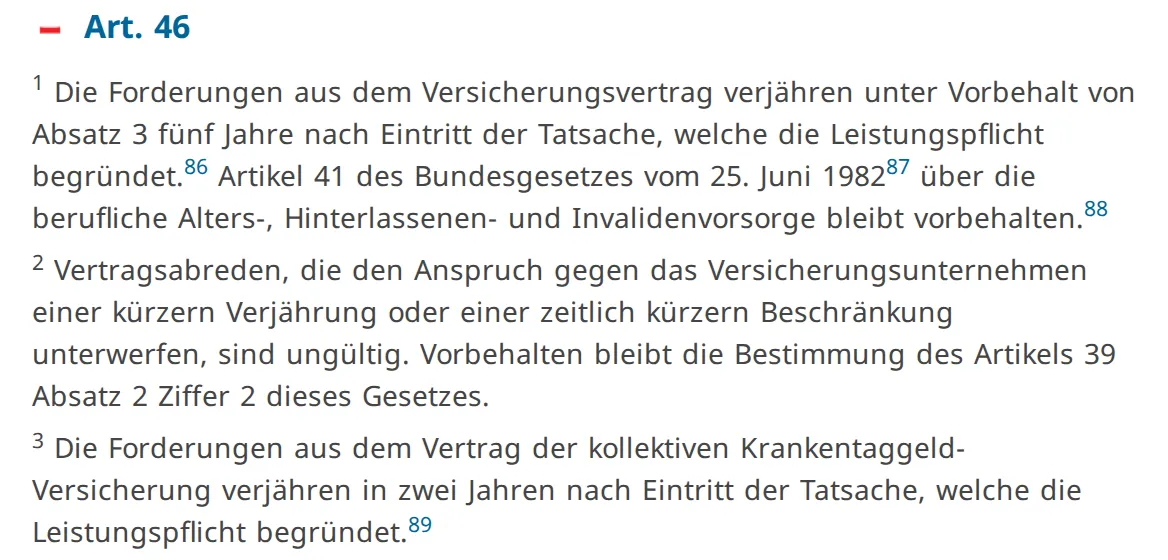
So if you do nothing for two years after you became unable to work, your claim risks being time-barred. You can get help from the L-GAV supervisory office in Basel. It gives advice by phone on 061 227 95 55, Monday to Friday from 8.30 to 11.30 am and from 1.30 to 5 pm. An employer that has taken out no insurance at all can expect sanctions, according to the supervisory office.
Ask about the insurance before you sign
The easiest time to sort this out is while you're healthy. In the interview, or at the latest when you sign, ask which insurer the business will register you with, how long the waiting period is and whether a reservation will be added. An employer that can answer straight away has its insurance in order.
For seasonal jobs in the mountains, add a second question: how you stay insured at the end of the season if you don't go straight into your next job.
You'll find more open jobs in hotels and restaurants in the canton of Graubünden, for example, or in Zurich.
Common questions
- Who pays if I have an accident rather than an illness?
- Then it's not the daily sickness benefit insurance that pays but the compulsory accident insurance. For the first two days after the day of the accident, your employer pays 88 percent of your gross wage, as set out in Art. 25 L-GAV. After that, the rules of the Accident Insurance Act apply.
- Can my employer deduct my share of the insurance premium later?
- Only for a short time. Under Art. 13 L-GAV, the right to deduct your contributions to sickness and accident insurance, AHV, unemployment insurance and the pension fund lapses after two months. If your employer forgot your share for months, it can't take the whole amount back from your wages retroactively.
- Does a long sick leave reduce my holiday entitlement in Switzerland?
- Only after a long absence. According to the L-GAV supervisory office, your employer may cut your holidays because of illness only if you're off for more than two months in a working year. The cut is one twelfth for each full month, and the first month of absence doesn't count.
- What does a doctor's note for my employer have to say?
- A simple medical certificate confirms that you're unable to work, and it's the usual proof. If that isn't enough for your employer, it can ask for a detailed certificate. It then gives the doctor a description of your job, and the doctor assesses which tasks you can still do and which you can't.
More posts
All posts
L-GAV Minimum Wage 2026: All Levels, Hourly Pay and 2027
Swiss hospitality minimum wage 2026 under the L-GAV: 3,713 francs without an apprenticeship, 4,528 with an EFZ. Hourly rates, the 8% rule and 2027.
Swiss Winter Season Jobs 2026/27: Contract, Room, Off-Season
Winter season job in Switzerland: what the contract must say, what a staff room may cost, when unemployment pays in the off-season, what EU citizens need.

Trial Day in Swiss Hospitality: Pay, Insurance and Length
Trial day or trial shift at a Swiss restaurant or hotel? You're owed L-GAV pay and the business's accident insurance covers you. What to agree first.